Online Merchants
Overview
SaveJob Zone Four: Considerable Preparation Needed
Experience
A considerable amount of work-related skill, knowledge, or experience is needed for these occupations. For example, an accountant must complete four years of college and work for several years in accounting to be considered qualified.
Education
Most of these occupations require a four-year bachelor's degree, but some do not.
Job Training
Employees in these occupations usually need several years of work-related experience, on-the-job training, and/or vocational training.
Examples
Many of these occupations involve coordinating, supervising, managing, or training others. Examples include real estate brokers, sales managers, database administrators, graphic designers, conservation scientists, art directors, and cost estimators.
Conduct retail activities of businesses operating exclusively online. May perform duties such as preparing business strategies, buying merchandise, managing inventory, implementing marketing activities, fulfilling and shipping online orders, and balancing financial records.

Demand
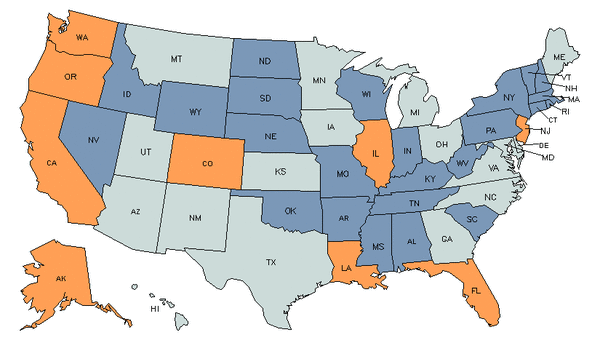

Core Tasks
- Fill customer orders by packaging sold items and documentation for direct shipping or by transferring orders to manufacturers or third-party distributors.
- Create, manage, or automate orders or invoices, using order management or invoicing software.
- Receive and process payments from customers, using electronic transaction services.
- Deliver e-mail confirmation of completed transactions and shipment.
- Correspond with online customers via electronic mail, telephone, or other electronic messaging to address questions or complaints about products, policies, or shipping methods.
- Design customer interface of online storefront, using web programming or e-commerce software.
- Purchase new or used items from online or physical sources for resale via retail or auction Web site.
- Determine and set product prices.
- Calculate purchase subtotals, taxes, and shipping costs for submission to customers.
- Compose descriptions of merchandise for posting to online storefront, auction sites, or other shopping Web sites.
- Calculate revenue, sales, and expenses, using financial accounting or spreadsheet software.
- Compose images of products, using video or still cameras, lighting equipment, props, or photo or video editing software.
- Upload digital media, such as photos, video, or scanned images to online storefront, auction sites, or other shopping Web sites.
- Cancel orders based on customer requests or inventory or delivery problems.
- Order or purchase merchandise to maintain optimal inventory levels.
- Prepare or organize online storefront marketing material, including product descriptions or subject lines, optimizing content to search engine criteria.
- Select and purchase technical web services, such as web hosting services, online merchant accounts, shopping cart software, payment gateway software, or spyware.
- Determine location for product listings to maximize exposure to online traffic.
- Transfer digital media, such as music, video, or software, to customers via the Internet.
- Collaborate with search engine shopping specialists to place marketing content in desired online locations.
- Create or maintain database of customer accounts.
- Investigate products or markets to determine areas for opportunity or viability for merchandising specific products, using online or offline sources.
- Promote products in online communities through weblog or discussion-forum postings, e-mail marketing programs, or online advertising.
- Devise, select, or purchase domain name and web address.
- Initiate online auctions through auction hosting sites or auction management software.
- Maintain inventory of shipping supplies, such as boxes, labels, tape, bubble wrap, loose packing materials, or tape guns.
- Develop or revise business plans for online business, emphasizing factors such as product line, pricing, inventory, or marketing strategy.
- Measure and analyze Web site usage data to maximize search engine returns or refine customer interfaces.
- Implement security practices to preserve assets, minimize liabilities, or ensure customer privacy, using parallel servers, hardware redundancy, fail-safe technology, information encryption, or firewalls.
- Investigate sources, such as auctions, estate sales, liquidators, wholesalers, or trade shows for new items, used items, or collectibles.
- Integrate online retailing strategy with physical or catalogue retailing operations.
- Participate in online forums or conferences to stay abreast of online retailing trends, techniques, or security threats.
- Disclose merchant information and terms and policies of transactions in online or offline materials.
- Create or distribute offline promotional material, such as brochures, pamphlets, business cards, stationary, or signage.
Technology Skills
Technology
Example
Hot Technology
Tools Used
Tool
Example
Top 10 Knowledge Required
English Language
84%
Knowledge of the structure and content of the English language including the meaning and spelling of words, and rules of composition and grammar.
Sales and Marketing
80%
Knowledge of principles and methods for showing, promoting, and selling products or services. This includes marketing strategy and tactics, product demonstration, sales techniques, and sales control systems.
Customer and Personal Service
79%
Knowledge of principles and processes for providing customer and personal services. This includes customer needs assessment, meeting quality standards for services, and evaluation of customer satisfaction.
Administration and Management
72%
Knowledge of business and management principles involved in strategic planning, resource allocation, human resources modeling, leadership technique, production methods, and coordination of people and resources.
Communications and Media
72%
Knowledge of media production, communication, and dissemination techniques and methods. This includes alternative ways to inform and entertain via written, oral, and visual media.
Computers and Electronics
72%
Knowledge of circuit boards, processors, chips, electronic equipment, and computer hardware and software, including applications and programming.
Administrative
67%
Knowledge of administrative and office procedures and systems such as word processing, managing files and records, stenography and transcription, designing forms, and workplace terminology.
Economics and Accounting
64%
Knowledge of economic and accounting principles and practices, the financial markets, banking, and the analysis and reporting of financial data.
Mathematics
64%
Knowledge of arithmetic, algebra, geometry, calculus, statistics, and their applications.
Production and Processing
62%
Knowledge of raw materials, production processes, quality control, costs, and other techniques for maximizing the effective manufacture and distribution of goods.
Top 10 Skills
Reading Comprehension
73%
Understanding written sentences and paragraphs in work-related documents.
Active Listening
70%
Giving full attention to what other people are saying, taking time to understand the points being made, asking questions as appropriate, and not interrupting at inappropriate times.
Critical Thinking
70%
Using logic and reasoning to identify the strengths and weaknesses of alternative solutions, conclusions, or approaches to problems.
Speaking
70%
Talking to others to convey information effectively.
Persuasion
68%
Persuading others to change their minds or behavior.
Service Orientation
68%
Actively looking for ways to help people.
Writing
68%
Communicating effectively in writing as appropriate for the needs of the audience.
Judgment and Decision Making
65%
Considering the relative costs and benefits of potential actions to choose the most appropriate one.
Monitoring
63%
Monitoring/Assessing performance of yourself, other individuals, or organizations to make improvements or take corrective action.
Negotiation
63%
Bringing others together and trying to reconcile differences.
Top 10 Abilities
Written Comprehension
75%
The ability to read and understand information and ideas presented in writing.
Oral Expression
70%
The ability to communicate information and ideas in speaking so others will understand.
Problem Sensitivity
70%
The ability to tell when something is wrong or is likely to go wrong. It does not involve solving the problem, only recognizing that there is a problem.
Written Expression
70%
The ability to communicate information and ideas in writing so others will understand.
Deductive Reasoning
68%
The ability to apply general rules to specific problems to produce answers that make sense.
Near Vision
68%
The ability to see details at close range (within a few feet of the observer).
Oral Comprehension
68%
The ability to listen to and understand information and ideas presented through spoken words and sentences.
Speech Clarity
68%
The ability to speak clearly so others can understand you.
Speech Recognition
68%
The ability to identify and understand the speech of another person.
Inductive Reasoning
65%
The ability to combine pieces of information to form general rules or conclusions (includes finding a relationship among seemingly unrelated events).
Top 10 Work Activities
Working with Computers
94%
Using computers and computer systems (including hardware and software) to program, write software, set up functions, enter data, or process information.
Getting Information
84%
Observing, receiving, and otherwise obtaining information from all relevant sources.
Identifying Objects, Actions, and Events
81%
Identifying information by categorizing, estimating, recognizing differences or similarities, and detecting changes in circumstances or events.
Processing Information
80%
Compiling, coding, categorizing, calculating, tabulating, auditing, or verifying information or data.
Selling or Influencing Others
78%
Convincing others to buy merchandise/goods or to otherwise change their minds or actions.
Making Decisions and Solving Problems
77%
Analyzing information and evaluating results to choose the best solution and solve problems.
Establishing and Maintaining Interpersonal Relationships
76%
Developing constructive and cooperative working relationships with others, and maintaining them over time.
Updating and Using Relevant Knowledge
76%
Keeping up-to-date technically and applying new knowledge to your job.
Documenting/Recording Information
75%
Entering, transcribing, recording, storing, or maintaining information in written or electronic/magnetic form.
Communicating with People Outside the Organization
72%
Communicating with people outside the organization, representing the organization to customers, the public, government, and other external sources. This information can be exchanged in person, in writing, or by telephone or e-mail.
Detailed Work Activities
- Update professional knowledge.
- Create marketing materials.
- Purchase products or services.
- Allocate physical resources within organizations.
- Develop business or market strategies.
- Determine the value of goods or services.
- Correspond with customers to answer questions or resolve complaints.
- Execute sales or other financial transactions.
- Maintain data in information systems or databases.
- Market products, services, or events.
- Analyze business or financial data.
- Obtain information about goods or services.
- Identify strategic business investment opportunities.
- Develop business or financial information systems.
- Develop financial or business plans.
- Create images of data, locations, or products.
- Calculate data to inform organizational operations.
- Collect payments for goods or services.
Education
Interests
Conventional
90%
Work involves following procedures and regulations to organize information or data, typically in a business setting. Conventional occupations are often associated with office work, accounting, mathematics/statistics, information technology, finance, or human resources.
Enterprising
84%
Work involves managing, negotiating, marketing, or selling, typically in a business setting, or leading or advising people in political and legal situations. Enterprising occupations are often associated with business initiatives, sales, marketing/advertising, finance, management/administration, professional advising, public speaking, politics, or law.
Realistic
34%
Work involves designing, building, or repairing of equipment, materials, or structures, engaging in physical activity, or working outdoors. Realistic occupations are often associated with engineering, mechanics and electronics, construction, woodworking, transportation, machine operation, agriculture, animal services, physical or manual labor, athletics, or protective services.
Social
34%
Work involves helping, teaching, advising, assisting, or providing service to others. Social occupations are often associated with social, health care, personal service, teaching/education, or religious activities.
Artistic
23%
Work involves creating original visual artwork, performances, written works, food, or music for a variety of media, or applying artistic principles to the design of various objects and materials. Artistic occupations are often associated with visual arts, applied arts and design, performing arts, music, creative writing, media, or culinary art.
Investigative
22%
Work involves studying and researching non-living objects, living organisms, disease or other forms of impairment, or human behavior. Investigative occupations are often associated with physical, life, medical, or social sciences, and can be found in the fields of humanities, mathematics/statistics, information technology, or health care service.
Work Values
Independence
72%
Occupations that satisfy this work value allow employees to work on their own and make decisions. Corresponding needs are Creativity, Responsibility and Autonomy.
Achievement
67%
Occupations that satisfy this work value are results oriented and allow employees to use their strongest abilities, giving them a feeling of accomplishment. Corresponding needs are Ability Utilization and Achievement.
Relationships
58%
Occupations that satisfy this work value allow employees to provide service to others and work with co-workers in a friendly non-competitive environment. Corresponding needs are Co-workers, Moral Values and Social Service.
Working Conditions
58%
Occupations that satisfy this work value offer job security and good working conditions. Corresponding needs are Activity, Compensation, Independence, Security, Variety and Working Conditions.
Recognition
53%
Occupations that satisfy this work value offer advancement, potential for leadership, and are often considered prestigious. Corresponding needs are Advancement, Authority, Recognition and Social Status.
Support
43%
Occupations that satisfy this work value offer supportive management that stands behind employees. Corresponding needs are Company Policies, Supervision: Human Relations and Supervision: Technical.