Database Architects
Overview
SaveJob Zone Four: Considerable Preparation Needed
Experience
A considerable amount of work-related skill, knowledge, or experience is needed for these occupations. For example, an accountant must complete four years of college and work for several years in accounting to be considered qualified.
Education
Most of these occupations require a four-year bachelor's degree, but some do not.
Job Training
Employees in these occupations usually need several years of work-related experience, on-the-job training, and/or vocational training.
Examples
Many of these occupations involve coordinating, supervising, managing, or training others. Examples include real estate brokers, sales managers, database administrators, graphic designers, conservation scientists, art directors, and cost estimators.
Design strategies for enterprise databases, data warehouse systems, and multidimensional networks. Set standards for database operations, programming, query processes, and security. Model, design, and construct large relational databases or data warehouses. Create and optimize data models for warehouse infrastructure and workflow. Integrate new systems with existing warehouse structure and refine system performance and functionality.

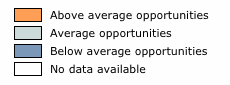
Demand

Core Tasks
- Develop and document database architectures.
- Collaborate with system architects, software architects, design analysts, and others to understand business or industry requirements.
- Develop database architectural strategies at the modeling, design and implementation stages to address business or industry requirements.
- Design databases to support business applications, ensuring system scalability, security, performance, and reliability.
- Design database applications, such as interfaces, data transfer mechanisms, global temporary tables, data partitions, and function-based indexes to enable efficient access of the generic database structure.
- Develop data models for applications, metadata tables, views or related database structures.
- Develop methods for integrating different products so they work properly together, such as customizing commercial databases to fit specific needs.
- Create and enforce database development standards.
- Develop data model describing data elements and their use, following procedures and using pen, template or computer software.
- Document and communicate database schemas, using accepted notations.
- Work as part of a project team to coordinate database development and determine project scope and limitations.
- Identify and evaluate industry trends in database systems to serve as a source of information and advice for upper management.
- Set up database clusters, backup, or recovery processes.
- Demonstrate database technical functionality, such as performance, security and reliability.
- Develop load-balancing processes to eliminate down time for backup processes.
- Identify, evaluate and recommend hardware or software technologies to achieve desired database performance.
- Plan and install upgrades of database management system software to enhance database performance.
- Identify and correct deviations from database development standards.
- Test programs or databases, correct errors, and make necessary modifications.
- Review project requests describing database user needs to estimate time and cost required to accomplish project.
- Write and code logical and physical database descriptions, and specify identifiers of database to management system or direct others in coding descriptions.
- Develop or maintain archived procedures, procedural codes, or queries for applications.
- Provide technical support to junior staff or clients.
- Establish and calculate optimum values for database parameters, using manuals and calculators.
- Train users and answer questions.
Technology Skills
Technology
Example
Hot Technology
Tools Used
Tool
Example
Top 10 Knowledge Required
Computers and Electronics
86%
Knowledge of circuit boards, processors, chips, electronic equipment, and computer hardware and software, including applications and programming.
Engineering and Technology
79%
Knowledge of the practical application of engineering science and technology. This includes applying principles, techniques, procedures, and equipment to the design and production of various goods and services.
Design
75%
Knowledge of design techniques, tools, and principles involved in production of precision technical plans, blueprints, drawings, and models.
Mathematics
74%
Knowledge of arithmetic, algebra, geometry, calculus, statistics, and their applications.
English Language
63%
Knowledge of the structure and content of the English language including the meaning and spelling of words, and rules of composition and grammar.
Administration and Management
58%
Knowledge of business and management principles involved in strategic planning, resource allocation, human resources modeling, leadership technique, production methods, and coordination of people and resources.
Education and Training
53%
Knowledge of principles and methods for curriculum and training design, teaching and instruction for individuals and groups, and the measurement of training effects.
Customer and Personal Service
47%
Knowledge of principles and processes for providing customer and personal services. This includes customer needs assessment, meeting quality standards for services, and evaluation of customer satisfaction.
Law and Government
45%
Knowledge of laws, legal codes, court procedures, precedents, government regulations, executive orders, agency rules, and the democratic political process.
Telecommunications
41%
Knowledge of transmission, broadcasting, switching, control, and operation of telecommunications systems.
Top 10 Skills
Complex Problem Solving
78%
Identifying complex problems and reviewing related information to develop and evaluate options and implement solutions.
Critical Thinking
78%
Using logic and reasoning to identify the strengths and weaknesses of alternative solutions, conclusions, or approaches to problems.
Judgment and Decision Making
78%
Considering the relative costs and benefits of potential actions to choose the most appropriate one.
Reading Comprehension
78%
Understanding written sentences and paragraphs in work-related documents.
Systems Analysis
75%
Determining how a system should work and how changes in conditions, operations, and the environment will affect outcomes.
Active Listening
70%
Giving full attention to what other people are saying, taking time to understand the points being made, asking questions as appropriate, and not interrupting at inappropriate times.
Speaking
70%
Talking to others to convey information effectively.
Programming
68%
Writing computer programs for various purposes.
Active Learning
65%
Understanding the implications of new information for both current and future problem-solving and decision-making.
Systems Evaluation
65%
Identifying measures or indicators of system performance and the actions needed to improve or correct performance, relative to the goals of the system.
Top 10 Abilities
Deductive Reasoning
78%
The ability to apply general rules to specific problems to produce answers that make sense.
Oral Comprehension
78%
The ability to listen to and understand information and ideas presented through spoken words and sentences.
Written Comprehension
78%
The ability to read and understand information and ideas presented in writing.
Inductive Reasoning
75%
The ability to combine pieces of information to form general rules or conclusions (includes finding a relationship among seemingly unrelated events).
Information Ordering
75%
The ability to arrange things or actions in a certain order or pattern according to a specific rule or set of rules (e.g., patterns of numbers, letters, words, pictures, mathematical operations).
Oral Expression
75%
The ability to communicate information and ideas in speaking so others will understand.
Problem Sensitivity
75%
The ability to tell when something is wrong or is likely to go wrong. It does not involve solving the problem, only recognizing that there is a problem.
Near Vision
73%
The ability to see details at close range (within a few feet of the observer).
Speech Clarity
73%
The ability to speak clearly so others can understand you.
Category Flexibility
68%
The ability to generate or use different sets of rules for combining or grouping things in different ways.
Top 10 Work Activities
Working with Computers
96%
Using computers and computer systems (including hardware and software) to program, write software, set up functions, enter data, or process information.
Analyzing Data or Information
93%
Identifying the underlying principles, reasons, or facts of information by breaking down information or data into separate parts.
Getting Information
88%
Observing, receiving, and otherwise obtaining information from all relevant sources.
Processing Information
88%
Compiling, coding, categorizing, calculating, tabulating, auditing, or verifying information or data.
Making Decisions and Solving Problems
86%
Analyzing information and evaluating results to choose the best solution and solve problems.
Updating and Using Relevant Knowledge
85%
Keeping up-to-date technically and applying new knowledge to your job.
Communicating with Supervisors, Peers, or Subordinates
83%
Providing information to supervisors, co-workers, and subordinates by telephone, in written form, e-mail, or in person.
Identifying Objects, Actions, and Events
82%
Identifying information by categorizing, estimating, recognizing differences or similarities, and detecting changes in circumstances or events.
Documenting/Recording Information
78%
Entering, transcribing, recording, storing, or maintaining information in written or electronic/magnetic form.
Estimating the Quantifiable Characteristics of Products, Events, or Information
78%
Estimating sizes, distances, and quantities; or determining time, costs, resources, or materials needed to perform a work activity.
Detailed Work Activities
- Create databases to store electronic data.
- Document technical specifications or requirements.
- Collaborate with others to determine design specifications or details.
- Develop procedures for data management.
- Design computer modeling or simulation programs.
- Develop models of information or communications systems.
- Develop database parameters or specifications.
- Develop guidelines for system implementation.
- Develop performance metrics or standards related to information technology.
- Document design or development procedures.
- Communicate project information to others.
- Coordinate project activities with other personnel or departments.
- Analyze market or customer related data.
- Analyze data to identify trends or relationships among variables.
- Assess database performance.
- Create electronic data backup to prevent loss of information.
- Install computer software.
- Evaluate utility of software or hardware technologies.
- Provide recommendations to others about computer hardware.
- Modify software programs to improve performance.
- Resolve computer software problems.
- Estimate time or monetary resources needed to complete projects.
- Write computer programming code.
- Provide technical support for software maintenance or use.
- Train others in computer interface or software use.
Education
Interests
Conventional
86%
Work involves following procedures and regulations to organize information or data, typically in a business setting. Conventional occupations are often associated with office work, accounting, mathematics/statistics, information technology, finance, or human resources.
Investigative
82%
Work involves studying and researching non-living objects, living organisms, disease or other forms of impairment, or human behavior. Investigative occupations are often associated with physical, life, medical, or social sciences, and can be found in the fields of humanities, mathematics/statistics, information technology, or health care service.
Enterprising
40%
Work involves managing, negotiating, marketing, or selling, typically in a business setting, or leading or advising people in political and legal situations. Enterprising occupations are often associated with business initiatives, sales, marketing/advertising, finance, management/administration, professional advising, public speaking, politics, or law.
Realistic
39%
Work involves designing, building, or repairing of equipment, materials, or structures, engaging in physical activity, or working outdoors. Realistic occupations are often associated with engineering, mechanics and electronics, construction, woodworking, transportation, machine operation, agriculture, animal services, physical or manual labor, athletics, or protective services.
Artistic
32%
Work involves creating original visual artwork, performances, written works, food, or music for a variety of media, or applying artistic principles to the design of various objects and materials. Artistic occupations are often associated with visual arts, applied arts and design, performing arts, music, creative writing, media, or culinary art.
Social
28%
Work involves helping, teaching, advising, assisting, or providing service to others. Social occupations are often associated with social, health care, personal service, teaching/education, or religious activities.
Work Values
Achievement
86%
Occupations that satisfy this work value are results oriented and allow employees to use their strongest abilities, giving them a feeling of accomplishment. Corresponding needs are Ability Utilization and Achievement.
Independence
77%
Occupations that satisfy this work value allow employees to work on their own and make decisions. Corresponding needs are Creativity, Responsibility and Autonomy.
Working Conditions
77%
Occupations that satisfy this work value offer job security and good working conditions. Corresponding needs are Activity, Compensation, Independence, Security, Variety and Working Conditions.
Recognition
62%
Occupations that satisfy this work value offer advancement, potential for leadership, and are often considered prestigious. Corresponding needs are Advancement, Authority, Recognition and Social Status.
Support
53%
Occupations that satisfy this work value offer supportive management that stands behind employees. Corresponding needs are Company Policies, Supervision: Human Relations and Supervision: Technical.
Relationships
39%
Occupations that satisfy this work value allow employees to provide service to others and work with co-workers in a friendly non-competitive environment. Corresponding needs are Co-workers, Moral Values and Social Service.
Majors
Colleges
SAGE Scholars Member Schools that offer majors leading to this career.
Check out the College Search to see the full list of schools with majors for this career.