Statisticians
Overview
SaveJob Zone Five: Extensive Preparation Needed
Experience
Extensive skill, knowledge, and experience are needed for these occupations. Many require more than five years of experience. For example, surgeons must complete four years of college and an additional five to seven years of specialized medical training to be able to do their job.
Education
Most of these occupations require graduate school. For example, they may require a master's degree, and some require a Ph.D., M.D., or J.D. (law degree).
Job Training
Employees may need some on-the-job training, but most of these occupations assume that the person will already have the required skills, knowledge, work-related experience, and/or training.
Examples
These occupations often involve coordinating, training, supervising, or managing the activities of others to accomplish goals. Very advanced communication and organizational skills are required. Examples include pharmacists, lawyers, astronomers, biologists, clergy, physician assistants, and veterinarians.
Develop or apply mathematical or statistical theory and methods to collect, organize, interpret, and summarize numerical data to provide usable information. May specialize in fields such as biostatistics, agricultural statistics, business statistics, or economic statistics. Includes mathematical and survey statisticians.
Yearly Salary
| High: | $150K |
| Median: | $92K |
| Low: | $52K |
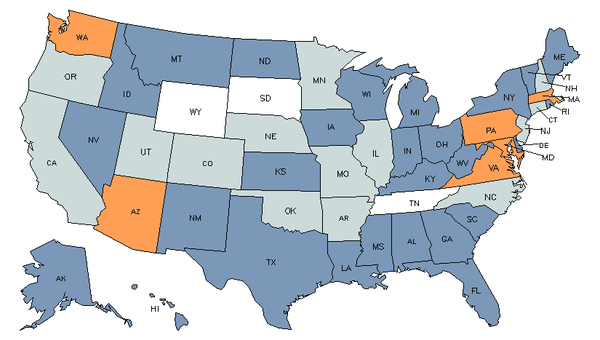
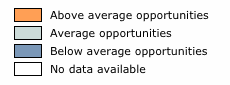
Demand
Core Tasks
- Analyze and interpret statistical data to identify significant differences in relationships among sources of information.
- Evaluate the statistical methods and procedures used to obtain data to ensure validity, applicability, efficiency, and accuracy.
- Report results of statistical analyses, including information in the form of graphs, charts, and tables.
- Determine whether statistical methods are appropriate, based on user needs or research questions of interest.
- Prepare data for processing by organizing information, checking for inaccuracies, and adjusting and weighting the raw data.
- Develop and test experimental designs, sampling techniques, and analytical methods.
- Identify relationships and trends in data, as well as any factors that could affect the results of research.
- Design research projects that apply valid scientific techniques, and use information obtained from baselines or historical data to structure uncompromised and efficient analyses.
- Present statistical and nonstatistical results, using charts, bullets, and graphs, in meetings or conferences to audiences such as clients, peers, and students.
- Adapt statistical methods to solve specific problems in many fields, such as economics, biology, and engineering.
- Evaluate sources of information to determine any limitations, in terms of reliability or usability.
- Process large amounts of data for statistical modeling and graphic analysis, using computers.
- Develop software applications or programming for statistical modeling and graphic analysis.
- Plan data collection methods for specific projects, and determine the types and sizes of sample groups to be used.
- Report results of statistical analyses in peer-reviewed papers and technical manuals.
- Apply sampling techniques, or use complete enumeration bases to determine and define groups to be surveyed.
- Examine theories, such as those of probability and inference, to discover mathematical bases for new or improved methods of obtaining and evaluating numerical data.
- Prepare and structure data warehouses for storing data.
- Supervise and provide instructions for workers collecting and tabulating data.
Technology Skills
Technology
Example
Hot Technology
Tools Used
Tool
Example
Top 10 Knowledge Required
Mathematics
94%
Knowledge of arithmetic, algebra, geometry, calculus, statistics, and their applications.
Computers and Electronics
84%
Knowledge of circuit boards, processors, chips, electronic equipment, and computer hardware and software, including applications and programming.
English Language
78%
Knowledge of the structure and content of the English language including the meaning and spelling of words, and rules of composition and grammar.
Education and Training
58%
Knowledge of principles and methods for curriculum and training design, teaching and instruction for individuals and groups, and the measurement of training effects.
Administration and Management
57%
Knowledge of business and management principles involved in strategic planning, resource allocation, human resources modeling, leadership technique, production methods, and coordination of people and resources.
Customer and Personal Service
50%
Knowledge of principles and processes for providing customer and personal services. This includes customer needs assessment, meeting quality standards for services, and evaluation of customer satisfaction.
Biology
49%
Knowledge of plant and animal organisms, their tissues, cells, functions, interdependencies, and interactions with each other and the environment.
Administrative
47%
Knowledge of administrative and office procedures and systems such as word processing, managing files and records, stenography and transcription, designing forms, and workplace terminology.
Engineering and Technology
47%
Knowledge of the practical application of engineering science and technology. This includes applying principles, techniques, procedures, and equipment to the design and production of various goods and services.
Communications and Media
45%
Knowledge of media production, communication, and dissemination techniques and methods. This includes alternative ways to inform and entertain via written, oral, and visual media.
Top 10 Skills
Mathematics
98%
Using mathematics to solve problems.
Critical Thinking
80%
Using logic and reasoning to identify the strengths and weaknesses of alternative solutions, conclusions, or approaches to problems.
Reading Comprehension
80%
Understanding written sentences and paragraphs in work-related documents.
Active Listening
78%
Giving full attention to what other people are saying, taking time to understand the points being made, asking questions as appropriate, and not interrupting at inappropriate times.
Complex Problem Solving
78%
Identifying complex problems and reviewing related information to develop and evaluate options and implement solutions.
Speaking
78%
Talking to others to convey information effectively.
Active Learning
75%
Understanding the implications of new information for both current and future problem-solving and decision-making.
Writing
75%
Communicating effectively in writing as appropriate for the needs of the audience.
Science
70%
Using scientific rules and methods to solve problems.
Judgment and Decision Making
68%
Considering the relative costs and benefits of potential actions to choose the most appropriate one.
Top 10 Abilities
Mathematical Reasoning
95%
The ability to choose the right mathematical methods or formulas to solve a problem.
Number Facility
88%
The ability to add, subtract, multiply, or divide quickly and correctly.
Written Comprehension
83%
The ability to read and understand information and ideas presented in writing.
Inductive Reasoning
80%
The ability to combine pieces of information to form general rules or conclusions (includes finding a relationship among seemingly unrelated events).
Near Vision
80%
The ability to see details at close range (within a few feet of the observer).
Oral Comprehension
80%
The ability to listen to and understand information and ideas presented through spoken words and sentences.
Oral Expression
80%
The ability to communicate information and ideas in speaking so others will understand.
Written Expression
80%
The ability to communicate information and ideas in writing so others will understand.
Deductive Reasoning
78%
The ability to apply general rules to specific problems to produce answers that make sense.
Information Ordering
75%
The ability to arrange things or actions in a certain order or pattern according to a specific rule or set of rules (e.g., patterns of numbers, letters, words, pictures, mathematical operations).
Top 10 Work Activities
Analyzing Data or Information
99%
Identifying the underlying principles, reasons, or facts of information by breaking down information or data into separate parts.
Working with Computers
99%
Using computers and computer systems (including hardware and software) to program, write software, set up functions, enter data, or process information.
Processing Information
96%
Compiling, coding, categorizing, calculating, tabulating, auditing, or verifying information or data.
Interpreting the Meaning of Information for Others
94%
Translating or explaining what information means and how it can be used.
Making Decisions and Solving Problems
93%
Analyzing information and evaluating results to choose the best solution and solve problems.
Getting Information
90%
Observing, receiving, and otherwise obtaining information from all relevant sources.
Communicating with Supervisors, Peers, or Subordinates
88%
Providing information to supervisors, co-workers, and subordinates by telephone, in written form, e-mail, or in person.
Updating and Using Relevant Knowledge
86%
Keeping up-to-date technically and applying new knowledge to your job.
Documenting/Recording Information
82%
Entering, transcribing, recording, storing, or maintaining information in written or electronic/magnetic form.
Providing Consultation and Advice to Others
80%
Providing guidance and expert advice to management or other groups on technical, systems-, or process-related topics.
Detailed Work Activities
- Analyze data to identify trends or relationships among variables.
- Evaluate project designs to determine adequacy or feasibility.
- Determine appropriate methods for data analysis.
- Prepare graphics or other visual representations of information.
- Prepare analytical reports.
- Evaluate technical data to determine effect on designs or plans.
- Evaluate data quality.
- Prepare data for analysis.
- Design research studies to obtain scientific information.
- Present research results to others.
- Apply mathematical principles or statistical approaches to solve problems in scientific or applied fields.
- Design software applications.
- Update knowledge about emerging industry or technology trends.
- Supervise information technology personnel.
- Write computer programming code.
- Implement security measures for computer or information systems.
- Install computer software.
Education
Interests
Investigative
95%
Work involves studying and researching non-living objects, living organisms, disease or other forms of impairment, or human behavior. Investigative occupations are often associated with physical, life, medical, or social sciences, and can be found in the fields of humanities, mathematics/statistics, information technology, or health care service.
Conventional
85%
Work involves following procedures and regulations to organize information or data, typically in a business setting. Conventional occupations are often associated with office work, accounting, mathematics/statistics, information technology, finance, or human resources.
Realistic
30%
Work involves designing, building, or repairing of equipment, materials, or structures, engaging in physical activity, or working outdoors. Realistic occupations are often associated with engineering, mechanics and electronics, construction, woodworking, transportation, machine operation, agriculture, animal services, physical or manual labor, athletics, or protective services.
Artistic
26%
Work involves creating original visual artwork, performances, written works, food, or music for a variety of media, or applying artistic principles to the design of various objects and materials. Artistic occupations are often associated with visual arts, applied arts and design, performing arts, music, creative writing, media, or culinary art.
Enterprising
26%
Work involves managing, negotiating, marketing, or selling, typically in a business setting, or leading or advising people in political and legal situations. Enterprising occupations are often associated with business initiatives, sales, marketing/advertising, finance, management/administration, professional advising, public speaking, politics, or law.
Social
25%
Work involves helping, teaching, advising, assisting, or providing service to others. Social occupations are often associated with social, health care, personal service, teaching/education, or religious activities.
Work Values
Independence
81%
Occupations that satisfy this work value allow employees to work on their own and make decisions. Corresponding needs are Creativity, Responsibility and Autonomy.
Achievement
77%
Occupations that satisfy this work value are results oriented and allow employees to use their strongest abilities, giving them a feeling of accomplishment. Corresponding needs are Ability Utilization and Achievement.
Recognition
72%
Occupations that satisfy this work value offer advancement, potential for leadership, and are often considered prestigious. Corresponding needs are Advancement, Authority, Recognition and Social Status.
Relationships
67%
Occupations that satisfy this work value allow employees to provide service to others and work with co-workers in a friendly non-competitive environment. Corresponding needs are Co-workers, Moral Values and Social Service.
Working Conditions
67%
Occupations that satisfy this work value offer job security and good working conditions. Corresponding needs are Activity, Compensation, Independence, Security, Variety and Working Conditions.
Support
43%
Occupations that satisfy this work value offer supportive management that stands behind employees. Corresponding needs are Company Policies, Supervision: Human Relations and Supervision: Technical.
Majors
Colleges
SAGE Scholars Member Schools that offer majors leading to this career.
Check out the College Search to see the full list of schools with majors for this career.