Broadcast Technicians
Overview
SaveJob Zone Three: Medium Preparation Needed
Experience
Previous work-related skill, knowledge, or experience is required for these occupations. For example, an electrician must have completed three or four years of apprenticeship or several years of vocational training, and often must have passed a licensing exam, in order to perform the job.
Education
Most occupations in this zone require training in vocational schools, related on-the-job experience, or an associate's degree.
Job Training
Employees in these occupations usually need one or two years of training involving both on-the-job experience and informal training with experienced workers. A recognized apprenticeship program may be associated with these occupations.
Examples
These occupations usually involve using communication and organizational skills to coordinate, supervise, manage, or train others to accomplish goals. Examples include hydroelectric production managers, desktop publishers, electricians, agricultural technicians, barbers, court reporters and simultaneous captioners, and medical assistants.
Set up, operate, and maintain the electronic equipment used to acquire, edit, and transmit audio and video for radio or television programs. Control and adjust incoming and outgoing broadcast signals to regulate sound volume, signal strength, and signal clarity. Operate satellite, microwave, or other transmitter equipment to broadcast radio or television programs.

Yearly Salary
| High: | $83K |
| Median: | $43K |
| Low: | $21K |
Demand
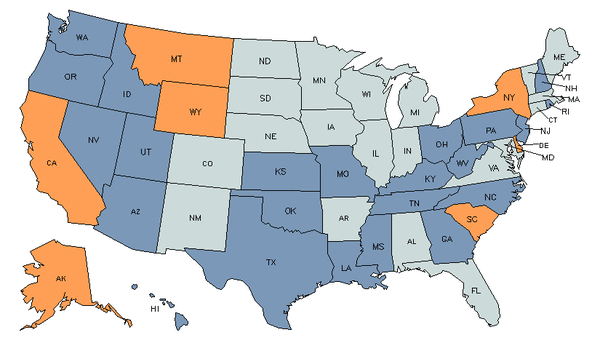
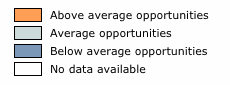
Core Tasks
- Report equipment problems, ensure that repairs are made, and make emergency repairs to equipment when necessary and possible.
- Maintain programming logs as required by station management and the Federal Communications Commission.
- Monitor and log transmitter readings.
- Monitor strength, clarity, and reliability of incoming and outgoing signals, and adjust equipment as necessary to maintain quality broadcasts.
- Observe monitors and converse with station personnel to determine audio and video levels and to ascertain that programs are airing.
- Preview scheduled programs to ensure that signals are functioning and programs are ready for transmission.
- Play and record broadcast programs, using automation systems.
- Set up, operate, and maintain broadcast station computers and networks.
- Record sound onto tape or film for radio or television, checking its quality and making adjustments where necessary.
- Schedule programming or read television programming logs to determine which programs are to be recorded or aired.
- Edit broadcast material electronically, using computers.
- Install broadcast equipment, troubleshoot equipment problems, and perform maintenance or minor repairs, using hand tools.
- Select sources from which programming will be received or through which programming will be transmitted.
- Develop employee work schedules.
- Substitute programs in cases where signals fail.
- Control audio equipment to regulate volume and sound quality during radio and television broadcasts.
- Design and modify equipment to employer specifications.
- Align antennae with receiving dishes to obtain the clearest signal for transmission of broadcasts from field locations.
- Instruct trainees in use of television production equipment, filming of events, and copying and editing graphics or sound onto videotape.
- Regulate the fidelity, brightness, and contrast of video transmissions, using video console control panels.
- Determine the number, type, and approximate location of microphones needed for best sound recording or transmission quality, and position them appropriately.
- Make commercial dubs.
- Organize recording sessions and prepare areas, such as radio booths and television stations, for recording.
- Set up and operate portable field transmission equipment outside the studio.
- Give technical directions to other personnel during filming.
- Prepare reports outlining past and future programs, including content.
- Discuss production requirements with clients.
Technology Skills
Technology
Example
Hot Technology
Tools Used
Tool
Example
Top 10 Knowledge Required
Computers and Electronics
91%
Knowledge of circuit boards, processors, chips, electronic equipment, and computer hardware and software, including applications and programming.
Telecommunications
84%
Knowledge of transmission, broadcasting, switching, control, and operation of telecommunications systems.
Engineering and Technology
77%
Knowledge of the practical application of engineering science and technology. This includes applying principles, techniques, procedures, and equipment to the design and production of various goods and services.
Communications and Media
71%
Knowledge of media production, communication, and dissemination techniques and methods. This includes alternative ways to inform and entertain via written, oral, and visual media.
English Language
69%
Knowledge of the structure and content of the English language including the meaning and spelling of words, and rules of composition and grammar.
Design
57%
Knowledge of design techniques, tools, and principles involved in production of precision technical plans, blueprints, drawings, and models.
Mathematics
56%
Knowledge of arithmetic, algebra, geometry, calculus, statistics, and their applications.
Education and Training
55%
Knowledge of principles and methods for curriculum and training design, teaching and instruction for individuals and groups, and the measurement of training effects.
Mechanical
54%
Knowledge of machines and tools, including their designs, uses, repair, and maintenance.
Customer and Personal Service
50%
Knowledge of principles and processes for providing customer and personal services. This includes customer needs assessment, meeting quality standards for services, and evaluation of customer satisfaction.
Top 10 Skills
Critical Thinking
75%
Using logic and reasoning to identify the strengths and weaknesses of alternative solutions, conclusions, or approaches to problems.
Active Listening
73%
Giving full attention to what other people are saying, taking time to understand the points being made, asking questions as appropriate, and not interrupting at inappropriate times.
Monitoring
70%
Monitoring/Assessing performance of yourself, other individuals, or organizations to make improvements or take corrective action.
Operations Monitoring
70%
Watching gauges, dials, or other indicators to make sure a machine is working properly.
Complex Problem Solving
65%
Identifying complex problems and reviewing related information to develop and evaluate options and implement solutions.
Writing
65%
Communicating effectively in writing as appropriate for the needs of the audience.
Active Learning
63%
Understanding the implications of new information for both current and future problem-solving and decision-making.
Equipment Maintenance
63%
Performing routine maintenance on equipment and determining when and what kind of maintenance is needed.
Judgment and Decision Making
63%
Considering the relative costs and benefits of potential actions to choose the most appropriate one.
Reading Comprehension
63%
Understanding written sentences and paragraphs in work-related documents.
Top 10 Abilities
Near Vision
78%
The ability to see details at close range (within a few feet of the observer).
Oral Comprehension
73%
The ability to listen to and understand information and ideas presented through spoken words and sentences.
Problem Sensitivity
73%
The ability to tell when something is wrong or is likely to go wrong. It does not involve solving the problem, only recognizing that there is a problem.
Written Comprehension
73%
The ability to read and understand information and ideas presented in writing.
Deductive Reasoning
65%
The ability to apply general rules to specific problems to produce answers that make sense.
Information Ordering
65%
The ability to arrange things or actions in a certain order or pattern according to a specific rule or set of rules (e.g., patterns of numbers, letters, words, pictures, mathematical operations).
Oral Expression
65%
The ability to communicate information and ideas in speaking so others will understand.
Written Expression
65%
The ability to communicate information and ideas in writing so others will understand.
Flexibility of Closure
63%
The ability to identify or detect a known pattern (a figure, object, word, or sound) that is hidden in other distracting material.
Inductive Reasoning
63%
The ability to combine pieces of information to form general rules or conclusions (includes finding a relationship among seemingly unrelated events).
Top 10 Work Activities
Working with Computers
92%
Using computers and computer systems (including hardware and software) to program, write software, set up functions, enter data, or process information.
Communicating with Supervisors, Peers, or Subordinates
87%
Providing information to supervisors, co-workers, and subordinates by telephone, in written form, e-mail, or in person.
Getting Information
85%
Observing, receiving, and otherwise obtaining information from all relevant sources.
Updating and Using Relevant Knowledge
83%
Keeping up-to-date technically and applying new knowledge to your job.
Identifying Objects, Actions, and Events
82%
Identifying information by categorizing, estimating, recognizing differences or similarities, and detecting changes in circumstances or events.
Repairing and Maintaining Electronic Equipment
79%
Servicing, repairing, calibrating, regulating, fine-tuning, or testing machines, devices, and equipment that operate primarily on the basis of electrical or electronic (not mechanical) principles.
Documenting/Recording Information
78%
Entering, transcribing, recording, storing, or maintaining information in written or electronic/magnetic form.
Inspecting Equipment, Structures, or Materials
78%
Inspecting equipment, structures, or materials to identify the cause of errors or other problems or defects.
Making Decisions and Solving Problems
78%
Analyzing information and evaluating results to choose the best solution and solve problems.
Monitoring Processes, Materials, or Surroundings
76%
Monitoring and reviewing information from materials, events, or the environment, to detect or assess problems.
Detailed Work Activities
- Maintain recording or broadcasting equipment.
- Notify others of equipment problems.
- Maintain logs of production activities.
- Monitor broadcasting operations to ensure proper functioning.
- Operate communications, transmissions, or broadcasting equipment.
- Operate control consoles for sound, lighting or video.
- Design tools, fixtures, or other devices for production equipment.
- Design electrical equipment or systems.
- Operate audio recording equipment.
- Read materials to determine needed actions.
- Schedule operational activities.
- Edit audio or video recordings.
- Coordinate activities of production personnel.
- Train others on work processes.
- Determine technical requirements of productions or projects.
- Direct productions or performances.
- Confer with clients to determine needs.
Education
Interests
Conventional
72%
Work involves following procedures and regulations to organize information or data, typically in a business setting. Conventional occupations are often associated with office work, accounting, mathematics/statistics, information technology, finance, or human resources.
Realistic
71%
Work involves designing, building, or repairing of equipment, materials, or structures, engaging in physical activity, or working outdoors. Realistic occupations are often associated with engineering, mechanics and electronics, construction, woodworking, transportation, machine operation, agriculture, animal services, physical or manual labor, athletics, or protective services.
Investigative
45%
Work involves studying and researching non-living objects, living organisms, disease or other forms of impairment, or human behavior. Investigative occupations are often associated with physical, life, medical, or social sciences, and can be found in the fields of humanities, mathematics/statistics, information technology, or health care service.
Artistic
40%
Work involves creating original visual artwork, performances, written works, food, or music for a variety of media, or applying artistic principles to the design of various objects and materials. Artistic occupations are often associated with visual arts, applied arts and design, performing arts, music, creative writing, media, or culinary art.
Enterprising
35%
Work involves managing, negotiating, marketing, or selling, typically in a business setting, or leading or advising people in political and legal situations. Enterprising occupations are often associated with business initiatives, sales, marketing/advertising, finance, management/administration, professional advising, public speaking, politics, or law.
Social
31%
Work involves helping, teaching, advising, assisting, or providing service to others. Social occupations are often associated with social, health care, personal service, teaching/education, or religious activities.
Work Values
Support
62%
Occupations that satisfy this work value offer supportive management that stands behind employees. Corresponding needs are Company Policies, Supervision: Human Relations and Supervision: Technical.
Achievement
58%
Occupations that satisfy this work value are results oriented and allow employees to use their strongest abilities, giving them a feeling of accomplishment. Corresponding needs are Ability Utilization and Achievement.
Independence
58%
Occupations that satisfy this work value allow employees to work on their own and make decisions. Corresponding needs are Creativity, Responsibility and Autonomy.
Working Conditions
53%
Occupations that satisfy this work value offer job security and good working conditions. Corresponding needs are Activity, Compensation, Independence, Security, Variety and Working Conditions.
Relationships
48%
Occupations that satisfy this work value allow employees to provide service to others and work with co-workers in a friendly non-competitive environment. Corresponding needs are Co-workers, Moral Values and Social Service.
Recognition
43%
Occupations that satisfy this work value offer advancement, potential for leadership, and are often considered prestigious. Corresponding needs are Advancement, Authority, Recognition and Social Status.