Dermatologists
Overview
SaveJob Zone Five: Extensive Preparation Needed
Experience
Extensive skill, knowledge, and experience are needed for these occupations. Many require more than five years of experience. For example, surgeons must complete four years of college and an additional five to seven years of specialized medical training to be able to do their job.
Education
Most of these occupations require graduate school. For example, they may require a master's degree, and some require a Ph.D., M.D., or J.D. (law degree).
Job Training
Employees may need some on-the-job training, but most of these occupations assume that the person will already have the required skills, knowledge, work-related experience, and/or training.
Examples
These occupations often involve coordinating, training, supervising, or managing the activities of others to accomplish goals. Very advanced communication and organizational skills are required. Examples include pharmacists, lawyers, astronomers, biologists, clergy, physician assistants, and veterinarians.
Diagnose and treat diseases relating to the skin, hair, and nails. May perform both medical and dermatological surgery functions.

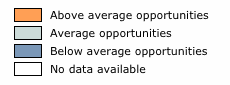
Demand

Core Tasks
- Conduct complete skin examinations.
- Diagnose and treat pigmented lesions such as common acquired nevi, congenital nevi, dysplastic nevi, Spitz nevi, blue nevi, or melanoma.
- Perform incisional biopsies to diagnose melanoma.
- Perform skin surgery to improve appearance, make early diagnoses, or control diseases such as skin cancer.
- Counsel patients on topics such as the need for annual dermatologic screenings, sun protection, skin cancer awareness, or skin and lymph node self-examinations.
- Diagnose and treat skin conditions such as acne, dandruff, athlete's foot, moles, psoriasis, or skin cancer.
- Recommend diagnostic tests based on patients' histories and physical examination findings.
- Record patients' health histories.
- Conduct or order diagnostic tests such as chest radiographs (x-rays), microbiologic tests, or endocrinologic tests.
- Prescribe hormonal agents or topical treatments such as contraceptives, spironolactone, antiandrogens, oral corticosteroids, retinoids, benzoyl peroxide, or antibiotics.
- Read current literature, talk with colleagues, and participate in professional organizations or conferences to keep abreast of developments in dermatology.
- Provide dermatologic consultation to other health professionals.
- Refer patients to other specialists, as needed.
- Instruct interns or residents in diagnosis and treatment of dermatological diseases.
- Provide therapies such as intralesional steroids, chemical peels, or comodo removal to treat age spots, sun damage, rough skin, discolored skin, or oily skin.
- Conduct clinical or basic research.
- Provide dermabrasion or laser abrasion to treat atrophic scars, elevated scars, or other skin conditions.
- Evaluate patients to determine eligibility for cosmetic procedures such as liposuction, laser resurfacing, or microdermabrasion.
Technology Skills
Technology
Example
Hot Technology
Tools Used
Tool
Example
Top 10 Knowledge Required
Medicine and Dentistry
97%
Knowledge of the information and techniques needed to diagnose and treat human injuries, diseases, and deformities. This includes symptoms, treatment alternatives, drug properties and interactions, and preventive health-care measures.
Customer and Personal Service
92%
Knowledge of principles and processes for providing customer and personal services. This includes customer needs assessment, meeting quality standards for services, and evaluation of customer satisfaction.
English Language
81%
Knowledge of the structure and content of the English language including the meaning and spelling of words, and rules of composition and grammar.
Administration and Management
78%
Knowledge of business and management principles involved in strategic planning, resource allocation, human resources modeling, leadership technique, production methods, and coordination of people and resources.
Education and Training
75%
Knowledge of principles and methods for curriculum and training design, teaching and instruction for individuals and groups, and the measurement of training effects.
Biology
74%
Knowledge of plant and animal organisms, their tissues, cells, functions, interdependencies, and interactions with each other and the environment.
Personnel and Human Resources
71%
Knowledge of principles and procedures for personnel recruitment, selection, training, compensation and benefits, labor relations and negotiation, and personnel information systems.
Psychology
69%
Knowledge of human behavior and performance; individual differences in ability, personality, and interests; learning and motivation; psychological research methods; and the assessment and treatment of behavioral and affective disorders.
Computers and Electronics
61%
Knowledge of circuit boards, processors, chips, electronic equipment, and computer hardware and software, including applications and programming.
Therapy and Counseling
60%
Knowledge of principles, methods, and procedures for diagnosis, treatment, and rehabilitation of physical and mental dysfunctions, and for career counseling and guidance.
Top 10 Skills
Critical Thinking
83%
Using logic and reasoning to identify the strengths and weaknesses of alternative solutions, conclusions, or approaches to problems.
Active Listening
80%
Giving full attention to what other people are saying, taking time to understand the points being made, asking questions as appropriate, and not interrupting at inappropriate times.
Service Orientation
80%
Actively looking for ways to help people.
Reading Comprehension
78%
Understanding written sentences and paragraphs in work-related documents.
Social Perceptiveness
78%
Being aware of others' reactions and understanding why they react as they do.
Speaking
78%
Talking to others to convey information effectively.
Active Learning
75%
Understanding the implications of new information for both current and future problem-solving and decision-making.
Judgment and Decision Making
75%
Considering the relative costs and benefits of potential actions to choose the most appropriate one.
Science
73%
Using scientific rules and methods to solve problems.
Complex Problem Solving
70%
Identifying complex problems and reviewing related information to develop and evaluate options and implement solutions.
Top 10 Abilities
Oral Expression
85%
The ability to communicate information and ideas in speaking so others will understand.
Problem Sensitivity
85%
The ability to tell when something is wrong or is likely to go wrong. It does not involve solving the problem, only recognizing that there is a problem.
Deductive Reasoning
83%
The ability to apply general rules to specific problems to produce answers that make sense.
Inductive Reasoning
83%
The ability to combine pieces of information to form general rules or conclusions (includes finding a relationship among seemingly unrelated events).
Oral Comprehension
83%
The ability to listen to and understand information and ideas presented through spoken words and sentences.
Near Vision
80%
The ability to see details at close range (within a few feet of the observer).
Written Comprehension
80%
The ability to read and understand information and ideas presented in writing.
Written Expression
78%
The ability to communicate information and ideas in writing so others will understand.
Information Ordering
75%
The ability to arrange things or actions in a certain order or pattern according to a specific rule or set of rules (e.g., patterns of numbers, letters, words, pictures, mathematical operations).
Speech Clarity
75%
The ability to speak clearly so others can understand you.
Top 10 Work Activities
Assisting and Caring for Others
95%
Providing personal assistance, medical attention, emotional support, or other personal care to others such as coworkers, customers, or patients.
Documenting/Recording Information
93%
Entering, transcribing, recording, storing, or maintaining information in written or electronic/magnetic form.
Getting Information
93%
Observing, receiving, and otherwise obtaining information from all relevant sources.
Making Decisions and Solving Problems
87%
Analyzing information and evaluating results to choose the best solution and solve problems.
Communicating with Supervisors, Peers, or Subordinates
86%
Providing information to supervisors, co-workers, and subordinates by telephone, in written form, e-mail, or in person.
Establishing and Maintaining Interpersonal Relationships
86%
Developing constructive and cooperative working relationships with others, and maintaining them over time.
Interpreting the Meaning of Information for Others
83%
Translating or explaining what information means and how it can be used.
Working with Computers
83%
Using computers and computer systems (including hardware and software) to program, write software, set up functions, enter data, or process information.
Identifying Objects, Actions, and Events
81%
Identifying information by categorizing, estimating, recognizing differences or similarities, and detecting changes in circumstances or events.
Training and Teaching Others
77%
Identifying the educational needs of others, developing formal educational or training programs or classes, and teaching or instructing others.
Detailed Work Activities
- Refer patients to other healthcare practitioners or health resources.
- Record patient medical histories.
- Advise medical personnel regarding healthcare issues.
- Maintain medical or professional knowledge.
- Train medical providers.
- Analyze patient data to determine patient needs or treatment goals.
- Order medical diagnostic or clinical tests.
- Conduct research to increase knowledge about medical issues.
- Treat chronic diseases or disorders.
- Prescribe medications.
- Operate on patients to treat conditions.
- Diagnose medical conditions.
- Advise patients on preventive care techniques.
- Examine patients to assess general physical condition.
Education
Interests
Investigative
90%
Work involves studying and researching non-living objects, living organisms, disease or other forms of impairment, or human behavior. Investigative occupations are often associated with physical, life, medical, or social sciences, and can be found in the fields of humanities, mathematics/statistics, information technology, or health care service.
Realistic
80%
Work involves designing, building, or repairing of equipment, materials, or structures, engaging in physical activity, or working outdoors. Realistic occupations are often associated with engineering, mechanics and electronics, construction, woodworking, transportation, machine operation, agriculture, animal services, physical or manual labor, athletics, or protective services.
Social
62%
Work involves helping, teaching, advising, assisting, or providing service to others. Social occupations are often associated with social, health care, personal service, teaching/education, or religious activities.
Conventional
53%
Work involves following procedures and regulations to organize information or data, typically in a business setting. Conventional occupations are often associated with office work, accounting, mathematics/statistics, information technology, finance, or human resources.
Artistic
26%
Work involves creating original visual artwork, performances, written works, food, or music for a variety of media, or applying artistic principles to the design of various objects and materials. Artistic occupations are often associated with visual arts, applied arts and design, performing arts, music, creative writing, media, or culinary art.
Enterprising
26%
Work involves managing, negotiating, marketing, or selling, typically in a business setting, or leading or advising people in political and legal situations. Enterprising occupations are often associated with business initiatives, sales, marketing/advertising, finance, management/administration, professional advising, public speaking, politics, or law.
Work Values
Achievement
86%
Occupations that satisfy this work value are results oriented and allow employees to use their strongest abilities, giving them a feeling of accomplishment. Corresponding needs are Ability Utilization and Achievement.
Independence
81%
Occupations that satisfy this work value allow employees to work on their own and make decisions. Corresponding needs are Creativity, Responsibility and Autonomy.
Recognition
81%
Occupations that satisfy this work value offer advancement, potential for leadership, and are often considered prestigious. Corresponding needs are Advancement, Authority, Recognition and Social Status.
Relationships
81%
Occupations that satisfy this work value allow employees to provide service to others and work with co-workers in a friendly non-competitive environment. Corresponding needs are Co-workers, Moral Values and Social Service.
Working Conditions
81%
Occupations that satisfy this work value offer job security and good working conditions. Corresponding needs are Activity, Compensation, Independence, Security, Variety and Working Conditions.
Support
72%
Occupations that satisfy this work value offer supportive management that stands behind employees. Corresponding needs are Company Policies, Supervision: Human Relations and Supervision: Technical.