Paramedics
Overview
SaveJob Zone Three: Medium Preparation Needed
Experience
Previous work-related skill, knowledge, or experience is required for these occupations. For example, an electrician must have completed three or four years of apprenticeship or several years of vocational training, and often must have passed a licensing exam, in order to perform the job.
Education
Most occupations in this zone require training in vocational schools, related on-the-job experience, or an associate's degree.
Job Training
Employees in these occupations usually need one or two years of training involving both on-the-job experience and informal training with experienced workers. A recognized apprenticeship program may be associated with these occupations.
Examples
These occupations usually involve using communication and organizational skills to coordinate, supervise, manage, or train others to accomplish goals. Examples include hydroelectric production managers, desktop publishers, electricians, agricultural technicians, barbers, court reporters and simultaneous captioners, and medical assistants.
Administer basic or advanced emergency medical care and assess injuries and illnesses. May administer medication intravenously, use equipment such as EKGs, or administer advanced life support to sick or injured individuals.

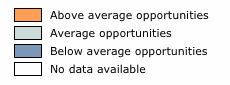
Demand

Technology Skills
Technology
Example
Hot Technology
Tools Used
Tool
Example
Detailed Work Activities
- Administer non-intravenous medications.
- Administer intravenous medications.
- Treat medical emergencies.
- Analyze patient data to determine patient needs or treatment goals.
- Maintain medical or professional knowledge.
- Interact with patients to build rapport or provide emotional support.
- Collaborate with healthcare professionals to plan or provide treatment.
- Train medical providers.
- Teach medical procedures to healthcare personnel.
- Monitor patient progress or responses to treatments.
- Record patient medical histories.
- Inform medical professionals regarding patient conditions and care.
- Operate diagnostic or therapeutic medical instruments or equipment.
- Implement advanced life support techniques.
Interests
Social
79%
Work involves helping, teaching, advising, assisting, or providing service to others. Social occupations are often associated with social, health care, personal service, teaching/education, or religious activities.
Realistic
75%
Work involves designing, building, or repairing of equipment, materials, or structures, engaging in physical activity, or working outdoors. Realistic occupations are often associated with engineering, mechanics and electronics, construction, woodworking, transportation, machine operation, agriculture, animal services, physical or manual labor, athletics, or protective services.
Investigative
72%
Work involves studying and researching non-living objects, living organisms, disease or other forms of impairment, or human behavior. Investigative occupations are often associated with physical, life, medical, or social sciences, and can be found in the fields of humanities, mathematics/statistics, information technology, or health care service.
Conventional
50%
Work involves following procedures and regulations to organize information or data, typically in a business setting. Conventional occupations are often associated with office work, accounting, mathematics/statistics, information technology, finance, or human resources.
Enterprising
27%
Work involves managing, negotiating, marketing, or selling, typically in a business setting, or leading or advising people in political and legal situations. Enterprising occupations are often associated with business initiatives, sales, marketing/advertising, finance, management/administration, professional advising, public speaking, politics, or law.
Artistic
15%
Work involves creating original visual artwork, performances, written works, food, or music for a variety of media, or applying artistic principles to the design of various objects and materials. Artistic occupations are often associated with visual arts, applied arts and design, performing arts, music, creative writing, media, or culinary art.