Dishwashers
Overview
SaveJob Zone One: Little or No Preparation Needed
Experience
Little or no previous work-related skill, knowledge, or experience is needed for these occupations. For example, a person can become a waiter or waitress even if he/she has never worked before.
Education
Some of these occupations may require a high school diploma or GED certificate.
Job Training
Employees in these occupations need anywhere from a few days to a few months of training. Usually, an experienced worker could show you how to do the job.
Examples
These occupations involve following instructions and helping others. Examples include agricultural equipment operators, dishwashers, floor sanders and finishers, landscaping and groundskeeping workers, logging equipment operators, baristas, and maids and housekeeping cleaners.
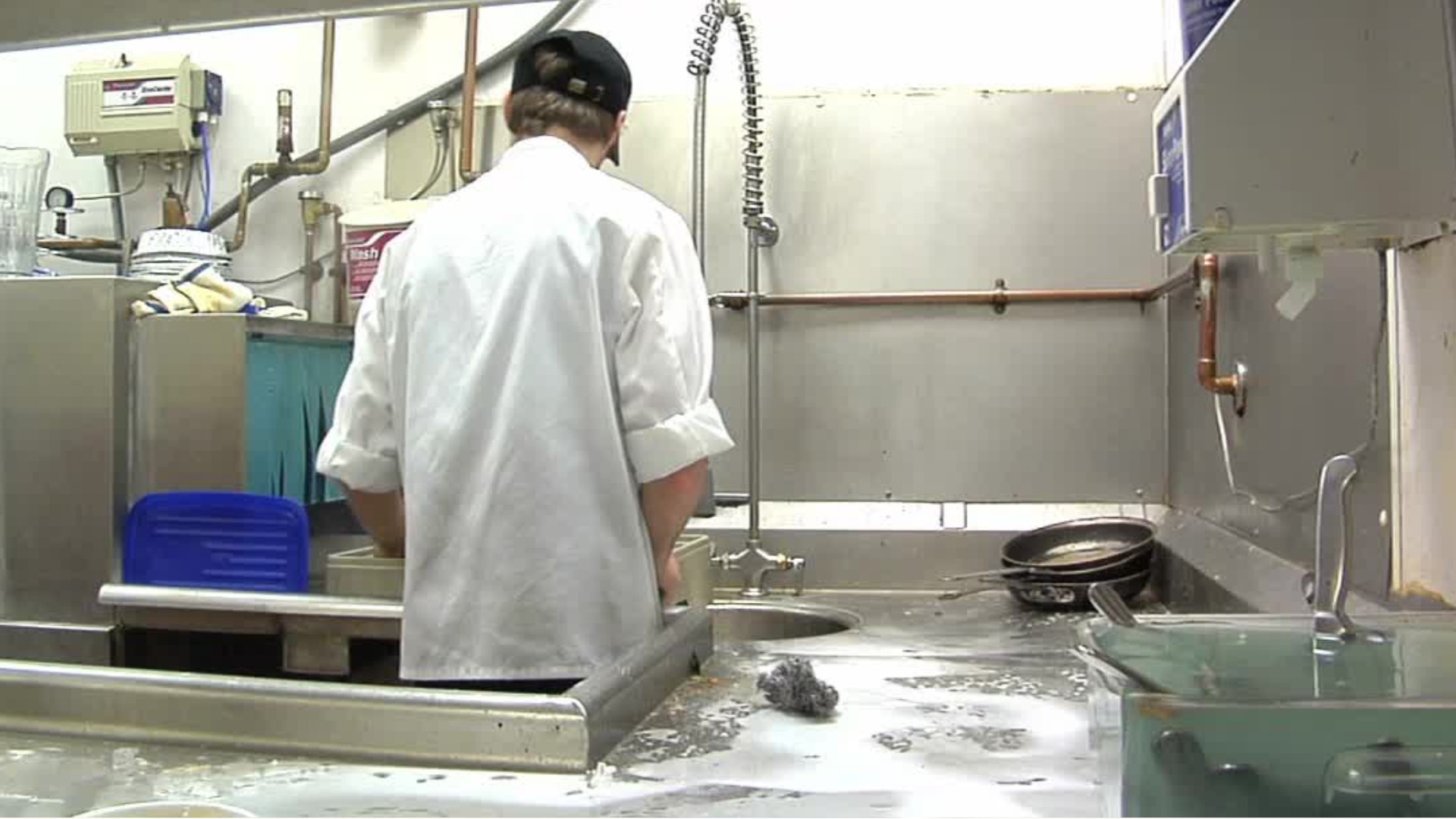
Clean dishes, kitchen, food preparation equipment, or utensils.
Yearly Salary
| High: | $32K |
| Median: | $25K |
| Low: | $18K |
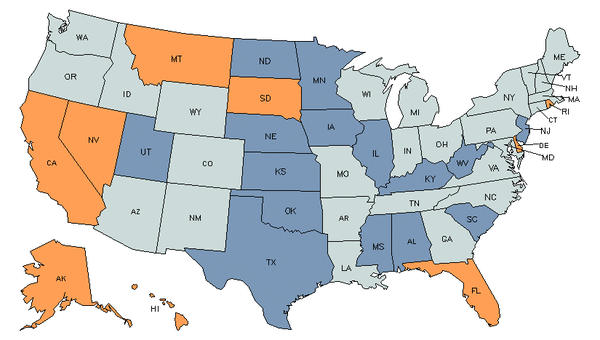
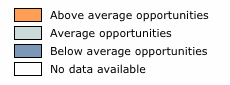
Demand
Core Tasks
- Wash dishes, glassware, flatware, pots, or pans, using dishwashers or by hand.
- Maintain kitchen work areas, equipment, or utensils in clean and orderly condition.
- Place clean dishes, utensils, or cooking equipment in storage areas.
- Sweep or scrub floors.
- Load or unload trucks that deliver or pick up food or supplies.
- Stock supplies, such as food or utensils, in serving stations, cupboards, refrigerators, or salad bars.
- Clean or prepare various foods for cooking or serving.
- Sort and remove trash, placing it in designated pickup areas.
- Transfer supplies or equipment between storage and work areas, by hand or using hand trucks.
- Clean garbage cans with water or steam.
- Receive and store supplies.
- Prepare and package individual place settings.
- Set up banquet tables.
Technology Skills
Technology
Example
Hot Technology
Tools Used
Tool
Example
Top 10 Knowledge Required
English Language
64%
Knowledge of the structure and content of the English language including the meaning and spelling of words, and rules of composition and grammar.
Food Production
56%
Knowledge of techniques and equipment for planting, growing, and harvesting food products (both plant and animal) for consumption, including storage/handling techniques.
Education and Training
50%
Knowledge of principles and methods for curriculum and training design, teaching and instruction for individuals and groups, and the measurement of training effects.
Customer and Personal Service
49%
Knowledge of principles and processes for providing customer and personal services. This includes customer needs assessment, meeting quality standards for services, and evaluation of customer satisfaction.
Public Safety and Security
47%
Knowledge of relevant equipment, policies, procedures, and strategies to promote effective local, state, or national security operations for the protection of people, data, property, and institutions.
Administration and Management
39%
Knowledge of business and management principles involved in strategic planning, resource allocation, human resources modeling, leadership technique, production methods, and coordination of people and resources.
Communications and Media
38%
Knowledge of media production, communication, and dissemination techniques and methods. This includes alternative ways to inform and entertain via written, oral, and visual media.
Foreign Language
35%
Knowledge of the structure and content of a foreign (non-English) language including the meaning and spelling of words, rules of composition and grammar, and pronunciation.
Production and Processing
35%
Knowledge of raw materials, production processes, quality control, costs, and other techniques for maximizing the effective manufacture and distribution of goods.
Transportation
35%
Knowledge of principles and methods for moving people or goods by air, rail, sea, or road, including the relative costs and benefits.
Top 10 Skills
Operation and Control
58%
Controlling operations of equipment or systems.
Coordination
55%
Adjusting actions in relation to others' actions.
Active Listening
53%
Giving full attention to what other people are saying, taking time to understand the points being made, asking questions as appropriate, and not interrupting at inappropriate times.
Time Management
53%
Managing one's own time and the time of others.
Critical Thinking
50%
Using logic and reasoning to identify the strengths and weaknesses of alternative solutions, conclusions, or approaches to problems.
Monitoring
50%
Monitoring/Assessing performance of yourself, other individuals, or organizations to make improvements or take corrective action.
Operations Monitoring
50%
Watching gauges, dials, or other indicators to make sure a machine is working properly.
Social Perceptiveness
50%
Being aware of others' reactions and understanding why they react as they do.
Speaking
50%
Talking to others to convey information effectively.
Quality Control Analysis
48%
Conducting tests and inspections of products, services, or processes to evaluate quality or performance.
Top 10 Abilities
Manual Dexterity
73%
The ability to quickly move your hand, your hand together with your arm, or your two hands to grasp, manipulate, or assemble objects.
Arm-Hand Steadiness
60%
The ability to keep your hand and arm steady while moving your arm or while holding your arm and hand in one position.
Extent Flexibility
60%
The ability to bend, stretch, twist, or reach with your body, arms, and/or legs.
Near Vision
60%
The ability to see details at close range (within a few feet of the observer).
Trunk Strength
60%
The ability to use your abdominal and lower back muscles to support part of the body repeatedly or continuously over time without "giving out" or fatiguing.
Information Ordering
58%
The ability to arrange things or actions in a certain order or pattern according to a specific rule or set of rules (e.g., patterns of numbers, letters, words, pictures, mathematical operations).
Multilimb Coordination
58%
The ability to coordinate two or more limbs (for example, two arms, two legs, or one leg and one arm) while sitting, standing, or lying down. It does not involve performing the activities while the whole body is in motion.
Oral Comprehension
58%
The ability to listen to and understand information and ideas presented through spoken words and sentences.
Control Precision
55%
The ability to quickly and repeatedly adjust the controls of a machine or a vehicle to exact positions.
Finger Dexterity
55%
The ability to make precisely coordinated movements of the fingers of one or both hands to grasp, manipulate, or assemble very small objects.
Top 10 Work Activities
Handling and Moving Objects
68%
Using hands and arms in handling, installing, positioning, and moving materials, and manipulating things.
Judging the Qualities of Objects, Services, or People
67%
Assessing the value, importance, or quality of things or people.
Inspecting Equipment, Structures, or Materials
63%
Inspecting equipment, structures, or materials to identify the cause of errors or other problems or defects.
Training and Teaching Others
62%
Identifying the educational needs of others, developing formal educational or training programs or classes, and teaching or instructing others.
Communicating with Supervisors, Peers, or Subordinates
61%
Providing information to supervisors, co-workers, and subordinates by telephone, in written form, e-mail, or in person.
Performing General Physical Activities
61%
Performing general physical activities includes doing activities that require considerable use of your arms and legs and moving your whole body, such as climbing, lifting, balancing, walking, stooping, and handling materials.
Making Decisions and Solving Problems
60%
Analyzing information and evaluating results to choose the best solution and solve problems.
Monitoring Processes, Materials, or Surroundings
58%
Monitoring and reviewing information from materials, events, or the environment, to detect or assess problems.
Assisting and Caring for Others
57%
Providing personal assistance, medical attention, emotional support, or other personal care to others such as coworkers, customers, or patients.
Evaluating Information to Determine Compliance with Standards
57%
Using relevant information and individual judgment to determine whether events or processes comply with laws, regulations, or standards.
Detailed Work Activities
- Clean tableware.
- Store supplies or goods in kitchens or storage areas.
- Clean food preparation areas, facilities, or equipment.
- Stock serving stations or dining areas with food or supplies.
- Remove trash.
- Prepare foods for cooking or serving.
- Arrange tables or dining areas.
- Move equipment, supplies or food to required locations.
- Package food or supplies.
- Load shipments, belongings, or materials.
Education
Interests
Realistic
100%
Work involves designing, building, or repairing of equipment, materials, or structures, engaging in physical activity, or working outdoors. Realistic occupations are often associated with engineering, mechanics and electronics, construction, woodworking, transportation, machine operation, agriculture, animal services, physical or manual labor, athletics, or protective services.
Conventional
64%
Work involves following procedures and regulations to organize information or data, typically in a business setting. Conventional occupations are often associated with office work, accounting, mathematics/statistics, information technology, finance, or human resources.
Social
27%
Work involves helping, teaching, advising, assisting, or providing service to others. Social occupations are often associated with social, health care, personal service, teaching/education, or religious activities.
Enterprising
21%
Work involves managing, negotiating, marketing, or selling, typically in a business setting, or leading or advising people in political and legal situations. Enterprising occupations are often associated with business initiatives, sales, marketing/advertising, finance, management/administration, professional advising, public speaking, politics, or law.
Artistic
15%
Work involves creating original visual artwork, performances, written works, food, or music for a variety of media, or applying artistic principles to the design of various objects and materials. Artistic occupations are often associated with visual arts, applied arts and design, performing arts, music, creative writing, media, or culinary art.
Investigative
15%
Work involves studying and researching non-living objects, living organisms, disease or other forms of impairment, or human behavior. Investigative occupations are often associated with physical, life, medical, or social sciences, and can be found in the fields of humanities, mathematics/statistics, information technology, or health care service.
Work Values
Relationships
58%
Occupations that satisfy this work value allow employees to provide service to others and work with co-workers in a friendly non-competitive environment. Corresponding needs are Co-workers, Moral Values and Social Service.
Support
39%
Occupations that satisfy this work value offer supportive management that stands behind employees. Corresponding needs are Company Policies, Supervision: Human Relations and Supervision: Technical.
Independence
29%
Occupations that satisfy this work value allow employees to work on their own and make decisions. Corresponding needs are Creativity, Responsibility and Autonomy.
Achievement
24%
Occupations that satisfy this work value are results oriented and allow employees to use their strongest abilities, giving them a feeling of accomplishment. Corresponding needs are Ability Utilization and Achievement.
Recognition
24%
Occupations that satisfy this work value offer advancement, potential for leadership, and are often considered prestigious. Corresponding needs are Advancement, Authority, Recognition and Social Status.
Working Conditions
22%
Occupations that satisfy this work value offer job security and good working conditions. Corresponding needs are Activity, Compensation, Independence, Security, Variety and Working Conditions.