Ship Engineers
Overview
SaveJob Zone Three: Medium Preparation Needed
Experience
Previous work-related skill, knowledge, or experience is required for these occupations. For example, an electrician must have completed three or four years of apprenticeship or several years of vocational training, and often must have passed a licensing exam, in order to perform the job.
Education
Most occupations in this zone require training in vocational schools, related on-the-job experience, or an associate's degree.
Job Training
Employees in these occupations usually need one or two years of training involving both on-the-job experience and informal training with experienced workers. A recognized apprenticeship program may be associated with these occupations.
Examples
These occupations usually involve using communication and organizational skills to coordinate, supervise, manage, or train others to accomplish goals. Examples include hydroelectric production managers, desktop publishers, electricians, agricultural technicians, barbers, court reporters and simultaneous captioners, and medical assistants.
Supervise and coordinate activities of crew engaged in operating and maintaining engines, boilers, deck machinery, and electrical, sanitary, and refrigeration equipment aboard ship.

Yearly Salary
| High: | $131K |
| Median: | $75K |
| Low: | $43K |
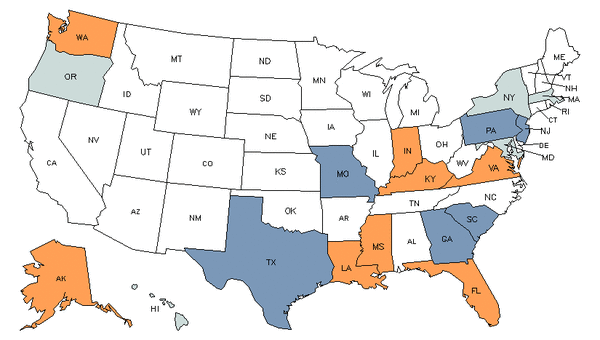
Demand

Core Tasks
- Monitor engine, machinery, or equipment indicators when vessels are underway, and report abnormalities to appropriate shipboard staff.
- Monitor the availability, use, or condition of lifesaving equipment or pollution preventatives to ensure that international regulations are followed.
- Monitor and test operations of engines or other equipment so that malfunctions and their causes can be identified.
- Start engines to propel ships, and regulate engines and power transmissions to control speeds of ships, according to directions from captains or bridge computers.
- Perform or participate in emergency drills, as required.
- Perform general marine vessel maintenance or repair work, such as repairing leaks, finishing interiors, refueling, or maintaining decks.
- Maintain complete records of engineering department activities, including machine operations.
- Maintain or repair engines, electric motors, pumps, winches, or other mechanical or electrical equipment, or assist other crew members with maintenance or repair duties.
- Operate or maintain off-loading liquid pumps or valves.
- Install engine controls, propeller shafts, or propellers.
- Maintain electrical power, heating, ventilation, refrigeration, water, or sewerage systems.
- Clean engine parts and keep engine rooms clean.
- Record orders for changes in ship speed or direction, and note gauge readings or test data, such as revolutions per minute or voltage output, in engineering logs or bellbooks.
- Act as a liaison between a ship's captain and shore personnel to ensure that schedules and budgets are maintained and that the ship is operated safely and efficiently.
- Order and receive engine room stores, such as oil or spare parts, maintain inventories, and record usage of supplies.
- Supervise marine engine technicians engaged in the maintenance or repair of mechanical or electrical marine vessels, and inspect their work to ensure that it is performed properly.
- Fabricate engine replacement parts, such as valves, stay rods, or bolts, using metalworking machinery.
Technology Skills
Technology
Example
Hot Technology
Tools Used
Tool
Example
Top 10 Knowledge Required
Mechanical
91%
Knowledge of machines and tools, including their designs, uses, repair, and maintenance.
Engineering and Technology
71%
Knowledge of the practical application of engineering science and technology. This includes applying principles, techniques, procedures, and equipment to the design and production of various goods and services.
English Language
71%
Knowledge of the structure and content of the English language including the meaning and spelling of words, and rules of composition and grammar.
Public Safety and Security
70%
Knowledge of relevant equipment, policies, procedures, and strategies to promote effective local, state, or national security operations for the protection of people, data, property, and institutions.
Transportation
66%
Knowledge of principles and methods for moving people or goods by air, rail, sea, or road, including the relative costs and benefits.
Mathematics
65%
Knowledge of arithmetic, algebra, geometry, calculus, statistics, and their applications.
Computers and Electronics
64%
Knowledge of circuit boards, processors, chips, electronic equipment, and computer hardware and software, including applications and programming.
Building and Construction
60%
Knowledge of materials, methods, and the tools involved in the construction or repair of houses, buildings, or other structures such as highways and roads.
Administration and Management
59%
Knowledge of business and management principles involved in strategic planning, resource allocation, human resources modeling, leadership technique, production methods, and coordination of people and resources.
Chemistry
56%
Knowledge of the chemical composition, structure, and properties of substances and of the chemical processes and transformations that they undergo. This includes uses of chemicals and their interactions, danger signs, production techniques, and disposal methods.
Top 10 Skills
Critical Thinking
78%
Using logic and reasoning to identify the strengths and weaknesses of alternative solutions, conclusions, or approaches to problems.
Operation and Control
78%
Controlling operations of equipment or systems.
Operations Monitoring
78%
Watching gauges, dials, or other indicators to make sure a machine is working properly.
Equipment Maintenance
75%
Performing routine maintenance on equipment and determining when and what kind of maintenance is needed.
Repairing
75%
Repairing machines or systems using the needed tools.
Troubleshooting
75%
Determining causes of operating errors and deciding what to do about it.
Active Listening
73%
Giving full attention to what other people are saying, taking time to understand the points being made, asking questions as appropriate, and not interrupting at inappropriate times.
Monitoring
73%
Monitoring/Assessing performance of yourself, other individuals, or organizations to make improvements or take corrective action.
Speaking
70%
Talking to others to convey information effectively.
Complex Problem Solving
68%
Identifying complex problems and reviewing related information to develop and evaluate options and implement solutions.
Top 10 Abilities
Deductive Reasoning
80%
The ability to apply general rules to specific problems to produce answers that make sense.
Oral Comprehension
80%
The ability to listen to and understand information and ideas presented through spoken words and sentences.
Oral Expression
80%
The ability to communicate information and ideas in speaking so others will understand.
Problem Sensitivity
80%
The ability to tell when something is wrong or is likely to go wrong. It does not involve solving the problem, only recognizing that there is a problem.
Control Precision
73%
The ability to quickly and repeatedly adjust the controls of a machine or a vehicle to exact positions.
Near Vision
73%
The ability to see details at close range (within a few feet of the observer).
Written Comprehension
73%
The ability to read and understand information and ideas presented in writing.
Speech Clarity
70%
The ability to speak clearly so others can understand you.
Speech Recognition
68%
The ability to identify and understand the speech of another person.
Inductive Reasoning
65%
The ability to combine pieces of information to form general rules or conclusions (includes finding a relationship among seemingly unrelated events).
Top 10 Work Activities
Repairing and Maintaining Mechanical Equipment
94%
Servicing, repairing, adjusting, and testing machines, devices, moving parts, and equipment that operate primarily on the basis of mechanical (not electronic) principles.
Identifying Objects, Actions, and Events
92%
Identifying information by categorizing, estimating, recognizing differences or similarities, and detecting changes in circumstances or events.
Making Decisions and Solving Problems
90%
Analyzing information and evaluating results to choose the best solution and solve problems.
Controlling Machines and Processes
87%
Using either control mechanisms or direct physical activity to operate machines or processes (not including computers or vehicles).
Getting Information
86%
Observing, receiving, and otherwise obtaining information from all relevant sources.
Inspecting Equipment, Structures, or Materials
86%
Inspecting equipment, structures, or materials to identify the cause of errors or other problems or defects.
Monitoring Processes, Materials, or Surroundings
86%
Monitoring and reviewing information from materials, events, or the environment, to detect or assess problems.
Operating Vehicles, Mechanized Devices, or Equipment
84%
Running, maneuvering, navigating, or driving vehicles or mechanized equipment, such as forklifts, passenger vehicles, aircraft, or watercraft.
Evaluating Information to Determine Compliance with Standards
81%
Using relevant information and individual judgment to determine whether events or processes comply with laws, regulations, or standards.
Communicating with Supervisors, Peers, or Subordinates
80%
Providing information to supervisors, co-workers, and subordinates by telephone, in written form, e-mail, or in person.
Detailed Work Activities
- Monitor engine operation or functioning.
- Report vehicle or equipment malfunctions.
- Monitor availability of equipment or supplies.
- Operate ships or other watercraft.
- Direct emergency management activities.
- Maintain watercraft engines or machinery.
- Record operational or production data.
- Control pumps or pumping equipment.
- Install parts, assemblies, or attachments in transportation or material handling equipment.
- Clean facilities or work areas.
- Clean machinery or equipment.
- Record operational details of travel.
- Acquire supplies or equipment.
- Communicate with others to coordinate vehicle movement.
- Direct maintenance or repair activities.
- Fabricate products or components using machine tools.
Education
Interests
Realistic
94%
Work involves designing, building, or repairing of equipment, materials, or structures, engaging in physical activity, or working outdoors. Realistic occupations are often associated with engineering, mechanics and electronics, construction, woodworking, transportation, machine operation, agriculture, animal services, physical or manual labor, athletics, or protective services.
Conventional
68%
Work involves following procedures and regulations to organize information or data, typically in a business setting. Conventional occupations are often associated with office work, accounting, mathematics/statistics, information technology, finance, or human resources.
Enterprising
53%
Work involves managing, negotiating, marketing, or selling, typically in a business setting, or leading or advising people in political and legal situations. Enterprising occupations are often associated with business initiatives, sales, marketing/advertising, finance, management/administration, professional advising, public speaking, politics, or law.
Investigative
51%
Work involves studying and researching non-living objects, living organisms, disease or other forms of impairment, or human behavior. Investigative occupations are often associated with physical, life, medical, or social sciences, and can be found in the fields of humanities, mathematics/statistics, information technology, or health care service.
Social
26%
Work involves helping, teaching, advising, assisting, or providing service to others. Social occupations are often associated with social, health care, personal service, teaching/education, or religious activities.
Artistic
15%
Work involves creating original visual artwork, performances, written works, food, or music for a variety of media, or applying artistic principles to the design of various objects and materials. Artistic occupations are often associated with visual arts, applied arts and design, performing arts, music, creative writing, media, or culinary art.
Work Values
Independence
72%
Occupations that satisfy this work value allow employees to work on their own and make decisions. Corresponding needs are Creativity, Responsibility and Autonomy.
Relationships
72%
Occupations that satisfy this work value allow employees to provide service to others and work with co-workers in a friendly non-competitive environment. Corresponding needs are Co-workers, Moral Values and Social Service.
Support
72%
Occupations that satisfy this work value offer supportive management that stands behind employees. Corresponding needs are Company Policies, Supervision: Human Relations and Supervision: Technical.
Achievement
67%
Occupations that satisfy this work value are results oriented and allow employees to use their strongest abilities, giving them a feeling of accomplishment. Corresponding needs are Ability Utilization and Achievement.
Recognition
67%
Occupations that satisfy this work value offer advancement, potential for leadership, and are often considered prestigious. Corresponding needs are Advancement, Authority, Recognition and Social Status.
Working Conditions
60%
Occupations that satisfy this work value offer job security and good working conditions. Corresponding needs are Activity, Compensation, Independence, Security, Variety and Working Conditions.