Agriculture for Business Majors
SaveWhile the field of business is broad and its niches in project management, communication, accounting, marketing, etc. encompass many skillsets, they all have viable applications in the development and sustainability of farm operations.

For folks outside of the practice or field itself, agriculture can seem like a very simple process. Put seeds in the ground, water the seeds, harvest the end-product, and occasionally ride around in a tractor. If you have animals, feed them too and give them lots of love so they stay on their best behavior. During even the best seasons, this is an extremely simplified run down of operations, and even to have a season this smooth takes a lot of prep of the land beforehand. For example, the soil for growing produce may not be perfectly arable, and may need some tilling or added nutrients to provide the best growing conditions. Even then, healthy soil is vehicle for growth not just for the desired produce, but for weeds as well.
And then with healthy crops, farmers have to wonder what other beings besides humans might want to munch on the goods and well… you can see where it goes from here. Even after the harvest, a magical line doesn't just appear outside of the farm gates offering equitable rates or trades for the harvested goods, guaranteeing the farmers a sustainable living. Even when pouring into the most nutritious and beautiful produce, being connected to a strong and sustained market can make or break the livelihood of a farmer. In short, a successful farm operation requires a varied skillset. When you apply this to rise of urban farming to address the needs of communities impacted by food apartheid and the fact that for as long as humans inhabit this Earth they will need to consume food to fuel their bodies, a career in agriculture remains wise to consider. Have you taken the time to think about how your major might play a role in sustaining food for communities? If not, keep reading to see if you have any of these skillsets or are interested in gaining them!
Business
Agriculture has a reputation for being a physical profession and practice. For any agriculture endeavor to sustain itself financially, it must have some kind of business plan. This includes setting up a budget before the season starts to ensure all the seeds and equipment can be ordered, allotting for labor costs, budgeting for error but also land remediation after extreme weather events, or pest disturbances. On the other side of planning, a business skillset in urban agriculture lends to engaging with a consumer marker. This includes understanding how to price produce, potentially offering a sliding scale for equity and accessibility, or even differentiating wholesale prices based on local market competition. Understanding these numbers, and using them as support to guide the production for any given season is key to keeping operations in order without spending more than is available.
Business in Community Connections
In thinking through business structures for sustained community support, Community Supported Agriculture is a known method for allowing interested members provide financial support before the growing season exchange for farm shares during the peak growing season. These funds would be used to purchase seeds and necessary equipment to kick off the growing season, and the harvests from these initial investments are the returns offered. If this model is unfamiliar to the farm manager or greater community members, the ability to strategically communicate and advertise this option can pull from the business skillset of modeling and financial projections while integrating understandings of social impact and/or impact investing.
To be realistic in balancing community support with other forms of financial stability, an accounting perspective may even need to come into play to ensure the proposed model can self-sustain for multiple seasons or cycles and scale appropriately across the span of time. As agriculture is sought for sustenance and utilized as a tool of resilience and community control in response to discriminatory policies barring access to healthy foods, cooperative ownership and business models have a role in distributing the power of production within the community whose needs are being met. While this realm of business may be considered alternative to some, the history and structures of cooperative ownership are robust, date back a long time, and takes lots of coordination across multiple partners to establish.
Expanded Business Fields and Skillsets
Related skillsets that also come out of the field of business include project management, communications, and marketing. As most building these skillsets understand, they can be applied to almost any operational process, but especially when it comes to urban farming and intentional community engagement, that project management lens can be applied to streamlining opportunities for communication and engagement that balances fair access for the community and delegation for the staff's other operations in managing the farm space. Communicating expectations internally and externally, across staff, partners, and other community members in a uniform fashion comes from a skillset related to the business field, and translates to the greater realm of branding, and marketing as well.
Many farms today that are making intentional connections to community for increased access are working towards the goal of food sovereignty. This takes one step beyond securing access to fresh food, and emphasizes the knowledge to reproduce systems of growing on reasonable scaled for community members, and also the knowledge to prepare and utilize the produce delivered in a way that is most nutrient dense to the end consumer/community member. This line of thinking in its own is in stark contrast from the dominant narrative around food access currently, and requires intentional points of connection to understand the present narrative, challenge it within contexts that make sense for communities, and distribute adequate knowledge and resources to drive this change within a network. Through a distributed newsletter, door to door campaigns, or series of community meetings, building a forward movement to redistribute power and control in food systems will take a long-term coordinated effort, with expertise outside physically growing food.
While the field of business is broad and its niches in project management, communication, accounting, marketing, etc. encompass many skillsets, they all have viable applications in the development and sustainability of farm operations, whether urban or rural. Think about the current projects or framings offered in your business courses currently. How might you integrate the future of agriculture or equitable food systems within your expansion of business knowledge in your academic journey?
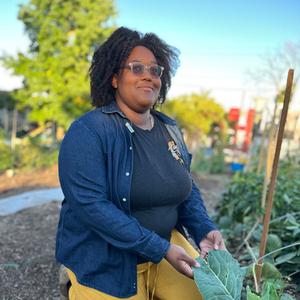
Justina Thompson
Justina "Farmer J" Thompson is the Farm Education and Volunteer Manager at Urban Creators, Philadelphia, PA. Justina intentionally attended school in Philadelphia so she could “connect her passion and experience to the ongoing environmental justice work in the area.” As a speaker, educational curriculum designer, program leader, and community organizer, Justina possesses extensive knowledge on urban farming inspired to work in the field of environmental justice from a young age.Articles & Advice
Featured Articles from The SAGE Scholars Benefit

Preplanning for College

College School Supplies
