As the conversation shifts from sustainability to environmental justice, it's important to take that moment and pause to understand what the transition actually entails. The environmental justice movement is able to hold many nuances that take time and repeated exposure to understand with depth, but an introduction like what will follow is a great way to get a glimpse of the landscape. With education as the foundation for the next generation of leaders, dreamers, and innovators who will address societies complex issues, continuous space to learn and engage with the branches of these issues while still in school supports a broader sense of knowledge and smoother application of skillsets outside the academic space.
The science birthed from academia has always proven to us time and time again that the environmental degradation we're seeing to the world around us is at a level that must be addresses if we want to prevent collapse and disaster of the systems we know today. The science has also already proven that the environment has so many gifts to offer us and that we can exist in relationship with the Earth in harmonious ways. Especially as we make space for global indigenous stewardship practices in our sustainability frameworks, we understand so much is possible, and so much work has to be done. And this work, needs to center repairing harm done to the Earth and frontline communities who have both been resisting.
Where We Are
The next question for us to ask then in the academic space is how do we do this work? How do we make scientific knowledge accessible and digestible to community people? How do we co-educate and coordinate strategies and activation to do the work? How do we work across fields and sectors for comprehensive and unified approaches? The work of convening and translating what's been published thus far is the task for the training academics today. Brining these lines of work together is crucial because the answers to enact environmental justice must come from an intersectional lens. The harm that has led to the current circumstances was done across many spheres of community and will need economic justice, racial justice, gender justice, and queer justice among other equity-based frameworks to bring the futures we need forward.
Environmental justice can be explored in about four general realms, and these include Land, Food, Air, and Water, understanding areas of overlap and exceptions. Introducing these four spheres within the realm of justice and giving academic connections for advancement among them may be a good starting point for infusing some of these perspectives into your academic journey.
Land
Land is an all-encompassing question of justice, starting from the framework of ownership itself. This is often the goal for 'security' and protection of interests within given barriers, but is rooted in many harmful colonial ideologies, beginning with conquer and acquisition. Indigenous guidance offers stewardship to see relationship with the Earth: one of care, mutual understanding, and rest between humans and nature.
Environmental Justice begins to look at how relationships with the earth and its people can be repaired. This includes access to and grounded knowledge about surrounding environments and their natural resources, and harvesting for sustenance through restorative practices. Green spaces and protected waterfronts that community members can enjoy are often set afar from low-income communities and communities of color, and are sometimes even inaccessible by public transportation. This inequitable access directly correlates to lack of familiarity with the natural environment.
Within other, less equitable systems which still require navigation, barriers to ownership from the past and present such as redlining, and blight designations need to be examined. This is to understand how racism and its biased and prejudice tendencies have shaped structural inequalities in neighborhood and community access today. Exclusionary loan practices under redlining are still reflected in essence today when we look at policies around vacant lots, land auctions, sheriff's sales and general favor towards development and gentrification. Community members who have been living and investing inter neighborhoods are not receiving the same access to long term protection over lands they live and steward within and are often in jeopardy of losing access due to external and financial pressures.
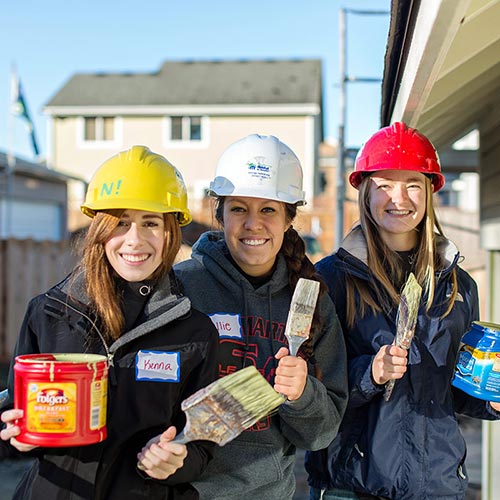
Finally, when we consider the physicality of the land itself, contamination of soils is a persistent threat to individual and community health, especially as it relates to paths towards sovereignty. At times, low-income neighborhoods can be known to be stuck in 'time loops' and due to lack of financial investment, are left with old and often decaying infrastructures from decades past throughout the communities. Lead has a common presence in household paint, pencils, and even children's toys before it was understood to be toxics and have damaging affects like lower IQ for young children with exposure. Due to lack of investment or funds for community-based research, repair and remediation, many of these communities are still impacted today with lead in their homes and in surrounding community soils, especially as houses are demolished for redevelopment in rapidly gentrifying neighborhoods.
A Holistic Focus
As the issue has grown to span to have so many branches of negative impact on communities, it will similarly require multiple approaches from different angles to give holistic attention. This also means the skills required to address this harm will span across academic fields, so there are many ways to get educated and involved. Architecture, City and Urban Planning, Design, and related fields will be needed to guide processes that prioritize equity and access, when it comes to green and blue spaces, when it comes to tree coverage, and when it comes to public transportation as well.
Law, specifically Environmental Law and Housing Law, will be required skillsets when it comes to navigating legal protections over green and blue spaces, making sense of eminent domain for residents whose homes may be under threat due to its use, and even helping residents navigate tangled titles and deeds, or other spaces around their home and land ownership. Beyond this, a law perspective can be helpful in setting up alternative structures for community support, such as a community land bank or community land trust, where cooperative ownership can keep land exchange more affordable for invested community members.
Science, Technology, Data, and the Social Sciences surrounding them will be able to drive participatory action research models that center community knowledge and processes and citizen science to keep accurate data (quantitative and qualitative) regarding residents' experiences, and using it to drive action in the institutional and community systems.
Food
Food is directly tied to land in a lot of ways and the justice-based issues around it regarding transportation and access, but translated to the production of food and distribution, especially to communities most in need. After the land, labor is most central to this harm we see around food. A lot of immigrant labor is used to drive agricultural operations today, and this is just a slightly altered system from the enslavement and sharecropping we know drove the economic foundation of America. For goods that are imported, lack of labor regulations abroad can result in actual enslavement and other labor violations till playing key parts in our greater food system in the present.
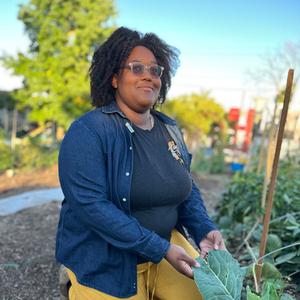
This international food exchange emits a series of harmful emissions into the atmosphere from flights, boats, and trucks moving produce to consumer retrieval points. With local food systems, regionally operating in complement with each other, consumers can have access to their staple dietary needs, potentially even fibers and furniture too, with the potential for real relationship and connection with the producers themselves, driving a circular economy and foundation for equitable pay in these fields. And for needs not able to be met in this regional economy, coordinating larger collective orders and splitting the bulk expands access with a less harmful impact from emissions on the environment. Localized systems can also redirect power to the community level by encouraged sovereign growing practices and sharing amongst neighbors. Looking at community gardens and urban farms, we see examples of these possibilities.
Students focusing on policy will be able to lay a track within systems for potential collaboration and development of a regional and circular support. Business and economics majors will be crucial is supporting the models with data and numbers and also using imagination to adjust the systems they may be taught about to best serve the needs of society today. Of course, natural science and agriculture majors will be able to support conditions for growth at these local levels and advise around the most sustainable growing methods that are reparative to the land and preventing future harm to the surrounding communities.
Black and Indigenous Perspectives
As we're discussing knowledge-based journeys and skillsets to embody this justice-oriented frameworks for the environment, it's essential to call in Black and Indigenous land stewardship practices as key guides for how to do this work in harmony with the Earth and community moving forward.
Sankofa is the African-based belief of relating to the lessons of the past and bringing into the present and future. It requires being connected to history of the past, often through intergenerational relationships and storytelling, and keeping those practices close even as growth into new eras occurs. As the word is broken down, (san) means to return, (ka) means to engage, and (fa) means to bring it here. When related to the practice of growing food, we can turn to Indigenous methods of growing corn beans and squash together for mutual benefit, or the teachings of George Washington Carver around rotating crops to prevent pests and soil depletion as guidance to keep close as the need for reparative and localized food growing grows into the future. This is important in academia especially, intentionally looking for sources that call in alternative forms of knowledge besides the typical white cis-het perspective will give a more nuanced understanding of how to center justice in these efforts moving forward.
Not all professors will have direct access to sources from Black and Indigenous communities and their intersections, but this is an important challenge pursue in the learning space. As communities may look to their ancestors for guidance and knowledge beyond the realm, this and other intuitive knowledge sources are important to make room for in academic spaces where justice is in pursuit.
Intentionally intergenerational learning spaces are key for keeping the community elders connected to the youth so they can continuously exchange experiences and perspectives to strengthen the community holistically. Experience-based wisdom when met with curious imagination is a powerful formula for innovation and community investment. This also allows for transfer of traditions and rituals, and sustained connection between past and future generations through a lineage. Next time you're skimming through a syllabus or engaging in class, ask yourself if there are experienced-based elders in the realm that could offer a new or additional perspective to what you're learning in the classroom!