Food Service Managers
Overview
SaveJob Zone Two: Some Preparation Needed
Experience
Some previous work-related skill, knowledge, or experience is usually needed. For example, a teller would benefit from experience working directly with the public.
Education
These occupations usually require a high school diploma.
Job Training
Employees in these occupations need anywhere from a few months to one year of working with experienced employees. A recognized apprenticeship program may be associated with these occupations.
Examples
These occupations often involve using your knowledge and skills to help others. Examples include orderlies, counter and rental clerks, customer service representatives, security guards, upholsterers, tellers, and dental laboratory technicians.
Plan, direct, or coordinate activities of an organization or department that serves food and beverages.

Yearly Salary
| High: | $94K |
| Median: | $56K |
| Low: | $33K |
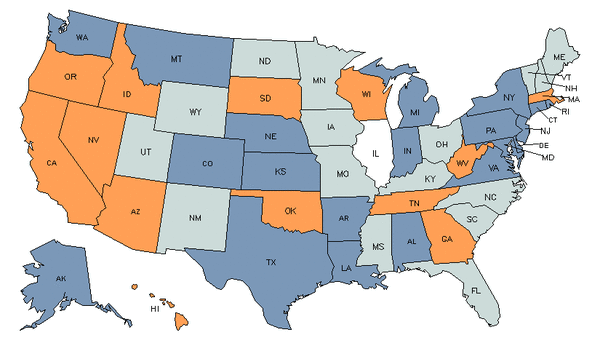
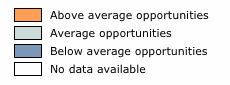
Demand
Core Tasks
- Monitor employee and patron activities to ensure liquor regulations are obeyed.
- Greet guests, escort them to their seats, and present them with menus and wine lists.
- Count money and make bank deposits.
- Establish standards for personnel performance and customer service.
- Keep records required by government agencies regarding sanitation or food subsidies.
- Schedule staff hours and assign duties.
- Investigate and resolve complaints regarding food quality, service, or accommodations.
- Maintain food and equipment inventories, and keep inventory records.
- Coordinate assignments of cooking personnel to ensure economical use of food and timely preparation.
- Monitor budgets and payroll records, and review financial transactions to ensure that expenditures are authorized and budgeted.
- Perform some food preparation or service tasks, such as cooking, clearing tables, and serving food and drinks when necessary.
- Schedule and receive food and beverage deliveries, checking delivery contents to verify product quality and quantity.
- Organize and direct worker training programs, resolve personnel problems, hire new staff, and evaluate employee performance in dining and lodging facilities.
- Assess staffing needs and recruit staff, using methods such as newspaper advertisements or attendance at job fairs.
- Estimate food, liquor, wine, and other beverage consumption to anticipate amounts to be purchased or requisitioned.
- Monitor food preparation methods, portion sizes, and garnishing and presentation of food to ensure that food is prepared and presented in an acceptable manner.
- Monitor compliance with health and fire regulations regarding food preparation and serving, and building maintenance in lodging and dining facilities.
- Order and purchase equipment and supplies.
- Test cooked food by tasting and smelling it to ensure palatability and flavor conformity.
- Review work procedures and operational problems to determine ways to improve service, performance, or safety.
- Arrange for equipment maintenance and repairs, and coordinate a variety of services, such as waste removal and pest control.
- Record the number, type, and cost of items sold to determine which items may be unpopular or less profitable.
- Plan menus and food utilization, based on anticipated number of guests, nutritional value, palatability, popularity, and costs.
- Review menus and analyze recipes to determine labor and overhead costs, and assign prices to menu items.
- Take dining reservations.
- Create specialty dishes and develop recipes to be used in dining facilities.
- Schedule use of facilities or catering services for events such as banquets or receptions, and negotiate details of arrangements with clients.
- Establish and enforce nutritional standards for dining establishments, based on accepted industry standards.
Technology Skills
Technology
Example
Hot Technology
Tools Used
Tool
Example
Top 10 Knowledge Required
Customer and Personal Service
91%
Knowledge of principles and processes for providing customer and personal services. This includes customer needs assessment, meeting quality standards for services, and evaluation of customer satisfaction.
Administration and Management
82%
Knowledge of business and management principles involved in strategic planning, resource allocation, human resources modeling, leadership technique, production methods, and coordination of people and resources.
Food Production
79%
Knowledge of techniques and equipment for planting, growing, and harvesting food products (both plant and animal) for consumption, including storage/handling techniques.
English Language
71%
Knowledge of the structure and content of the English language including the meaning and spelling of words, and rules of composition and grammar.
Personnel and Human Resources
70%
Knowledge of principles and procedures for personnel recruitment, selection, training, compensation and benefits, labor relations and negotiation, and personnel information systems.
Sales and Marketing
69%
Knowledge of principles and methods for showing, promoting, and selling products or services. This includes marketing strategy and tactics, product demonstration, sales techniques, and sales control systems.
Mathematics
68%
Knowledge of arithmetic, algebra, geometry, calculus, statistics, and their applications.
Administrative
66%
Knowledge of administrative and office procedures and systems such as word processing, managing files and records, stenography and transcription, designing forms, and workplace terminology.
Production and Processing
65%
Knowledge of raw materials, production processes, quality control, costs, and other techniques for maximizing the effective manufacture and distribution of goods.
Education and Training
63%
Knowledge of principles and methods for curriculum and training design, teaching and instruction for individuals and groups, and the measurement of training effects.
Top 10 Skills
Active Listening
78%
Giving full attention to what other people are saying, taking time to understand the points being made, asking questions as appropriate, and not interrupting at inappropriate times.
Coordination
78%
Adjusting actions in relation to others' actions.
Management of Personnel Resources
78%
Motivating, developing, and directing people as they work, identifying the best people for the job.
Monitoring
78%
Monitoring/Assessing performance of yourself, other individuals, or organizations to make improvements or take corrective action.
Speaking
78%
Talking to others to convey information effectively.
Reading Comprehension
75%
Understanding written sentences and paragraphs in work-related documents.
Service Orientation
75%
Actively looking for ways to help people.
Critical Thinking
73%
Using logic and reasoning to identify the strengths and weaknesses of alternative solutions, conclusions, or approaches to problems.
Social Perceptiveness
73%
Being aware of others' reactions and understanding why they react as they do.
Time Management
70%
Managing one's own time and the time of others.
Top 10 Abilities
Deductive Reasoning
78%
The ability to apply general rules to specific problems to produce answers that make sense.
Oral Comprehension
78%
The ability to listen to and understand information and ideas presented through spoken words and sentences.
Oral Expression
78%
The ability to communicate information and ideas in speaking so others will understand.
Problem Sensitivity
78%
The ability to tell when something is wrong or is likely to go wrong. It does not involve solving the problem, only recognizing that there is a problem.
Written Comprehension
78%
The ability to read and understand information and ideas presented in writing.
Speech Clarity
75%
The ability to speak clearly so others can understand you.
Near Vision
63%
The ability to see details at close range (within a few feet of the observer).
Selective Attention
63%
The ability to concentrate on a task over a period of time without being distracted.
Speech Recognition
63%
The ability to identify and understand the speech of another person.
Category Flexibility
60%
The ability to generate or use different sets of rules for combining or grouping things in different ways.
Top 10 Work Activities
Identifying Objects, Actions, and Events
88%
Identifying information by categorizing, estimating, recognizing differences or similarities, and detecting changes in circumstances or events.
Getting Information
86%
Observing, receiving, and otherwise obtaining information from all relevant sources.
Making Decisions and Solving Problems
85%
Analyzing information and evaluating results to choose the best solution and solve problems.
Coaching and Developing Others
84%
Identifying the developmental needs of others and coaching, mentoring, or otherwise helping others to improve their knowledge or skills.
Training and Teaching Others
83%
Identifying the educational needs of others, developing formal educational or training programs or classes, and teaching or instructing others.
Coordinating the Work and Activities of Others
81%
Getting members of a group to work together to accomplish tasks.
Establishing and Maintaining Interpersonal Relationships
81%
Developing constructive and cooperative working relationships with others, and maintaining them over time.
Evaluating Information to Determine Compliance with Standards
81%
Using relevant information and individual judgment to determine whether events or processes comply with laws, regulations, or standards.
Communicating with Supervisors, Peers, or Subordinates
80%
Providing information to supervisors, co-workers, and subordinates by telephone, in written form, e-mail, or in person.
Inspecting Equipment, Structures, or Materials
80%
Inspecting equipment, structures, or materials to identify the cause of errors or other problems or defects.
Detailed Work Activities
- Collect payments for goods or services.
- Develop organizational policies or programs.
- Maintain regulatory or compliance documentation.
- Prepare staff schedules or work assignments.
- Resolve customer complaints or problems.
- Maintain operational records.
- Manage inventories of products or organizational resources.
- Perform manual service or maintenance tasks.
- Manage organizational or project budgets.
- Evaluate quality of materials or products.
- Schedule product or material transportation.
- Manage guest services.
- Evaluate employee performance.
- Manage human resources activities.
- Determine resource needs.
- Recruit personnel.
- Estimate cost or material requirements.
- Monitor organizational procedures to ensure proper functioning.
- Monitor organizational compliance with regulations.
- Purchase materials, equipment, or other resources.
- Analyze data to inform operational decisions or activities.
- Recommend organizational process or policy changes.
- Direct facility maintenance or repair activities.
- Monitor activities of individuals to ensure safety or compliance with rules.
- Provide basic information to guests, visitors, or clients.
- Schedule dining reservations.
- Arrange services or reservations for patrons.
- Create new recipes or food presentations.
- Plan menu options.
- Schedule activities or facility use.
- Negotiate sales or lease agreements for products or services.
- Advise communities or institutions regarding health or safety issues.
Education
Interests
Enterprising
85%
Work involves managing, negotiating, marketing, or selling, typically in a business setting, or leading or advising people in political and legal situations. Enterprising occupations are often associated with business initiatives, sales, marketing/advertising, finance, management/administration, professional advising, public speaking, politics, or law.
Conventional
76%
Work involves following procedures and regulations to organize information or data, typically in a business setting. Conventional occupations are often associated with office work, accounting, mathematics/statistics, information technology, finance, or human resources.
Realistic
57%
Work involves designing, building, or repairing of equipment, materials, or structures, engaging in physical activity, or working outdoors. Realistic occupations are often associated with engineering, mechanics and electronics, construction, woodworking, transportation, machine operation, agriculture, animal services, physical or manual labor, athletics, or protective services.
Social
51%
Work involves helping, teaching, advising, assisting, or providing service to others. Social occupations are often associated with social, health care, personal service, teaching/education, or religious activities.
Investigative
27%
Work involves studying and researching non-living objects, living organisms, disease or other forms of impairment, or human behavior. Investigative occupations are often associated with physical, life, medical, or social sciences, and can be found in the fields of humanities, mathematics/statistics, information technology, or health care service.
Artistic
23%
Work involves creating original visual artwork, performances, written works, food, or music for a variety of media, or applying artistic principles to the design of various objects and materials. Artistic occupations are often associated with visual arts, applied arts and design, performing arts, music, creative writing, media, or culinary art.
Work Values
Independence
81%
Occupations that satisfy this work value allow employees to work on their own and make decisions. Corresponding needs are Creativity, Responsibility and Autonomy.
Relationships
67%
Occupations that satisfy this work value allow employees to provide service to others and work with co-workers in a friendly non-competitive environment. Corresponding needs are Co-workers, Moral Values and Social Service.
Support
67%
Occupations that satisfy this work value offer supportive management that stands behind employees. Corresponding needs are Company Policies, Supervision: Human Relations and Supervision: Technical.
Working Conditions
65%
Occupations that satisfy this work value offer job security and good working conditions. Corresponding needs are Activity, Compensation, Independence, Security, Variety and Working Conditions.
Achievement
62%
Occupations that satisfy this work value are results oriented and allow employees to use their strongest abilities, giving them a feeling of accomplishment. Corresponding needs are Ability Utilization and Achievement.
Recognition
62%
Occupations that satisfy this work value offer advancement, potential for leadership, and are often considered prestigious. Corresponding needs are Advancement, Authority, Recognition and Social Status.