Manufacturing Engineers
Overview
SaveJob Zone Four: Considerable Preparation Needed
Experience
A considerable amount of work-related skill, knowledge, or experience is needed for these occupations. For example, an accountant must complete four years of college and work for several years in accounting to be considered qualified.
Education
Most of these occupations require a four-year bachelor's degree, but some do not.
Job Training
Employees in these occupations usually need several years of work-related experience, on-the-job training, and/or vocational training.
Examples
Many of these occupations involve coordinating, supervising, managing, or training others. Examples include real estate brokers, sales managers, database administrators, graphic designers, conservation scientists, art directors, and cost estimators.
Design, integrate, or improve manufacturing systems or related processes. May work with commercial or industrial designers to refine product designs to increase producibility and decrease costs.

Yearly Salary
| High: | $136K |
| Median: | $88K |
| Low: | $57K |
Demand
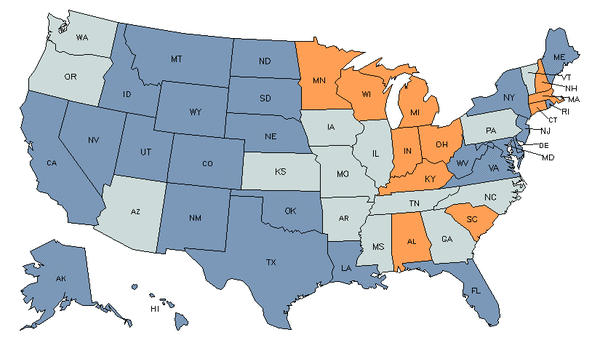
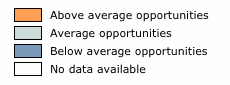
Core Tasks
- Troubleshoot new or existing product problems involving designs, materials, or processes.
- Investigate or resolve operational problems, such as material use variances or bottlenecks.
- Apply continuous improvement methods, such as lean manufacturing, to enhance manufacturing quality, reliability, or cost-effectiveness.
- Identify opportunities or implement changes to improve manufacturing processes or products or to reduce costs, using knowledge of fabrication processes, tooling and production equipment, assembly methods, quality control standards, or product design, materials and parts.
- Provide technical expertise or support related to manufacturing.
- Incorporate new manufacturing methods or processes to improve existing operations.
- Determine root causes of failures or recommend changes in designs, tolerances, or processing methods, using statistical procedures.
- Review product designs for manufacturability or completeness.
- Prepare reports summarizing information or trends related to manufacturing performance.
- Communicate manufacturing capabilities, production schedules, or other information to facilitate production processes.
- Design layout of equipment or workspaces to achieve maximum efficiency.
- Prepare documentation for new manufacturing processes or engineering procedures.
- Design, install, or troubleshoot manufacturing equipment.
- Evaluate manufactured products according to specifications and quality standards.
- Supervise technicians, technologists, analysts, administrative staff, or other engineers.
- Estimate costs, production times, or staffing requirements for new designs.
- Train production personnel in new or existing methods.
- Design tests of finished products or process capabilities to establish standards or validate process requirements.
- Analyze the financial impacts of sustainable manufacturing processes or sustainable product manufacturing.
- Develop sustainable manufacturing technologies to reduce greenhouse gas emissions, minimize raw material use, replace toxic materials with non-toxic materials, replace non-renewable materials with renewable materials, or reduce waste.
- Purchase equipment, materials, or parts.
- Evaluate current or proposed manufacturing processes or practices for environmental sustainability, considering factors such as greenhouse gas emissions, air pollution, water pollution, energy use, or waste creation.
- Read current literature, talk with colleagues, participate in educational programs, attend meetings or workshops, or participate in professional organizations or conferences to keep abreast of developments in the manufacturing field.
- Redesign packaging for manufactured products to minimize raw material use or waste.
Technology Skills
Technology
Example
Hot Technology
Tools Used
Tool
Example
Top 10 Knowledge Required
Engineering and Technology
89%
Knowledge of the practical application of engineering science and technology. This includes applying principles, techniques, procedures, and equipment to the design and production of various goods and services.
Production and Processing
89%
Knowledge of raw materials, production processes, quality control, costs, and other techniques for maximizing the effective manufacture and distribution of goods.
Mechanical
82%
Knowledge of machines and tools, including their designs, uses, repair, and maintenance.
Design
80%
Knowledge of design techniques, tools, and principles involved in production of precision technical plans, blueprints, drawings, and models.
Mathematics
80%
Knowledge of arithmetic, algebra, geometry, calculus, statistics, and their applications.
Computers and Electronics
77%
Knowledge of circuit boards, processors, chips, electronic equipment, and computer hardware and software, including applications and programming.
English Language
76%
Knowledge of the structure and content of the English language including the meaning and spelling of words, and rules of composition and grammar.
Physics
69%
Knowledge and prediction of physical principles, laws, their interrelationships, and applications to understanding fluid, material, and atmospheric dynamics, and mechanical, electrical, atomic and sub-atomic structures and processes.
Administration and Management
65%
Knowledge of business and management principles involved in strategic planning, resource allocation, human resources modeling, leadership technique, production methods, and coordination of people and resources.
Education and Training
63%
Knowledge of principles and methods for curriculum and training design, teaching and instruction for individuals and groups, and the measurement of training effects.
Top 10 Skills
Complex Problem Solving
80%
Identifying complex problems and reviewing related information to develop and evaluate options and implement solutions.
Mathematics
80%
Using mathematics to solve problems.
Reading Comprehension
80%
Understanding written sentences and paragraphs in work-related documents.
Active Listening
78%
Giving full attention to what other people are saying, taking time to understand the points being made, asking questions as appropriate, and not interrupting at inappropriate times.
Judgment and Decision Making
78%
Considering the relative costs and benefits of potential actions to choose the most appropriate one.
Monitoring
78%
Monitoring/Assessing performance of yourself, other individuals, or organizations to make improvements or take corrective action.
Operations Monitoring
78%
Watching gauges, dials, or other indicators to make sure a machine is working properly.
Speaking
78%
Talking to others to convey information effectively.
Critical Thinking
75%
Using logic and reasoning to identify the strengths and weaknesses of alternative solutions, conclusions, or approaches to problems.
Systems Analysis
75%
Determining how a system should work and how changes in conditions, operations, and the environment will affect outcomes.
Top 10 Abilities
Category Flexibility
80%
The ability to generate or use different sets of rules for combining or grouping things in different ways.
Deductive Reasoning
80%
The ability to apply general rules to specific problems to produce answers that make sense.
Inductive Reasoning
80%
The ability to combine pieces of information to form general rules or conclusions (includes finding a relationship among seemingly unrelated events).
Near Vision
80%
The ability to see details at close range (within a few feet of the observer).
Oral Comprehension
80%
The ability to listen to and understand information and ideas presented through spoken words and sentences.
Problem Sensitivity
80%
The ability to tell when something is wrong or is likely to go wrong. It does not involve solving the problem, only recognizing that there is a problem.
Visualization
80%
The ability to imagine how something will look after it is moved around or when its parts are moved or rearranged.
Information Ordering
78%
The ability to arrange things or actions in a certain order or pattern according to a specific rule or set of rules (e.g., patterns of numbers, letters, words, pictures, mathematical operations).
Oral Expression
78%
The ability to communicate information and ideas in speaking so others will understand.
Written Comprehension
78%
The ability to read and understand information and ideas presented in writing.
Top 10 Work Activities
Making Decisions and Solving Problems
90%
Analyzing information and evaluating results to choose the best solution and solve problems.
Getting Information
87%
Observing, receiving, and otherwise obtaining information from all relevant sources.
Working with Computers
86%
Using computers and computer systems (including hardware and software) to program, write software, set up functions, enter data, or process information.
Analyzing Data or Information
85%
Identifying the underlying principles, reasons, or facts of information by breaking down information or data into separate parts.
Communicating with Supervisors, Peers, or Subordinates
85%
Providing information to supervisors, co-workers, and subordinates by telephone, in written form, e-mail, or in person.
Processing Information
84%
Compiling, coding, categorizing, calculating, tabulating, auditing, or verifying information or data.
Identifying Objects, Actions, and Events
83%
Identifying information by categorizing, estimating, recognizing differences or similarities, and detecting changes in circumstances or events.
Monitoring Processes, Materials, or Surroundings
82%
Monitoring and reviewing information from materials, events, or the environment, to detect or assess problems.
Drafting, Laying Out, and Specifying Technical Devices, Parts, and Equipment
81%
Providing documentation, detailed instructions, drawings, or specifications to tell others about how devices, parts, equipment, or structures are to be fabricated, constructed, assembled, modified, maintained, or used.
Documenting/Recording Information
80%
Entering, transcribing, recording, storing, or maintaining information in written or electronic/magnetic form.
Detailed Work Activities
- Determine causes of operational problems or failures.
- Analyze operational data to evaluate operations, processes or products.
- Resolve operational performance problems.
- Implement design or process improvements.
- Develop technical methods or processes.
- Determine operational methods.
- Provide technical guidance to other personnel.
- Design industrial processing systems.
- Evaluate designs or specifications to ensure quality.
- Recommend technical design or process changes to improve efficiency, quality, or performance.
- Prepare operational reports.
- Prepare procedural documents.
- Create graphical representations of industrial production systems.
- Confer with technical personnel to prepare designs or operational plans.
- Supervise production or support personnel.
- Design industrial equipment.
- Install production equipment or systems.
- Assess product or process usefulness.
- Estimate operational costs.
- Estimate technical or resource requirements for development or production projects.
- Estimate time requirements for development or production projects.
- Train personnel on proper operational procedures.
- Devise research or testing protocols.
- Analyze costs and benefits of proposed designs or projects.
- Purchase materials, equipment, or other resources.
- Investigate the environmental impact of projects.
- Update technical knowledge.
- Develop operational methods or processes that use green materials or emphasize sustainability.
Education
Interests
Realistic
74%
Work involves designing, building, or repairing of equipment, materials, or structures, engaging in physical activity, or working outdoors. Realistic occupations are often associated with engineering, mechanics and electronics, construction, woodworking, transportation, machine operation, agriculture, animal services, physical or manual labor, athletics, or protective services.
Investigative
67%
Work involves studying and researching non-living objects, living organisms, disease or other forms of impairment, or human behavior. Investigative occupations are often associated with physical, life, medical, or social sciences, and can be found in the fields of humanities, mathematics/statistics, information technology, or health care service.
Conventional
64%
Work involves following procedures and regulations to organize information or data, typically in a business setting. Conventional occupations are often associated with office work, accounting, mathematics/statistics, information technology, finance, or human resources.
Enterprising
44%
Work involves managing, negotiating, marketing, or selling, typically in a business setting, or leading or advising people in political and legal situations. Enterprising occupations are often associated with business initiatives, sales, marketing/advertising, finance, management/administration, professional advising, public speaking, politics, or law.
Artistic
30%
Work involves creating original visual artwork, performances, written works, food, or music for a variety of media, or applying artistic principles to the design of various objects and materials. Artistic occupations are often associated with visual arts, applied arts and design, performing arts, music, creative writing, media, or culinary art.
Social
22%
Work involves helping, teaching, advising, assisting, or providing service to others. Social occupations are often associated with social, health care, personal service, teaching/education, or religious activities.
Work Values
Working Conditions
79%
Occupations that satisfy this work value offer job security and good working conditions. Corresponding needs are Activity, Compensation, Independence, Security, Variety and Working Conditions.
Support
77%
Occupations that satisfy this work value offer supportive management that stands behind employees. Corresponding needs are Company Policies, Supervision: Human Relations and Supervision: Technical.
Independence
72%
Occupations that satisfy this work value allow employees to work on their own and make decisions. Corresponding needs are Creativity, Responsibility and Autonomy.
Recognition
72%
Occupations that satisfy this work value offer advancement, potential for leadership, and are often considered prestigious. Corresponding needs are Advancement, Authority, Recognition and Social Status.
Achievement
67%
Occupations that satisfy this work value are results oriented and allow employees to use their strongest abilities, giving them a feeling of accomplishment. Corresponding needs are Ability Utilization and Achievement.
Relationships
48%
Occupations that satisfy this work value allow employees to provide service to others and work with co-workers in a friendly non-competitive environment. Corresponding needs are Co-workers, Moral Values and Social Service.
Colleges
SAGE Scholars Member Schools that offer majors leading to this career.
Check out the College Search to see the full list of schools with majors for this career.