Library Technicians
Overview
SaveJob Zone Three: Medium Preparation Needed
Experience
Previous work-related skill, knowledge, or experience is required for these occupations. For example, an electrician must have completed three or four years of apprenticeship or several years of vocational training, and often must have passed a licensing exam, in order to perform the job.
Education
Most occupations in this zone require training in vocational schools, related on-the-job experience, or an associate's degree.
Job Training
Employees in these occupations usually need one or two years of training involving both on-the-job experience and informal training with experienced workers. A recognized apprenticeship program may be associated with these occupations.
Examples
These occupations usually involve using communication and organizational skills to coordinate, supervise, manage, or train others to accomplish goals. Examples include hydroelectric production managers, desktop publishers, electricians, agricultural technicians, barbers, court reporters and simultaneous captioners, and medical assistants.
Assist librarians by helping readers in the use of library catalogs, databases, and indexes to locate books and other materials; and by answering questions that require only brief consultation of standard reference. Compile records; sort and shelve books or other media; remove or repair damaged books or other media; register patrons; and check materials in and out of the circulation process. Replace materials in shelving area (stacks) or files. Includes bookmobile drivers who assist with providing services in mobile libraries.

Yearly Salary
| High: | $61K |
| Median: | $37K |
| Low: | $23K |
Demand
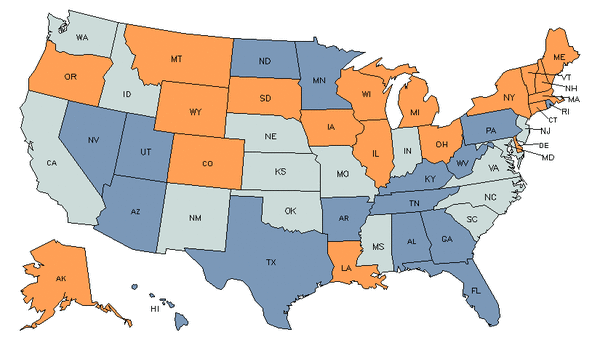

Core Tasks
- Reserve, circulate, renew, and discharge books and other materials.
- Answer routine telephone or in-person reference inquiries, referring patrons to librarians for further assistance, when necessary.
- Deliver and retrieve items throughout the library by hand or using pushcart.
- Help patrons find and use library resources, such as reference materials, audio-visual equipment, computers, and other electronic resources and provide technical assistance when needed.
- Process print and non-print library materials to prepare them for inclusion in library collections.
- Catalogue and sort books and other print and non-print materials according to procedure and return them to shelves, files, or other designated storage areas.
- Enter and update patrons' records on computers.
- Issue identification cards to borrowers.
- Provide assistance to teachers and students by locating materials and helping to complete special projects.
- Compile and maintain records relating to circulation, materials, and equipment.
- Take actions to halt disruption of library activities by problem patrons.
- Check for damaged library materials, such as books or audio-visual equipment, and provide replacements or make repairs.
- Maintain and troubleshoot problems with library equipment, including computers, photocopiers, and audio-visual equipment.
- Order all print and non-print library materials, checking prices, figuring costs, preparing order slips, and making payments.
- Process interlibrary loans for patrons.
- Review subject matter of materials to be classified and select classification numbers and headings according to classification systems.
- Collect fines and respond to complaints about fines.
- Send out notices about lost or overdue books.
- Retrieve information from central databases for storage in a library's computer.
- Conduct reference searches, using printed materials and in-house and online databases.
- Train other staff, volunteers, or student assistants and schedule and supervise their work.
- Verify bibliographical data for materials, including author, title, publisher, publication date, and edition.
- Plan and conduct children's programs, community outreach programs, and other specialized programs, such as library tours.
- Compile data and create statistical reports on library usage.
- Organize and maintain periodicals and reference materials.
- Claim missing issues of periodicals and journals.
- Design posters and special displays to promote use of library facilities or specific reading programs at libraries.
- Compose explanatory summaries of contents of books and other reference materials.
- Sort and deliver library mail and packages.
- Operate and maintain audio-visual equipment, such as projectors, tape recorders, and videocassette recorders.
- Compile bibliographies and prepare abstracts on subjects of interest to particular organizations or groups.
Technology Skills
Technology
Example
Hot Technology
Tools Used
Tool
Example
Top 10 Knowledge Required
Customer and Personal Service
82%
Knowledge of principles and processes for providing customer and personal services. This includes customer needs assessment, meeting quality standards for services, and evaluation of customer satisfaction.
English Language
77%
Knowledge of the structure and content of the English language including the meaning and spelling of words, and rules of composition and grammar.
Administrative
68%
Knowledge of administrative and office procedures and systems such as word processing, managing files and records, stenography and transcription, designing forms, and workplace terminology.
Computers and Electronics
66%
Knowledge of circuit boards, processors, chips, electronic equipment, and computer hardware and software, including applications and programming.
Education and Training
64%
Knowledge of principles and methods for curriculum and training design, teaching and instruction for individuals and groups, and the measurement of training effects.
Communications and Media
57%
Knowledge of media production, communication, and dissemination techniques and methods. This includes alternative ways to inform and entertain via written, oral, and visual media.
Mathematics
53%
Knowledge of arithmetic, algebra, geometry, calculus, statistics, and their applications.
Psychology
53%
Knowledge of human behavior and performance; individual differences in ability, personality, and interests; learning and motivation; psychological research methods; and the assessment and treatment of behavioral and affective disorders.
Public Safety and Security
52%
Knowledge of relevant equipment, policies, procedures, and strategies to promote effective local, state, or national security operations for the protection of people, data, property, and institutions.
Geography
48%
Knowledge of principles and methods for describing the features of land, sea, and air masses, including their physical characteristics, locations, interrelationships, and distribution of plant, animal, and human life.
Top 10 Skills
Reading Comprehension
68%
Understanding written sentences and paragraphs in work-related documents.
Active Listening
65%
Giving full attention to what other people are saying, taking time to understand the points being made, asking questions as appropriate, and not interrupting at inappropriate times.
Speaking
65%
Talking to others to convey information effectively.
Service Orientation
63%
Actively looking for ways to help people.
Coordination
60%
Adjusting actions in relation to others' actions.
Critical Thinking
60%
Using logic and reasoning to identify the strengths and weaknesses of alternative solutions, conclusions, or approaches to problems.
Learning Strategies
60%
Selecting and using training/instructional methods and procedures appropriate for the situation when learning or teaching new things.
Social Perceptiveness
60%
Being aware of others' reactions and understanding why they react as they do.
Active Learning
58%
Understanding the implications of new information for both current and future problem-solving and decision-making.
Judgment and Decision Making
58%
Considering the relative costs and benefits of potential actions to choose the most appropriate one.
Top 10 Abilities
Oral Comprehension
68%
The ability to listen to and understand information and ideas presented through spoken words and sentences.
Oral Expression
68%
The ability to communicate information and ideas in speaking so others will understand.
Near Vision
65%
The ability to see details at close range (within a few feet of the observer).
Speech Clarity
65%
The ability to speak clearly so others can understand you.
Speech Recognition
65%
The ability to identify and understand the speech of another person.
Written Comprehension
65%
The ability to read and understand information and ideas presented in writing.
Category Flexibility
63%
The ability to generate or use different sets of rules for combining or grouping things in different ways.
Deductive Reasoning
60%
The ability to apply general rules to specific problems to produce answers that make sense.
Far Vision
60%
The ability to see details at a distance.
Information Ordering
60%
The ability to arrange things or actions in a certain order or pattern according to a specific rule or set of rules (e.g., patterns of numbers, letters, words, pictures, mathematical operations).
Top 10 Work Activities
Working with Computers
86%
Using computers and computer systems (including hardware and software) to program, write software, set up functions, enter data, or process information.
Getting Information
81%
Observing, receiving, and otherwise obtaining information from all relevant sources.
Communicating with Supervisors, Peers, or Subordinates
80%
Providing information to supervisors, co-workers, and subordinates by telephone, in written form, e-mail, or in person.
Establishing and Maintaining Interpersonal Relationships
77%
Developing constructive and cooperative working relationships with others, and maintaining them over time.
Documenting/Recording Information
73%
Entering, transcribing, recording, storing, or maintaining information in written or electronic/magnetic form.
Handling and Moving Objects
71%
Using hands and arms in handling, installing, positioning, and moving materials, and manipulating things.
Identifying Objects, Actions, and Events
70%
Identifying information by categorizing, estimating, recognizing differences or similarities, and detecting changes in circumstances or events.
Organizing, Planning, and Prioritizing Work
70%
Developing specific goals and plans to prioritize, organize, and accomplish your work.
Performing for or Working Directly with the Public
70%
Performing for people or dealing directly with the public. This includes serving customers in restaurants and stores, and receiving clients or guests.
Processing Information
69%
Compiling, coding, categorizing, calculating, tabulating, auditing, or verifying information or data.
Detailed Work Activities
- Process library materials.
- Provide information to the general public.
- Help patrons use library or archival resources.
- Move materials, equipment, or supplies.
- Deliver items.
- Classify materials according to standard systems.
- Maintain operational records.
- Assist other educational professionals with projects or research.
- Mediate disputes.
- Maintain computer equipment or software.
- Inspect materials or equipment to determine need for repair or replacement.
- Respond to customer problems or complaints.
- Collect deposits, payments or fees.
- Train staff members.
- Direct activities of subordinates.
- Search information sources to find specific data.
- Develop instructional materials.
- Distribute instructional or library materials.
- Order instructional or library materials or equipment.
- Send information, materials or documentation.
- Plan community programs or activities for the general public.
- Organize informational materials.
- Maintain inventories of materials, equipment, or products.
- Write articles, books or other original materials in area of expertise.
- Sort mail.
- Operate audiovisual equipment.
- Compile specialized bibliographies or lists of materials.
Education
Interests
Conventional
93%
Work involves following procedures and regulations to organize information or data, typically in a business setting. Conventional occupations are often associated with office work, accounting, mathematics/statistics, information technology, finance, or human resources.
Social
59%
Work involves helping, teaching, advising, assisting, or providing service to others. Social occupations are often associated with social, health care, personal service, teaching/education, or religious activities.
Realistic
44%
Work involves designing, building, or repairing of equipment, materials, or structures, engaging in physical activity, or working outdoors. Realistic occupations are often associated with engineering, mechanics and electronics, construction, woodworking, transportation, machine operation, agriculture, animal services, physical or manual labor, athletics, or protective services.
Investigative
39%
Work involves studying and researching non-living objects, living organisms, disease or other forms of impairment, or human behavior. Investigative occupations are often associated with physical, life, medical, or social sciences, and can be found in the fields of humanities, mathematics/statistics, information technology, or health care service.
Enterprising
27%
Work involves managing, negotiating, marketing, or selling, typically in a business setting, or leading or advising people in political and legal situations. Enterprising occupations are often associated with business initiatives, sales, marketing/advertising, finance, management/administration, professional advising, public speaking, politics, or law.
Artistic
23%
Work involves creating original visual artwork, performances, written works, food, or music for a variety of media, or applying artistic principles to the design of various objects and materials. Artistic occupations are often associated with visual arts, applied arts and design, performing arts, music, creative writing, media, or culinary art.
Work Values
Relationships
77%
Occupations that satisfy this work value allow employees to provide service to others and work with co-workers in a friendly non-competitive environment. Corresponding needs are Co-workers, Moral Values and Social Service.
Support
67%
Occupations that satisfy this work value offer supportive management that stands behind employees. Corresponding needs are Company Policies, Supervision: Human Relations and Supervision: Technical.
Working Conditions
58%
Occupations that satisfy this work value offer job security and good working conditions. Corresponding needs are Activity, Compensation, Independence, Security, Variety and Working Conditions.
Independence
53%
Occupations that satisfy this work value allow employees to work on their own and make decisions. Corresponding needs are Creativity, Responsibility and Autonomy.
Achievement
43%
Occupations that satisfy this work value are results oriented and allow employees to use their strongest abilities, giving them a feeling of accomplishment. Corresponding needs are Ability Utilization and Achievement.
Recognition
34%
Occupations that satisfy this work value offer advancement, potential for leadership, and are often considered prestigious. Corresponding needs are Advancement, Authority, Recognition and Social Status.