Teaching Assistants, Special Education
Overview
SaveJob Zone Three: Medium Preparation Needed
Experience
Previous work-related skill, knowledge, or experience is required for these occupations. For example, an electrician must have completed three or four years of apprenticeship or several years of vocational training, and often must have passed a licensing exam, in order to perform the job.
Education
Most occupations in this zone require training in vocational schools, related on-the-job experience, or an associate's degree.
Job Training
Employees in these occupations usually need one or two years of training involving both on-the-job experience and informal training with experienced workers. A recognized apprenticeship program may be associated with these occupations.
Examples
These occupations usually involve using communication and organizational skills to coordinate, supervise, manage, or train others to accomplish goals. Examples include hydroelectric production managers, desktop publishers, electricians, agricultural technicians, barbers, court reporters and simultaneous captioners, and medical assistants.
Assist a preschool, elementary, middle, or secondary school teacher to provide academic, social, or life skills to students who have learning, emotional, or physical disabilities. Serve in a position for which a teacher has primary responsibility for the design and implementation of educational programs and services.

Demand

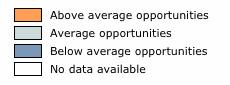
Core Tasks
- Provide assistance to students with special needs.
- Teach socially acceptable behavior, employing techniques such as behavior modification or positive reinforcement.
- Supervise students in classrooms, halls, cafeterias, school yards, and gymnasiums, or on field trips.
- Carry out therapeutic regimens, such as behavior modification and personal development programs, under the supervision of special education instructors, psychologists, or speech-language pathologists.
- Provide students with disabilities with assistive devices, supportive technology, and assistance accessing facilities, such as restrooms.
- Tutor and assist children individually or in small groups to help them master assignments and to reinforce learning concepts presented by teachers.
- Employ special educational strategies or techniques during instruction to improve the development of sensory- and perceptual-motor skills, language, cognition, or memory.
- Enforce administration policies and rules governing students.
- Instruct and monitor students in the use and care of equipment and materials to prevent injuries and damage.
- Observe students' performance, and record relevant data to assess progress.
- Present subject matter to students under the direction and guidance of teachers, using lectures, discussions, supervised role-playing methods, or by reading aloud.
- Discuss assigned duties with classroom teachers to coordinate instructional efforts.
- Grade homework and tests, and compute and record results, using answer sheets or electronic marking devices.
- Instruct students in daily living skills required for independent maintenance and self-sufficiency, such as hygiene, safety, or food preparation.
- Prepare classrooms with a variety of materials or resources for children to explore, manipulate, or use in learning activities or imaginative play.
- Assist in bus loading and unloading.
- Distribute teaching materials, such as textbooks, workbooks, papers, and pencils, to students.
- Organize and supervise games and other recreational activities to promote physical, mental, and social development.
- Take class attendance and maintain attendance records.
- Maintain computers in classrooms and laboratories, and assist students with hardware and software use.
- Use computers, audio-visual aids, and other equipment and materials to supplement presentations.
- Prepare lesson outlines and plans in assigned subject areas and submit outlines to teachers for review.
- Participate in teacher-parent conferences regarding students' progress or problems.
- Clean classrooms.
- Assist librarians in school libraries.
- Organize and label materials and display students' work in a manner appropriate for their eye levels and perceptual skills.
- Prepare lesson materials, bulletin board displays, exhibits, equipment, and demonstrations.
- Attend staff meetings and serve on committees, as required.
- Requisition and stock teaching materials and supplies.
- Laminate teaching materials to increase their durability under repeated use.
Technology Skills
Technology
Example
Hot Technology
Tools Used
Tool
Example
Top 10 Knowledge Required
English Language
71%
Knowledge of the structure and content of the English language including the meaning and spelling of words, and rules of composition and grammar.
Psychology
68%
Knowledge of human behavior and performance; individual differences in ability, personality, and interests; learning and motivation; psychological research methods; and the assessment and treatment of behavioral and affective disorders.
Education and Training
58%
Knowledge of principles and methods for curriculum and training design, teaching and instruction for individuals and groups, and the measurement of training effects.
Customer and Personal Service
57%
Knowledge of principles and processes for providing customer and personal services. This includes customer needs assessment, meeting quality standards for services, and evaluation of customer satisfaction.
Mathematics
54%
Knowledge of arithmetic, algebra, geometry, calculus, statistics, and their applications.
Public Safety and Security
52%
Knowledge of relevant equipment, policies, procedures, and strategies to promote effective local, state, or national security operations for the protection of people, data, property, and institutions.
History and Archeology
51%
Knowledge of historical events and their causes, indicators, and effects on civilizations and cultures.
Geography
49%
Knowledge of principles and methods for describing the features of land, sea, and air masses, including their physical characteristics, locations, interrelationships, and distribution of plant, animal, and human life.
Communications and Media
48%
Knowledge of media production, communication, and dissemination techniques and methods. This includes alternative ways to inform and entertain via written, oral, and visual media.
Sociology and Anthropology
48%
Knowledge of group behavior and dynamics, societal trends and influences, human migrations, ethnicity, cultures, and their history and origins.
Top 10 Skills
Active Listening
78%
Giving full attention to what other people are saying, taking time to understand the points being made, asking questions as appropriate, and not interrupting at inappropriate times.
Social Perceptiveness
75%
Being aware of others' reactions and understanding why they react as they do.
Speaking
75%
Talking to others to convey information effectively.
Learning Strategies
73%
Selecting and using training/instructional methods and procedures appropriate for the situation when learning or teaching new things.
Monitoring
73%
Monitoring/Assessing performance of yourself, other individuals, or organizations to make improvements or take corrective action.
Reading Comprehension
73%
Understanding written sentences and paragraphs in work-related documents.
Service Orientation
73%
Actively looking for ways to help people.
Instructing
70%
Teaching others how to do something.
Critical Thinking
68%
Using logic and reasoning to identify the strengths and weaknesses of alternative solutions, conclusions, or approaches to problems.
Coordination
63%
Adjusting actions in relation to others' actions.
Top 10 Abilities
Oral Comprehension
80%
The ability to listen to and understand information and ideas presented through spoken words and sentences.
Oral Expression
80%
The ability to communicate information and ideas in speaking so others will understand.
Problem Sensitivity
75%
The ability to tell when something is wrong or is likely to go wrong. It does not involve solving the problem, only recognizing that there is a problem.
Speech Clarity
75%
The ability to speak clearly so others can understand you.
Speech Recognition
75%
The ability to identify and understand the speech of another person.
Near Vision
73%
The ability to see details at close range (within a few feet of the observer).
Written Comprehension
73%
The ability to read and understand information and ideas presented in writing.
Deductive Reasoning
68%
The ability to apply general rules to specific problems to produce answers that make sense.
Fluency of Ideas
65%
The ability to come up with a number of ideas about a topic (the number of ideas is important, not their quality, correctness, or creativity).
Information Ordering
65%
The ability to arrange things or actions in a certain order or pattern according to a specific rule or set of rules (e.g., patterns of numbers, letters, words, pictures, mathematical operations).
Top 10 Work Activities
Getting Information
87%
Observing, receiving, and otherwise obtaining information from all relevant sources.
Assisting and Caring for Others
82%
Providing personal assistance, medical attention, emotional support, or other personal care to others such as coworkers, customers, or patients.
Communicating with Supervisors, Peers, or Subordinates
78%
Providing information to supervisors, co-workers, and subordinates by telephone, in written form, e-mail, or in person.
Establishing and Maintaining Interpersonal Relationships
76%
Developing constructive and cooperative working relationships with others, and maintaining them over time.
Monitoring Processes, Materials, or Surroundings
75%
Monitoring and reviewing information from materials, events, or the environment, to detect or assess problems.
Identifying Objects, Actions, and Events
73%
Identifying information by categorizing, estimating, recognizing differences or similarities, and detecting changes in circumstances or events.
Coaching and Developing Others
72%
Identifying the developmental needs of others and coaching, mentoring, or otherwise helping others to improve their knowledge or skills.
Making Decisions and Solving Problems
72%
Analyzing information and evaluating results to choose the best solution and solve problems.
Resolving Conflicts and Negotiating with Others
72%
Handling complaints, settling disputes, and resolving grievances and conflicts, or otherwise negotiating with others.
Training and Teaching Others
69%
Identifying the educational needs of others, developing formal educational or training programs or classes, and teaching or instructing others.
Detailed Work Activities
- Supervise school or student activities.
- Assist other educational professionals with projects or research.
- Serve on institutional or departmental committees.
- Implement therapeutic programs to improve patient functioning.
- Clean facilities or work areas.
- Maintain clean work areas.
- Collaborate with other teaching professionals to develop educational programs.
- Distribute instructional or library materials.
- Develop strategies or programs for students with special needs.
- Enforce rules or policies governing student behavior.
- Evaluate student work.
- Maintain student records.
- Monitor student performance.
- Teach others to use technology or equipment.
- Teach life skills.
- Set up classroom materials or equipment.
- Maintain computer equipment or software.
- Display student work.
- Plan educational activities.
- Discuss student progress with parents or guardians.
- Develop instructional materials.
- Document lesson plans.
- Lead classes or community events.
- Assist students with special educational needs.
- Maintain inventories of materials, equipment, or products.
- Tutor students who need extra assistance.
- Create technology-based learning materials.
Education
Interests
Social
99%
Work involves helping, teaching, advising, assisting, or providing service to others. Social occupations are often associated with social, health care, personal service, teaching/education, or religious activities.
Conventional
60%
Work involves following procedures and regulations to organize information or data, typically in a business setting. Conventional occupations are often associated with office work, accounting, mathematics/statistics, information technology, finance, or human resources.
Investigative
43%
Work involves studying and researching non-living objects, living organisms, disease or other forms of impairment, or human behavior. Investigative occupations are often associated with physical, life, medical, or social sciences, and can be found in the fields of humanities, mathematics/statistics, information technology, or health care service.
Artistic
39%
Work involves creating original visual artwork, performances, written works, food, or music for a variety of media, or applying artistic principles to the design of various objects and materials. Artistic occupations are often associated with visual arts, applied arts and design, performing arts, music, creative writing, media, or culinary art.
Realistic
36%
Work involves designing, building, or repairing of equipment, materials, or structures, engaging in physical activity, or working outdoors. Realistic occupations are often associated with engineering, mechanics and electronics, construction, woodworking, transportation, machine operation, agriculture, animal services, physical or manual labor, athletics, or protective services.
Enterprising
35%
Work involves managing, negotiating, marketing, or selling, typically in a business setting, or leading or advising people in political and legal situations. Enterprising occupations are often associated with business initiatives, sales, marketing/advertising, finance, management/administration, professional advising, public speaking, politics, or law.
Majors
Colleges
SAGE Scholars Member Schools that offer majors leading to this career.
Check out the College Search to see the full list of schools with majors for this career.