Craft Artists
Overview
SaveJob Zone Three: Medium Preparation Needed
Experience
Previous work-related skill, knowledge, or experience is required for these occupations. For example, an electrician must have completed three or four years of apprenticeship or several years of vocational training, and often must have passed a licensing exam, in order to perform the job.
Education
Most occupations in this zone require training in vocational schools, related on-the-job experience, or an associate's degree.
Job Training
Employees in these occupations usually need one or two years of training involving both on-the-job experience and informal training with experienced workers. A recognized apprenticeship program may be associated with these occupations.
Examples
These occupations usually involve using communication and organizational skills to coordinate, supervise, manage, or train others to accomplish goals. Examples include hydroelectric production managers, desktop publishers, electricians, agricultural technicians, barbers, court reporters and simultaneous captioners, and medical assistants.
Create or reproduce handmade objects for sale and exhibition using a variety of techniques, such as welding, weaving, pottery, and needlecraft.

Yearly Salary
| High: | $59K |
| Median: | $35K |
| Low: | $21K |
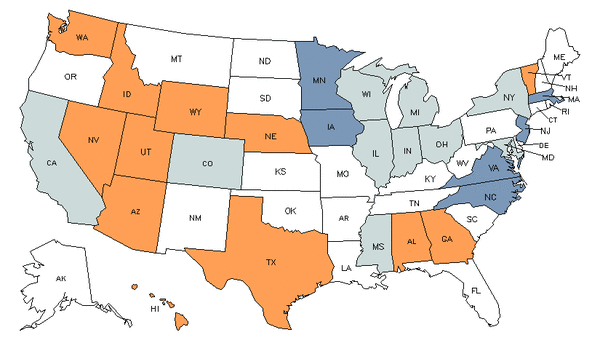
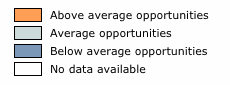
Demand
Core Tasks
- Select materials for use based on strength, color, texture, balance, weight, size, malleability and other characteristics.
- Create functional or decorative objects by hand, using a variety of methods and materials.
- Develop concepts or creative ideas for craft objects.
- Apply finishes to objects being crafted.
- Cut, shape, fit, join, mold, or otherwise process materials, using hand tools, power tools, or machinery.
- Set specifications for materials, dimensions, and finishes.
- Advertise products and work, using media such as internet advertising and brochures.
- Sketch or draw objects to be crafted.
- Pack products for shipping.
- Fabricate patterns or templates to guide craft production.
- Create prototypes or models of objects to be crafted.
- Develop product packaging, display, and pricing strategies.
- Confer with customers to assess customer needs or obtain feedback.
- Plan and attend craft shows to market products.
- Develop designs using specialized computer software.
- Research craft trends, venues, and customer buying patterns to inspire designs and marketing strategies.
Technology Skills
Technology
Example
Hot Technology
Tools Used
Tool
Example
Top 10 Knowledge Required
Design
79%
Knowledge of design techniques, tools, and principles involved in production of precision technical plans, blueprints, drawings, and models.
Fine Arts
74%
Knowledge of the theory and techniques required to compose, produce, and perform works of music, dance, visual arts, drama, and sculpture.
Sales and Marketing
73%
Knowledge of principles and methods for showing, promoting, and selling products or services. This includes marketing strategy and tactics, product demonstration, sales techniques, and sales control systems.
English Language
67%
Knowledge of the structure and content of the English language including the meaning and spelling of words, and rules of composition and grammar.
Customer and Personal Service
66%
Knowledge of principles and processes for providing customer and personal services. This includes customer needs assessment, meeting quality standards for services, and evaluation of customer satisfaction.
Production and Processing
64%
Knowledge of raw materials, production processes, quality control, costs, and other techniques for maximizing the effective manufacture and distribution of goods.
Communications and Media
57%
Knowledge of media production, communication, and dissemination techniques and methods. This includes alternative ways to inform and entertain via written, oral, and visual media.
Mechanical
56%
Knowledge of machines and tools, including their designs, uses, repair, and maintenance.
Computers and Electronics
53%
Knowledge of circuit boards, processors, chips, electronic equipment, and computer hardware and software, including applications and programming.
Education and Training
53%
Knowledge of principles and methods for curriculum and training design, teaching and instruction for individuals and groups, and the measurement of training effects.
Top 10 Skills
Critical Thinking
63%
Using logic and reasoning to identify the strengths and weaknesses of alternative solutions, conclusions, or approaches to problems.
Active Listening
60%
Giving full attention to what other people are saying, taking time to understand the points being made, asking questions as appropriate, and not interrupting at inappropriate times.
Monitoring
60%
Monitoring/Assessing performance of yourself, other individuals, or organizations to make improvements or take corrective action.
Reading Comprehension
60%
Understanding written sentences and paragraphs in work-related documents.
Speaking
60%
Talking to others to convey information effectively.
Judgment and Decision Making
58%
Considering the relative costs and benefits of potential actions to choose the most appropriate one.
Social Perceptiveness
58%
Being aware of others' reactions and understanding why they react as they do.
Active Learning
55%
Understanding the implications of new information for both current and future problem-solving and decision-making.
Complex Problem Solving
55%
Identifying complex problems and reviewing related information to develop and evaluate options and implement solutions.
Persuasion
55%
Persuading others to change their minds or behavior.
Top 10 Abilities
Originality
83%
The ability to come up with unusual or clever ideas about a given topic or situation, or to develop creative ways to solve a problem.
Arm-Hand Steadiness
78%
The ability to keep your hand and arm steady while moving your arm or while holding your arm and hand in one position.
Finger Dexterity
78%
The ability to make precisely coordinated movements of the fingers of one or both hands to grasp, manipulate, or assemble very small objects.
Manual Dexterity
75%
The ability to quickly move your hand, your hand together with your arm, or your two hands to grasp, manipulate, or assemble objects.
Near Vision
75%
The ability to see details at close range (within a few feet of the observer).
Fluency of Ideas
73%
The ability to come up with a number of ideas about a topic (the number of ideas is important, not their quality, correctness, or creativity).
Visualization
73%
The ability to imagine how something will look after it is moved around or when its parts are moved or rearranged.
Control Precision
63%
The ability to quickly and repeatedly adjust the controls of a machine or a vehicle to exact positions.
Multilimb Coordination
63%
The ability to coordinate two or more limbs (for example, two arms, two legs, or one leg and one arm) while sitting, standing, or lying down. It does not involve performing the activities while the whole body is in motion.
Category Flexibility
60%
The ability to generate or use different sets of rules for combining or grouping things in different ways.
Top 10 Work Activities
Thinking Creatively
93%
Developing, designing, or creating new applications, ideas, relationships, systems, or products, including artistic contributions.
Making Decisions and Solving Problems
80%
Analyzing information and evaluating results to choose the best solution and solve problems.
Getting Information
75%
Observing, receiving, and otherwise obtaining information from all relevant sources.
Handling and Moving Objects
73%
Using hands and arms in handling, installing, positioning, and moving materials, and manipulating things.
Organizing, Planning, and Prioritizing Work
73%
Developing specific goals and plans to prioritize, organize, and accomplish your work.
Selling or Influencing Others
73%
Convincing others to buy merchandise/goods or to otherwise change their minds or actions.
Controlling Machines and Processes
72%
Using either control mechanisms or direct physical activity to operate machines or processes (not including computers or vehicles).
Monitoring Processes, Materials, or Surroundings
72%
Monitoring and reviewing information from materials, events, or the environment, to detect or assess problems.
Inspecting Equipment, Structures, or Materials
66%
Inspecting equipment, structures, or materials to identify the cause of errors or other problems or defects.
Performing for or Working Directly with the Public
66%
Performing for people or dealing directly with the public. This includes serving customers in restaurants and stores, and receiving clients or guests.
Detailed Work Activities
- Promote products, activities, or organizations.
- Package materials for transport.
- Package objects for shipping.
- Construct distinctive physical objects for artistic, functional, or commercial purposes.
- Select materials or props.
- Apply finishes to artwork, crafts, or displays.
- Develop artistic or design concepts for decoration, exhibition, or commercial purposes.
- Calculate dimensions of workpieces, products, or equipment.
- Analyze project data to determine specifications or requirements.
- Confer with clients to determine needs.
- Build models, patterns, or templates.
- Draw detailed or technical illustrations.
- Develop promotional strategies or plans.
- Monitor current trends.
Education
Interests
Artistic
86%
Work involves creating original visual artwork, performances, written works, food, or music for a variety of media, or applying artistic principles to the design of various objects and materials. Artistic occupations are often associated with visual arts, applied arts and design, performing arts, music, creative writing, media, or culinary art.
Realistic
84%
Work involves designing, building, or repairing of equipment, materials, or structures, engaging in physical activity, or working outdoors. Realistic occupations are often associated with engineering, mechanics and electronics, construction, woodworking, transportation, machine operation, agriculture, animal services, physical or manual labor, athletics, or protective services.
Enterprising
42%
Work involves managing, negotiating, marketing, or selling, typically in a business setting, or leading or advising people in political and legal situations. Enterprising occupations are often associated with business initiatives, sales, marketing/advertising, finance, management/administration, professional advising, public speaking, politics, or law.
Conventional
37%
Work involves following procedures and regulations to organize information or data, typically in a business setting. Conventional occupations are often associated with office work, accounting, mathematics/statistics, information technology, finance, or human resources.
Investigative
27%
Work involves studying and researching non-living objects, living organisms, disease or other forms of impairment, or human behavior. Investigative occupations are often associated with physical, life, medical, or social sciences, and can be found in the fields of humanities, mathematics/statistics, information technology, or health care service.
Social
25%
Work involves helping, teaching, advising, assisting, or providing service to others. Social occupations are often associated with social, health care, personal service, teaching/education, or religious activities.
Work Values
Achievement
86%
Occupations that satisfy this work value are results oriented and allow employees to use their strongest abilities, giving them a feeling of accomplishment. Corresponding needs are Ability Utilization and Achievement.
Independence
77%
Occupations that satisfy this work value allow employees to work on their own and make decisions. Corresponding needs are Creativity, Responsibility and Autonomy.
Working Conditions
53%
Occupations that satisfy this work value offer job security and good working conditions. Corresponding needs are Activity, Compensation, Independence, Security, Variety and Working Conditions.
Recognition
43%
Occupations that satisfy this work value offer advancement, potential for leadership, and are often considered prestigious. Corresponding needs are Advancement, Authority, Recognition and Social Status.
Support
29%
Occupations that satisfy this work value offer supportive management that stands behind employees. Corresponding needs are Company Policies, Supervision: Human Relations and Supervision: Technical.
Relationships
24%
Occupations that satisfy this work value allow employees to provide service to others and work with co-workers in a friendly non-competitive environment. Corresponding needs are Co-workers, Moral Values and Social Service.
Majors
Colleges
SAGE Scholars Member Schools that offer majors leading to this career.
Check out the College Search to see the full list of schools with majors for this career.