Merchandise Displayers and Window Trimmers
Overview
SaveJob Zone Three: Medium Preparation Needed
Experience
Previous work-related skill, knowledge, or experience is required for these occupations. For example, an electrician must have completed three or four years of apprenticeship or several years of vocational training, and often must have passed a licensing exam, in order to perform the job.
Education
Most occupations in this zone require training in vocational schools, related on-the-job experience, or an associate's degree.
Job Training
Employees in these occupations usually need one or two years of training involving both on-the-job experience and informal training with experienced workers. A recognized apprenticeship program may be associated with these occupations.
Examples
These occupations usually involve using communication and organizational skills to coordinate, supervise, manage, or train others to accomplish goals. Examples include hydroelectric production managers, desktop publishers, electricians, agricultural technicians, barbers, court reporters and simultaneous captioners, and medical assistants.
Plan and erect commercial displays, such as those in windows and interiors of retail stores and at trade exhibitions.

Yearly Salary
| High: | $51K |
| Median: | $30K |
| Low: | $22K |
Demand

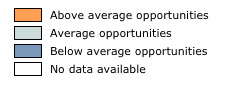
Core Tasks
- Dress mannequins for displays.
- Plan commercial displays to entice and appeal to customers.
- Arrange properties, furniture, merchandise, backdrops, or other accessories, as shown in prepared sketches.
- Change or rotate window displays, interior display areas, or signage to reflect changes in inventory or promotion.
- Place prices or descriptive signs on backdrops, fixtures, merchandise, or floor.
- Consult with store managers, buyers, sales associates, housekeeping staff, or engineering staff to determine appropriate placement of displays or products.
- Develop ideas or plans for merchandise displays or window decorations.
- Maintain props, products, or mannequins, inspecting them for imperfections, doing touch-ups, cleaning up after customers, or applying preservative coatings as necessary.
- Supervise or train staff members on daily tasks, such as visual merchandising.
- Assemble or set up displays, furniture, or products in store space, using colors, lights, pictures, or other accessories to display the product.
- Store, pack, and maintain inventory records of props, products, or display items.
- Install booths, exhibits, displays, carpets, or drapes, as guided by floor plan of building or specifications.
- Prepare sketches, floor plans, or models of proposed displays.
- Select themes, lighting, colors, or props to be used.
- Use computers to produce signage.
- Attend training sessions or corporate planning meetings to obtain new ideas for product launches.
- Consult with advertising or sales staff to determine type of merchandise to be featured and time and place for each display.
- Instruct sales staff in color coordination of clothing racks or counter displays.
- Collaborate with others to obtain products or other display items.
- Construct or assemble displays or display components from fabric, glass, paper, or plastic, using hand tools or woodworking power tools, according to specifications.
- Install decorations, such as flags, banners, festive lights, or bunting on or in building, street, exhibit hall, or booth.
- Obtain plans from display designers or display managers and discuss their implementation with clients or supervisors.
- Take photographs of displays or signage.
- Cut out designs on cardboard, hardboard, or plywood, according to motif of event.
Technology Skills
Technology
Example
Hot Technology
Tools Used
Tool
Example
Top 10 Knowledge Required
Customer and Personal Service
77%
Knowledge of principles and processes for providing customer and personal services. This includes customer needs assessment, meeting quality standards for services, and evaluation of customer satisfaction.
Sales and Marketing
76%
Knowledge of principles and methods for showing, promoting, and selling products or services. This includes marketing strategy and tactics, product demonstration, sales techniques, and sales control systems.
English Language
66%
Knowledge of the structure and content of the English language including the meaning and spelling of words, and rules of composition and grammar.
Administration and Management
63%
Knowledge of business and management principles involved in strategic planning, resource allocation, human resources modeling, leadership technique, production methods, and coordination of people and resources.
Computers and Electronics
57%
Knowledge of circuit boards, processors, chips, electronic equipment, and computer hardware and software, including applications and programming.
Design
57%
Knowledge of design techniques, tools, and principles involved in production of precision technical plans, blueprints, drawings, and models.
Communications and Media
55%
Knowledge of media production, communication, and dissemination techniques and methods. This includes alternative ways to inform and entertain via written, oral, and visual media.
Mathematics
50%
Knowledge of arithmetic, algebra, geometry, calculus, statistics, and their applications.
Personnel and Human Resources
47%
Knowledge of principles and procedures for personnel recruitment, selection, training, compensation and benefits, labor relations and negotiation, and personnel information systems.
Education and Training
46%
Knowledge of principles and methods for curriculum and training design, teaching and instruction for individuals and groups, and the measurement of training effects.
Top 10 Skills
Active Listening
70%
Giving full attention to what other people are saying, taking time to understand the points being made, asking questions as appropriate, and not interrupting at inappropriate times.
Critical Thinking
65%
Using logic and reasoning to identify the strengths and weaknesses of alternative solutions, conclusions, or approaches to problems.
Speaking
65%
Talking to others to convey information effectively.
Judgment and Decision Making
63%
Considering the relative costs and benefits of potential actions to choose the most appropriate one.
Coordination
60%
Adjusting actions in relation to others' actions.
Reading Comprehension
60%
Understanding written sentences and paragraphs in work-related documents.
Social Perceptiveness
60%
Being aware of others' reactions and understanding why they react as they do.
Time Management
60%
Managing one's own time and the time of others.
Active Learning
58%
Understanding the implications of new information for both current and future problem-solving and decision-making.
Complex Problem Solving
58%
Identifying complex problems and reviewing related information to develop and evaluate options and implement solutions.
Top 10 Abilities
Visualization
78%
The ability to imagine how something will look after it is moved around or when its parts are moved or rearranged.
Oral Comprehension
73%
The ability to listen to and understand information and ideas presented through spoken words and sentences.
Oral Expression
73%
The ability to communicate information and ideas in speaking so others will understand.
Speech Clarity
73%
The ability to speak clearly so others can understand you.
Fluency of Ideas
68%
The ability to come up with a number of ideas about a topic (the number of ideas is important, not their quality, correctness, or creativity).
Manual Dexterity
68%
The ability to quickly move your hand, your hand together with your arm, or your two hands to grasp, manipulate, or assemble objects.
Speech Recognition
68%
The ability to identify and understand the speech of another person.
Category Flexibility
65%
The ability to generate or use different sets of rules for combining or grouping things in different ways.
Deductive Reasoning
65%
The ability to apply general rules to specific problems to produce answers that make sense.
Far Vision
65%
The ability to see details at a distance.
Top 10 Work Activities
Getting Information
86%
Observing, receiving, and otherwise obtaining information from all relevant sources.
Performing General Physical Activities
86%
Performing general physical activities includes doing activities that require considerable use of your arms and legs and moving your whole body, such as climbing, lifting, balancing, walking, stooping, and handling materials.
Thinking Creatively
86%
Developing, designing, or creating new applications, ideas, relationships, systems, or products, including artistic contributions.
Handling and Moving Objects
85%
Using hands and arms in handling, installing, positioning, and moving materials, and manipulating things.
Communicating with Supervisors, Peers, or Subordinates
83%
Providing information to supervisors, co-workers, and subordinates by telephone, in written form, e-mail, or in person.
Organizing, Planning, and Prioritizing Work
83%
Developing specific goals and plans to prioritize, organize, and accomplish your work.
Establishing and Maintaining Interpersonal Relationships
80%
Developing constructive and cooperative working relationships with others, and maintaining them over time.
Identifying Objects, Actions, and Events
79%
Identifying information by categorizing, estimating, recognizing differences or similarities, and detecting changes in circumstances or events.
Making Decisions and Solving Problems
77%
Analyzing information and evaluating results to choose the best solution and solve problems.
Evaluating Information to Determine Compliance with Standards
70%
Using relevant information and individual judgment to determine whether events or processes comply with laws, regulations, or standards.
Detailed Work Activities
- Discuss production content and progress with others.
- Maintain inventories of materials, equipment, or products.
- Arrange artwork, products, or props.
- Train others on work processes.
- Maintain records, documents, or other files.
- Operate still or video cameras or related equipment.
- Develop promotional strategies or plans.
- Develop artistic or design concepts for decoration, exhibition, or commercial purposes.
- Collaborate with others in marketing activities.
- Draw detailed or technical illustrations.
- Select materials or props.
- Monitor current trends.
- Build models, patterns, or templates.
- Construct distinctive physical objects for artistic, functional, or commercial purposes.
Education
Interests
Artistic
70%
Work involves creating original visual artwork, performances, written works, food, or music for a variety of media, or applying artistic principles to the design of various objects and materials. Artistic occupations are often associated with visual arts, applied arts and design, performing arts, music, creative writing, media, or culinary art.
Realistic
64%
Work involves designing, building, or repairing of equipment, materials, or structures, engaging in physical activity, or working outdoors. Realistic occupations are often associated with engineering, mechanics and electronics, construction, woodworking, transportation, machine operation, agriculture, animal services, physical or manual labor, athletics, or protective services.
Enterprising
61%
Work involves managing, negotiating, marketing, or selling, typically in a business setting, or leading or advising people in political and legal situations. Enterprising occupations are often associated with business initiatives, sales, marketing/advertising, finance, management/administration, professional advising, public speaking, politics, or law.
Conventional
43%
Work involves following procedures and regulations to organize information or data, typically in a business setting. Conventional occupations are often associated with office work, accounting, mathematics/statistics, information technology, finance, or human resources.
Social
32%
Work involves helping, teaching, advising, assisting, or providing service to others. Social occupations are often associated with social, health care, personal service, teaching/education, or religious activities.
Investigative
23%
Work involves studying and researching non-living objects, living organisms, disease or other forms of impairment, or human behavior. Investigative occupations are often associated with physical, life, medical, or social sciences, and can be found in the fields of humanities, mathematics/statistics, information technology, or health care service.
Work Values
Relationships
72%
Occupations that satisfy this work value allow employees to provide service to others and work with co-workers in a friendly non-competitive environment. Corresponding needs are Co-workers, Moral Values and Social Service.
Independence
67%
Occupations that satisfy this work value allow employees to work on their own and make decisions. Corresponding needs are Creativity, Responsibility and Autonomy.
Achievement
58%
Occupations that satisfy this work value are results oriented and allow employees to use their strongest abilities, giving them a feeling of accomplishment. Corresponding needs are Ability Utilization and Achievement.
Support
53%
Occupations that satisfy this work value offer supportive management that stands behind employees. Corresponding needs are Company Policies, Supervision: Human Relations and Supervision: Technical.
Working Conditions
53%
Occupations that satisfy this work value offer job security and good working conditions. Corresponding needs are Activity, Compensation, Independence, Security, Variety and Working Conditions.
Recognition
39%
Occupations that satisfy this work value offer advancement, potential for leadership, and are often considered prestigious. Corresponding needs are Advancement, Authority, Recognition and Social Status.
Colleges
SAGE Scholars Member Schools that offer majors leading to this career.
Check out the College Search to see the full list of schools with majors for this career.