Fine Artists, Including Painters, Sculptors, and Illustrators
Overview
SaveJob Zone Three: Medium Preparation Needed
Experience
Previous work-related skill, knowledge, or experience is required for these occupations. For example, an electrician must have completed three or four years of apprenticeship or several years of vocational training, and often must have passed a licensing exam, in order to perform the job.
Education
Most occupations in this zone require training in vocational schools, related on-the-job experience, or an associate's degree.
Job Training
Employees in these occupations usually need one or two years of training involving both on-the-job experience and informal training with experienced workers. A recognized apprenticeship program may be associated with these occupations.
Examples
These occupations usually involve using communication and organizational skills to coordinate, supervise, manage, or train others to accomplish goals. Examples include hydroelectric production managers, desktop publishers, electricians, agricultural technicians, barbers, court reporters and simultaneous captioners, and medical assistants.
Create original artwork using any of a wide variety of media and techniques.
Yearly Salary
| High: | $122K |
| Median: | $52K |
| Low: | $19K |
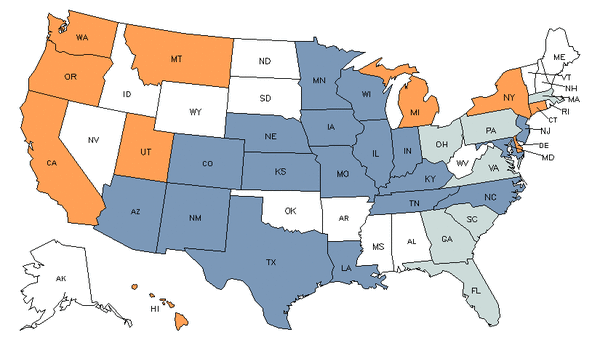
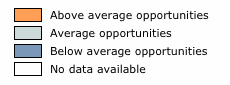
Demand
Core Tasks
- Use materials such as pens and ink, watercolors, charcoal, oil, or computer software to create artwork.
- Integrate and develop visual elements, such as line, space, mass, color, and perspective, to produce desired effects, such as the illustration of ideas, emotions, or moods.
- Model substances such as clay or wax, using fingers and small hand tools to form objects.
- Create sculptures, statues, and other three-dimensional artwork by using abrasives and tools to shape, carve, and fabricate materials such as clay, stone, wood, or metal.
- Set up exhibitions of artwork for display or sale.
- Render drawings, illustrations, and sketches of buildings, manufactured products, or models, working from sketches, blueprints, memory, models, or reference materials.
- Confer with clients, editors, writers, art directors, and other interested parties regarding the nature and content of artwork to be produced.
- Frame and mat artwork for display or sale.
- Shade and fill in sketch outlines and backgrounds, using a variety of media such as water colors, markers, and transparent washes, labeling designated colors when necessary.
- Submit artwork to shows or galleries.
- Submit preliminary or finished artwork or project plans to clients for approval, incorporating changes as necessary.
- Collaborate with engineers, mechanics, and other technical experts as necessary to build and install creations.
- Cut, bend, laminate, arrange, and fasten individual or mixed raw and manufactured materials and products to form works of art.
- Maintain portfolios of artistic work to demonstrate styles, interests, and abilities.
- Provide entertainment at special events by performing activities such as drawing cartoons.
- Create and prepare sketches and model drawings of cartoon characters, providing details from memory, live models, manufactured products, or reference materials.
- Develop project budgets for approval, estimating time lines and material costs.
- Market artwork through brochures, mailings, or Web sites.
- Study different techniques to learn how to apply them to artistic endeavors.
- Create finished art work as decoration, or to elucidate or substitute for spoken or written messages.
- Create sketches, profiles, or likenesses of posed subjects or photographs, using any combination of freehand drawing, mechanical assembly kits, and computer imaging.
- Trace drawings onto clear acetate for painting or coloring, or trace them with ink to make final copies.
- Apply solvents and cleaning agents to clean surfaces of paintings, and to remove accretions, discolorations, and deteriorated varnish.
- Collaborate with writers who create ideas, stories, or captions that are combined with artists' work.
- Brush or spray protective or decorative finishes on completed background panels, informational legends, exhibit accessories, or finished paintings.
- Monitor events, trends, and other circumstances, research specific subject areas, attend art exhibitions, and read art publications to develop ideas and keep current on art world activities.
- Photograph objects, places, or scenes for reference material.
- Teach artistic techniques to children or adults.
Technology Skills
Technology
Example
Hot Technology
Tools Used
Tool
Example
Top 10 Knowledge Required
Design
87%
Knowledge of design techniques, tools, and principles involved in production of precision technical plans, blueprints, drawings, and models.
Computers and Electronics
85%
Knowledge of circuit boards, processors, chips, electronic equipment, and computer hardware and software, including applications and programming.
English Language
78%
Knowledge of the structure and content of the English language including the meaning and spelling of words, and rules of composition and grammar.
Production and Processing
72%
Knowledge of raw materials, production processes, quality control, costs, and other techniques for maximizing the effective manufacture and distribution of goods.
Education and Training
69%
Knowledge of principles and methods for curriculum and training design, teaching and instruction for individuals and groups, and the measurement of training effects.
Fine Arts
69%
Knowledge of the theory and techniques required to compose, produce, and perform works of music, dance, visual arts, drama, and sculpture.
Communications and Media
68%
Knowledge of media production, communication, and dissemination techniques and methods. This includes alternative ways to inform and entertain via written, oral, and visual media.
Customer and Personal Service
67%
Knowledge of principles and processes for providing customer and personal services. This includes customer needs assessment, meeting quality standards for services, and evaluation of customer satisfaction.
Mathematics
64%
Knowledge of arithmetic, algebra, geometry, calculus, statistics, and their applications.
Administration and Management
61%
Knowledge of business and management principles involved in strategic planning, resource allocation, human resources modeling, leadership technique, production methods, and coordination of people and resources.
Top 10 Skills
Active Learning
65%
Understanding the implications of new information for both current and future problem-solving and decision-making.
Critical Thinking
65%
Using logic and reasoning to identify the strengths and weaknesses of alternative solutions, conclusions, or approaches to problems.
Active Listening
63%
Giving full attention to what other people are saying, taking time to understand the points being made, asking questions as appropriate, and not interrupting at inappropriate times.
Judgment and Decision Making
60%
Considering the relative costs and benefits of potential actions to choose the most appropriate one.
Reading Comprehension
60%
Understanding written sentences and paragraphs in work-related documents.
Speaking
60%
Talking to others to convey information effectively.
Complex Problem Solving
58%
Identifying complex problems and reviewing related information to develop and evaluate options and implement solutions.
Social Perceptiveness
58%
Being aware of others' reactions and understanding why they react as they do.
Time Management
58%
Managing one's own time and the time of others.
Writing
58%
Communicating effectively in writing as appropriate for the needs of the audience.
Top 10 Abilities
Originality
88%
The ability to come up with unusual or clever ideas about a given topic or situation, or to develop creative ways to solve a problem.
Fluency of Ideas
80%
The ability to come up with a number of ideas about a topic (the number of ideas is important, not their quality, correctness, or creativity).
Visualization
80%
The ability to imagine how something will look after it is moved around or when its parts are moved or rearranged.
Arm-Hand Steadiness
75%
The ability to keep your hand and arm steady while moving your arm or while holding your arm and hand in one position.
Visual Color Discrimination
75%
The ability to match or detect differences between colors, including shades of color and brightness.
Near Vision
73%
The ability to see details at close range (within a few feet of the observer).
Finger Dexterity
68%
The ability to make precisely coordinated movements of the fingers of one or both hands to grasp, manipulate, or assemble very small objects.
Manual Dexterity
68%
The ability to quickly move your hand, your hand together with your arm, or your two hands to grasp, manipulate, or assemble objects.
Category Flexibility
63%
The ability to generate or use different sets of rules for combining or grouping things in different ways.
Oral Comprehension
63%
The ability to listen to and understand information and ideas presented through spoken words and sentences.
Top 10 Work Activities
Thinking Creatively
96%
Developing, designing, or creating new applications, ideas, relationships, systems, or products, including artistic contributions.
Getting Information
79%
Observing, receiving, and otherwise obtaining information from all relevant sources.
Organizing, Planning, and Prioritizing Work
75%
Developing specific goals and plans to prioritize, organize, and accomplish your work.
Establishing and Maintaining Interpersonal Relationships
72%
Developing constructive and cooperative working relationships with others, and maintaining them over time.
Making Decisions and Solving Problems
72%
Analyzing information and evaluating results to choose the best solution and solve problems.
Updating and Using Relevant Knowledge
70%
Keeping up-to-date technically and applying new knowledge to your job.
Working with Computers
70%
Using computers and computer systems (including hardware and software) to program, write software, set up functions, enter data, or process information.
Monitoring Processes, Materials, or Surroundings
68%
Monitoring and reviewing information from materials, events, or the environment, to detect or assess problems.
Inspecting Equipment, Structures, or Materials
67%
Inspecting equipment, structures, or materials to identify the cause of errors or other problems or defects.
Handling and Moving Objects
64%
Using hands and arms in handling, installing, positioning, and moving materials, and manipulating things.
Detailed Work Activities
- Construct distinctive physical objects for artistic, functional, or commercial purposes.
- Apply paint to surfaces.
- Apply finishes to artwork, crafts, or displays.
- Develop artistic or design concepts for decoration, exhibition, or commercial purposes.
- Collaborate with others to determine technical details of productions.
- Maintain records, documents, or other files.
- Perform marketing activities.
- Research new technologies.
- Monitor current trends.
- Conduct research to inform art, designs, or other work.
- Operate still or video cameras or related equipment.
- Build models, patterns, or templates.
- Arrange artwork, products, or props.
- Draw detailed or technical illustrations.
- Prepare materials for preservation, storage, or display.
- Send information, materials or documentation.
- Present work to clients for approval.
- Coordinate logistics for productions or events.
- Entertain public with comedic or dramatic performances.
- Estimate costs for projects or productions.
- Clean surfaces in preparation for work activities.
- Clean objects.
- Immerse objects or workpieces in cleaning or coating solutions.
- Collaborate with others to prepare or perform artistic productions.
- Teach classes in area of specialization.
Education
Interests
Artistic
100%
Work involves creating original visual artwork, performances, written works, food, or music for a variety of media, or applying artistic principles to the design of various objects and materials. Artistic occupations are often associated with visual arts, applied arts and design, performing arts, music, creative writing, media, or culinary art.
Realistic
58%
Work involves designing, building, or repairing of equipment, materials, or structures, engaging in physical activity, or working outdoors. Realistic occupations are often associated with engineering, mechanics and electronics, construction, woodworking, transportation, machine operation, agriculture, animal services, physical or manual labor, athletics, or protective services.
Investigative
39%
Work involves studying and researching non-living objects, living organisms, disease or other forms of impairment, or human behavior. Investigative occupations are often associated with physical, life, medical, or social sciences, and can be found in the fields of humanities, mathematics/statistics, information technology, or health care service.
Conventional
34%
Work involves following procedures and regulations to organize information or data, typically in a business setting. Conventional occupations are often associated with office work, accounting, mathematics/statistics, information technology, finance, or human resources.
Enterprising
34%
Work involves managing, negotiating, marketing, or selling, typically in a business setting, or leading or advising people in political and legal situations. Enterprising occupations are often associated with business initiatives, sales, marketing/advertising, finance, management/administration, professional advising, public speaking, politics, or law.
Social
33%
Work involves helping, teaching, advising, assisting, or providing service to others. Social occupations are often associated with social, health care, personal service, teaching/education, or religious activities.
Work Values
Achievement
81%
Occupations that satisfy this work value are results oriented and allow employees to use their strongest abilities, giving them a feeling of accomplishment. Corresponding needs are Ability Utilization and Achievement.
Independence
81%
Occupations that satisfy this work value allow employees to work on their own and make decisions. Corresponding needs are Creativity, Responsibility and Autonomy.
Recognition
67%
Occupations that satisfy this work value offer advancement, potential for leadership, and are often considered prestigious. Corresponding needs are Advancement, Authority, Recognition and Social Status.
Working Conditions
67%
Occupations that satisfy this work value offer job security and good working conditions. Corresponding needs are Activity, Compensation, Independence, Security, Variety and Working Conditions.
Relationships
58%
Occupations that satisfy this work value allow employees to provide service to others and work with co-workers in a friendly non-competitive environment. Corresponding needs are Co-workers, Moral Values and Social Service.
Support
29%
Occupations that satisfy this work value offer supportive management that stands behind employees. Corresponding needs are Company Policies, Supervision: Human Relations and Supervision: Technical.