Costume Attendants
Overview
SaveJob Zone Two: Some Preparation Needed
Experience
Some previous work-related skill, knowledge, or experience is usually needed. For example, a teller would benefit from experience working directly with the public.
Education
These occupations usually require a high school diploma.
Job Training
Employees in these occupations need anywhere from a few months to one year of working with experienced employees. A recognized apprenticeship program may be associated with these occupations.
Examples
These occupations often involve using your knowledge and skills to help others. Examples include orderlies, counter and rental clerks, customer service representatives, security guards, upholsterers, tellers, and dental laboratory technicians.
Select, fit, and take care of costumes for cast members, and aid entertainers. May assist with multiple costume changes during performances.
Yearly Salary
| High: | $93K |
| Median: | $42K |
| Low: | $24K |
Demand
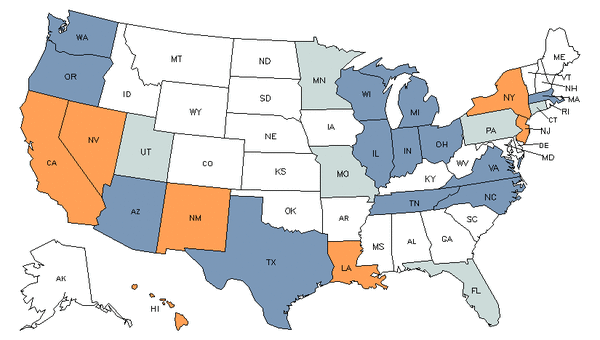
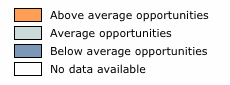
Core Tasks
- Create worksheets for dressing lists, show notes, or costume checks.
- Provide dressing assistance to cast members or assign cast dressers to assist specific cast members with costume changes.
- Arrange costumes in order of use to facilitate quick-change procedures for performances.
- Design or construct costumes or send them to tailors for construction, major repairs, or alterations.
- Examine costume fit on cast members and sketch or write notes for alterations.
- Check the appearance of costumes on stage or under lights to determine whether desired effects are being achieved.
- Distribute costumes or related equipment and keep records of item status.
- Clean and press costumes before and after performances and perform any minor repairs.
- Collaborate with production designers, costume designers, or other production staff to discuss and execute costume design details.
- Monitor, maintain, or secure inventories of costumes, wigs, or makeup, providing keys or access to assigned directors, costume designers, or wardrobe mistresses/masters.
- Purchase, rent, or requisition costumes or other wardrobe necessities.
- Direct the work of wardrobe crews during dress rehearsals or performances.
- Participate in the hiring, training, scheduling, or supervision of alteration workers.
- Provide managers with budget recommendations and take responsibility for budgetary line items related to costumes, storage, or makeup needs.
- Assign lockers to employees and maintain locker rooms, dressing rooms, wig rooms, or costume storage or laundry areas.
- Return borrowed or rented items when productions are complete and return other items to storage.
- Study books, pictures, or examples of period clothing to determine styles worn during specific periods in history.
- Review scripts or other production information to determine a story's locale or period, as well as the number of characters and required costumes.
- Inventory stock to determine types or conditions of available costuming.
- Recommend vendors and monitor their work.
- Care for non-clothing items, such as flags, table skirts, or draperies.
Technology Skills
Technology
Example
Hot Technology
Tools Used
Tool
Example
Top 10 Knowledge Required
Fine Arts
73%
Knowledge of the theory and techniques required to compose, produce, and perform works of music, dance, visual arts, drama, and sculpture.
Design
65%
Knowledge of design techniques, tools, and principles involved in production of precision technical plans, blueprints, drawings, and models.
Production and Processing
65%
Knowledge of raw materials, production processes, quality control, costs, and other techniques for maximizing the effective manufacture and distribution of goods.
Customer and Personal Service
63%
Knowledge of principles and processes for providing customer and personal services. This includes customer needs assessment, meeting quality standards for services, and evaluation of customer satisfaction.
English Language
63%
Knowledge of the structure and content of the English language including the meaning and spelling of words, and rules of composition and grammar.
Psychology
62%
Knowledge of human behavior and performance; individual differences in ability, personality, and interests; learning and motivation; psychological research methods; and the assessment and treatment of behavioral and affective disorders.
Administration and Management
60%
Knowledge of business and management principles involved in strategic planning, resource allocation, human resources modeling, leadership technique, production methods, and coordination of people and resources.
Mechanical
57%
Knowledge of machines and tools, including their designs, uses, repair, and maintenance.
Mathematics
56%
Knowledge of arithmetic, algebra, geometry, calculus, statistics, and their applications.
Education and Training
53%
Knowledge of principles and methods for curriculum and training design, teaching and instruction for individuals and groups, and the measurement of training effects.
Top 10 Skills
Active Listening
63%
Giving full attention to what other people are saying, taking time to understand the points being made, asking questions as appropriate, and not interrupting at inappropriate times.
Coordination
63%
Adjusting actions in relation to others' actions.
Monitoring
63%
Monitoring/Assessing performance of yourself, other individuals, or organizations to make improvements or take corrective action.
Speaking
63%
Talking to others to convey information effectively.
Social Perceptiveness
60%
Being aware of others' reactions and understanding why they react as they do.
Critical Thinking
58%
Using logic and reasoning to identify the strengths and weaknesses of alternative solutions, conclusions, or approaches to problems.
Reading Comprehension
58%
Understanding written sentences and paragraphs in work-related documents.
Service Orientation
58%
Actively looking for ways to help people.
Negotiation
55%
Bringing others together and trying to reconcile differences.
Persuasion
55%
Persuading others to change their minds or behavior.
Top 10 Abilities
Oral Comprehension
73%
The ability to listen to and understand information and ideas presented through spoken words and sentences.
Oral Expression
73%
The ability to communicate information and ideas in speaking so others will understand.
Near Vision
65%
The ability to see details at close range (within a few feet of the observer).
Problem Sensitivity
65%
The ability to tell when something is wrong or is likely to go wrong. It does not involve solving the problem, only recognizing that there is a problem.
Category Flexibility
63%
The ability to generate or use different sets of rules for combining or grouping things in different ways.
Fluency of Ideas
63%
The ability to come up with a number of ideas about a topic (the number of ideas is important, not their quality, correctness, or creativity).
Information Ordering
63%
The ability to arrange things or actions in a certain order or pattern according to a specific rule or set of rules (e.g., patterns of numbers, letters, words, pictures, mathematical operations).
Speech Clarity
63%
The ability to speak clearly so others can understand you.
Arm-Hand Steadiness
60%
The ability to keep your hand and arm steady while moving your arm or while holding your arm and hand in one position.
Deductive Reasoning
60%
The ability to apply general rules to specific problems to produce answers that make sense.
Top 10 Work Activities
Thinking Creatively
85%
Developing, designing, or creating new applications, ideas, relationships, systems, or products, including artistic contributions.
Communicating with Supervisors, Peers, or Subordinates
84%
Providing information to supervisors, co-workers, and subordinates by telephone, in written form, e-mail, or in person.
Getting Information
84%
Observing, receiving, and otherwise obtaining information from all relevant sources.
Handling and Moving Objects
82%
Using hands and arms in handling, installing, positioning, and moving materials, and manipulating things.
Making Decisions and Solving Problems
82%
Analyzing information and evaluating results to choose the best solution and solve problems.
Identifying Objects, Actions, and Events
81%
Identifying information by categorizing, estimating, recognizing differences or similarities, and detecting changes in circumstances or events.
Establishing and Maintaining Interpersonal Relationships
76%
Developing constructive and cooperative working relationships with others, and maintaining them over time.
Organizing, Planning, and Prioritizing Work
75%
Developing specific goals and plans to prioritize, organize, and accomplish your work.
Performing General Physical Activities
73%
Performing general physical activities includes doing activities that require considerable use of your arms and legs and moving your whole body, such as climbing, lifting, balancing, walking, stooping, and handling materials.
Coordinating the Work and Activities of Others
68%
Getting members of a group to work together to accomplish tasks.
Detailed Work Activities
- Prepare operational reports or records.
- Assign duties or work schedules to employees.
- Arrange items for use or display.
- Design costumes or cosmetic effects for characters.
- Evaluate quality of materials or products.
- Maintain supply or equipment inventories.
- Distribute resources to patrons or employees.
- Review art or design materials.
- Clean fabrics or apparel.
- Collaborate with others to determine production details.
- Monitor availability of equipment or supplies.
- Order materials, supplies, or equipment.
- Review production information to determine costume or makeup requirements.
- Deliver items.
- Supervise service workers.
- Train service staff.
- Perform human resources activities.
- Manage budgets for personal services operations.
- Maintain facilities.
- Assign resources or facilities to patrons or employees.
- Monitor operational quality or safety.
Education
Interests
Artistic
85%
Work involves creating original visual artwork, performances, written works, food, or music for a variety of media, or applying artistic principles to the design of various objects and materials. Artistic occupations are often associated with visual arts, applied arts and design, performing arts, music, creative writing, media, or culinary art.
Conventional
55%
Work involves following procedures and regulations to organize information or data, typically in a business setting. Conventional occupations are often associated with office work, accounting, mathematics/statistics, information technology, finance, or human resources.
Realistic
51%
Work involves designing, building, or repairing of equipment, materials, or structures, engaging in physical activity, or working outdoors. Realistic occupations are often associated with engineering, mechanics and electronics, construction, woodworking, transportation, machine operation, agriculture, animal services, physical or manual labor, athletics, or protective services.
Social
50%
Work involves helping, teaching, advising, assisting, or providing service to others. Social occupations are often associated with social, health care, personal service, teaching/education, or religious activities.
Enterprising
44%
Work involves managing, negotiating, marketing, or selling, typically in a business setting, or leading or advising people in political and legal situations. Enterprising occupations are often associated with business initiatives, sales, marketing/advertising, finance, management/administration, professional advising, public speaking, politics, or law.
Investigative
15%
Work involves studying and researching non-living objects, living organisms, disease or other forms of impairment, or human behavior. Investigative occupations are often associated with physical, life, medical, or social sciences, and can be found in the fields of humanities, mathematics/statistics, information technology, or health care service.
Work Values
Relationships
96%
Occupations that satisfy this work value allow employees to provide service to others and work with co-workers in a friendly non-competitive environment. Corresponding needs are Co-workers, Moral Values and Social Service.
Support
43%
Occupations that satisfy this work value offer supportive management that stands behind employees. Corresponding needs are Company Policies, Supervision: Human Relations and Supervision: Technical.
Working Conditions
41%
Occupations that satisfy this work value offer job security and good working conditions. Corresponding needs are Activity, Compensation, Independence, Security, Variety and Working Conditions.
Independence
34%
Occupations that satisfy this work value allow employees to work on their own and make decisions. Corresponding needs are Creativity, Responsibility and Autonomy.
Achievement
29%
Occupations that satisfy this work value are results oriented and allow employees to use their strongest abilities, giving them a feeling of accomplishment. Corresponding needs are Ability Utilization and Achievement.
Recognition
29%
Occupations that satisfy this work value offer advancement, potential for leadership, and are often considered prestigious. Corresponding needs are Advancement, Authority, Recognition and Social Status.