Models
Overview
SaveJob Zone Two: Some Preparation Needed
Experience
Some previous work-related skill, knowledge, or experience is usually needed. For example, a teller would benefit from experience working directly with the public.
Education
These occupations usually require a high school diploma.
Job Training
Employees in these occupations need anywhere from a few months to one year of working with experienced employees. A recognized apprenticeship program may be associated with these occupations.
Examples
These occupations often involve using your knowledge and skills to help others. Examples include orderlies, counter and rental clerks, customer service representatives, security guards, upholsterers, tellers, and dental laboratory technicians.
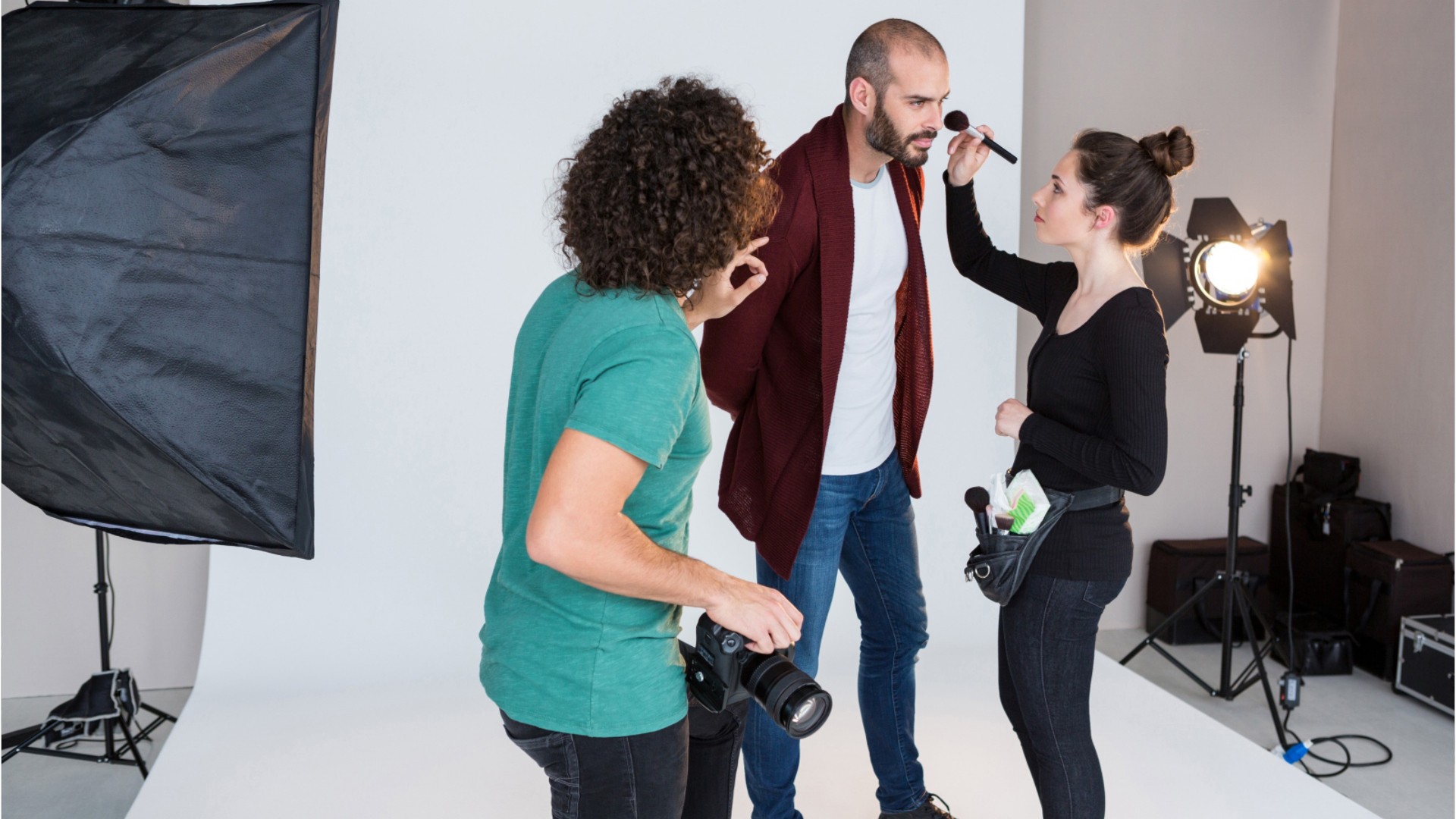
Model garments or other apparel and accessories for prospective buyers at fashion shows, private showings, or retail establishments. May pose for photos to be used in magazines or advertisements. May pose as subject for paintings, sculptures, and other types of artistic expression.
Yearly Salary
| High: | $124K |
| Median: | $31K |
| Low: | $24K |
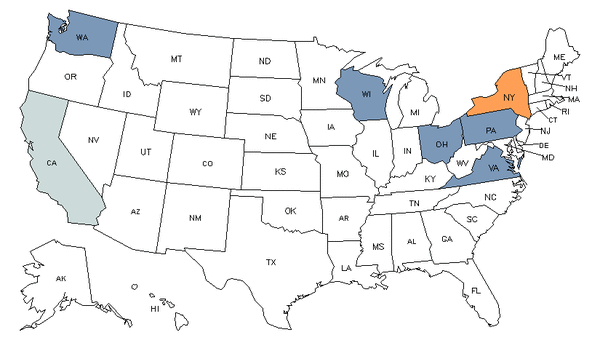
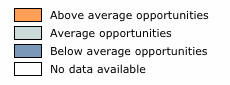
Demand
Core Tasks
- Record rates of pay and durations of jobs on vouchers.
- Pose for artists and photographers.
- Gather information from agents concerning the pay, dates, times, provisions, and lengths of jobs.
- Report job completions to agencies and obtain information about future appointments.
- Assemble and maintain portfolios, print composite cards, and travel to go-sees to obtain jobs.
- Pose as directed, or strike suitable interpretive poses for promoting and selling merchandise or fashions during appearances, filming, or photo sessions.
- Follow strict routines of diet, sleep, and exercise to maintain appearance.
- Apply makeup to face and style hair to enhance appearance, considering such factors as color, camera techniques, and facial features.
- Work closely with photographers, fashion coordinators, directors, producers, stylists, make-up artists, other models, and clients to produce the desired looks, and to finish photo shoots on schedule.
- Dress in sample or completed garments, and select accessories.
Technology Skills
Technology
Example
Hot Technology
Tools Used
Tool
Example
Top 10 Knowledge Required
Customer and Personal Service
55%
Knowledge of principles and processes for providing customer and personal services. This includes customer needs assessment, meeting quality standards for services, and evaluation of customer satisfaction.
English Language
50%
Knowledge of the structure and content of the English language including the meaning and spelling of words, and rules of composition and grammar.
Fine Arts
48%
Knowledge of the theory and techniques required to compose, produce, and perform works of music, dance, visual arts, drama, and sculpture.
Transportation
37%
Knowledge of principles and methods for moving people or goods by air, rail, sea, or road, including the relative costs and benefits.
Administration and Management
36%
Knowledge of business and management principles involved in strategic planning, resource allocation, human resources modeling, leadership technique, production methods, and coordination of people and resources.
Communications and Media
36%
Knowledge of media production, communication, and dissemination techniques and methods. This includes alternative ways to inform and entertain via written, oral, and visual media.
Computers and Electronics
33%
Knowledge of circuit boards, processors, chips, electronic equipment, and computer hardware and software, including applications and programming.
Public Safety and Security
31%
Knowledge of relevant equipment, policies, procedures, and strategies to promote effective local, state, or national security operations for the protection of people, data, property, and institutions.
Administrative
30%
Knowledge of administrative and office procedures and systems such as word processing, managing files and records, stenography and transcription, designing forms, and workplace terminology.
Design
30%
Knowledge of design techniques, tools, and principles involved in production of precision technical plans, blueprints, drawings, and models.
Top 10 Skills
Social Perceptiveness
58%
Being aware of others' reactions and understanding why they react as they do.
Active Listening
55%
Giving full attention to what other people are saying, taking time to understand the points being made, asking questions as appropriate, and not interrupting at inappropriate times.
Speaking
55%
Talking to others to convey information effectively.
Coordination
53%
Adjusting actions in relation to others' actions.
Critical Thinking
53%
Using logic and reasoning to identify the strengths and weaknesses of alternative solutions, conclusions, or approaches to problems.
Reading Comprehension
50%
Understanding written sentences and paragraphs in work-related documents.
Time Management
50%
Managing one's own time and the time of others.
Judgment and Decision Making
43%
Considering the relative costs and benefits of potential actions to choose the most appropriate one.
Negotiation
40%
Bringing others together and trying to reconcile differences.
Persuasion
40%
Persuading others to change their minds or behavior.
Top 10 Abilities
Oral Comprehension
58%
The ability to listen to and understand information and ideas presented through spoken words and sentences.
Gross Body Coordination
55%
The ability to coordinate the movement of your arms, legs, and torso together when the whole body is in motion.
Gross Body Equilibrium
55%
The ability to keep or regain your body balance or stay upright when in an unstable position.
Oral Expression
55%
The ability to communicate information and ideas in speaking so others will understand.
Speech Clarity
55%
The ability to speak clearly so others can understand you.
Speech Recognition
55%
The ability to identify and understand the speech of another person.
Trunk Strength
55%
The ability to use your abdominal and lower back muscles to support part of the body repeatedly or continuously over time without "giving out" or fatiguing.
Extent Flexibility
53%
The ability to bend, stretch, twist, or reach with your body, arms, and/or legs.
Multilimb Coordination
53%
The ability to coordinate two or more limbs (for example, two arms, two legs, or one leg and one arm) while sitting, standing, or lying down. It does not involve performing the activities while the whole body is in motion.
Selective Attention
53%
The ability to concentrate on a task over a period of time without being distracted.
Top 10 Work Activities
Performing General Physical Activities
89%
Performing general physical activities includes doing activities that require considerable use of your arms and legs and moving your whole body, such as climbing, lifting, balancing, walking, stooping, and handling materials.
Thinking Creatively
71%
Developing, designing, or creating new applications, ideas, relationships, systems, or products, including artistic contributions.
Establishing and Maintaining Interpersonal Relationships
64%
Developing constructive and cooperative working relationships with others, and maintaining them over time.
Scheduling Work and Activities
60%
Scheduling events, programs, and activities, as well as the work of others.
Getting Information
57%
Observing, receiving, and otherwise obtaining information from all relevant sources.
Organizing, Planning, and Prioritizing Work
53%
Developing specific goals and plans to prioritize, organize, and accomplish your work.
Performing for or Working Directly with the Public
51%
Performing for people or dealing directly with the public. This includes serving customers in restaurants and stores, and receiving clients or guests.
Communicating with Supervisors, Peers, or Subordinates
49%
Providing information to supervisors, co-workers, and subordinates by telephone, in written form, e-mail, or in person.
Documenting/Recording Information
46%
Entering, transcribing, recording, storing, or maintaining information in written or electronic/magnetic form.
Handling and Moving Objects
46%
Using hands and arms in handling, installing, positioning, and moving materials, and manipulating things.
Detailed Work Activities
- Model cosmetics, clothing, or accessories.
- Prepare financial documents, reports, or budgets.
- Gather information about work conditions or locations.
- Identify job or employment opportunities.
- Report information to managers or other personnel.
- Arrange artwork, products, or props.
- Drive passenger vehicles.
- Participate in physical training to maintain fitness.
Education
Interests
Artistic
100%
Work involves creating original visual artwork, performances, written works, food, or music for a variety of media, or applying artistic principles to the design of various objects and materials. Artistic occupations are often associated with visual arts, applied arts and design, performing arts, music, creative writing, media, or culinary art.
Realistic
69%
Work involves designing, building, or repairing of equipment, materials, or structures, engaging in physical activity, or working outdoors. Realistic occupations are often associated with engineering, mechanics and electronics, construction, woodworking, transportation, machine operation, agriculture, animal services, physical or manual labor, athletics, or protective services.
Enterprising
52%
Work involves managing, negotiating, marketing, or selling, typically in a business setting, or leading or advising people in political and legal situations. Enterprising occupations are often associated with business initiatives, sales, marketing/advertising, finance, management/administration, professional advising, public speaking, politics, or law.
Social
39%
Work involves helping, teaching, advising, assisting, or providing service to others. Social occupations are often associated with social, health care, personal service, teaching/education, or religious activities.
Conventional
30%
Work involves following procedures and regulations to organize information or data, typically in a business setting. Conventional occupations are often associated with office work, accounting, mathematics/statistics, information technology, finance, or human resources.
Investigative
15%
Work involves studying and researching non-living objects, living organisms, disease or other forms of impairment, or human behavior. Investigative occupations are often associated with physical, life, medical, or social sciences, and can be found in the fields of humanities, mathematics/statistics, information technology, or health care service.
Work Values
Relationships
72%
Occupations that satisfy this work value allow employees to provide service to others and work with co-workers in a friendly non-competitive environment. Corresponding needs are Co-workers, Moral Values and Social Service.
Recognition
58%
Occupations that satisfy this work value offer advancement, potential for leadership, and are often considered prestigious. Corresponding needs are Advancement, Authority, Recognition and Social Status.
Working Conditions
39%
Occupations that satisfy this work value offer job security and good working conditions. Corresponding needs are Activity, Compensation, Independence, Security, Variety and Working Conditions.
Achievement
24%
Occupations that satisfy this work value are results oriented and allow employees to use their strongest abilities, giving them a feeling of accomplishment. Corresponding needs are Ability Utilization and Achievement.
Independence
24%
Occupations that satisfy this work value allow employees to work on their own and make decisions. Corresponding needs are Creativity, Responsibility and Autonomy.
Support
24%
Occupations that satisfy this work value offer supportive management that stands behind employees. Corresponding needs are Company Policies, Supervision: Human Relations and Supervision: Technical.