Carpenters
Overview
SaveJob Zone Two: Some Preparation Needed
Experience
Some previous work-related skill, knowledge, or experience is usually needed. For example, a teller would benefit from experience working directly with the public.
Education
These occupations usually require a high school diploma.
Job Training
Employees in these occupations need anywhere from a few months to one year of working with experienced employees. A recognized apprenticeship program may be associated with these occupations.
Examples
These occupations often involve using your knowledge and skills to help others. Examples include orderlies, counter and rental clerks, customer service representatives, security guards, upholsterers, tellers, and dental laboratory technicians.
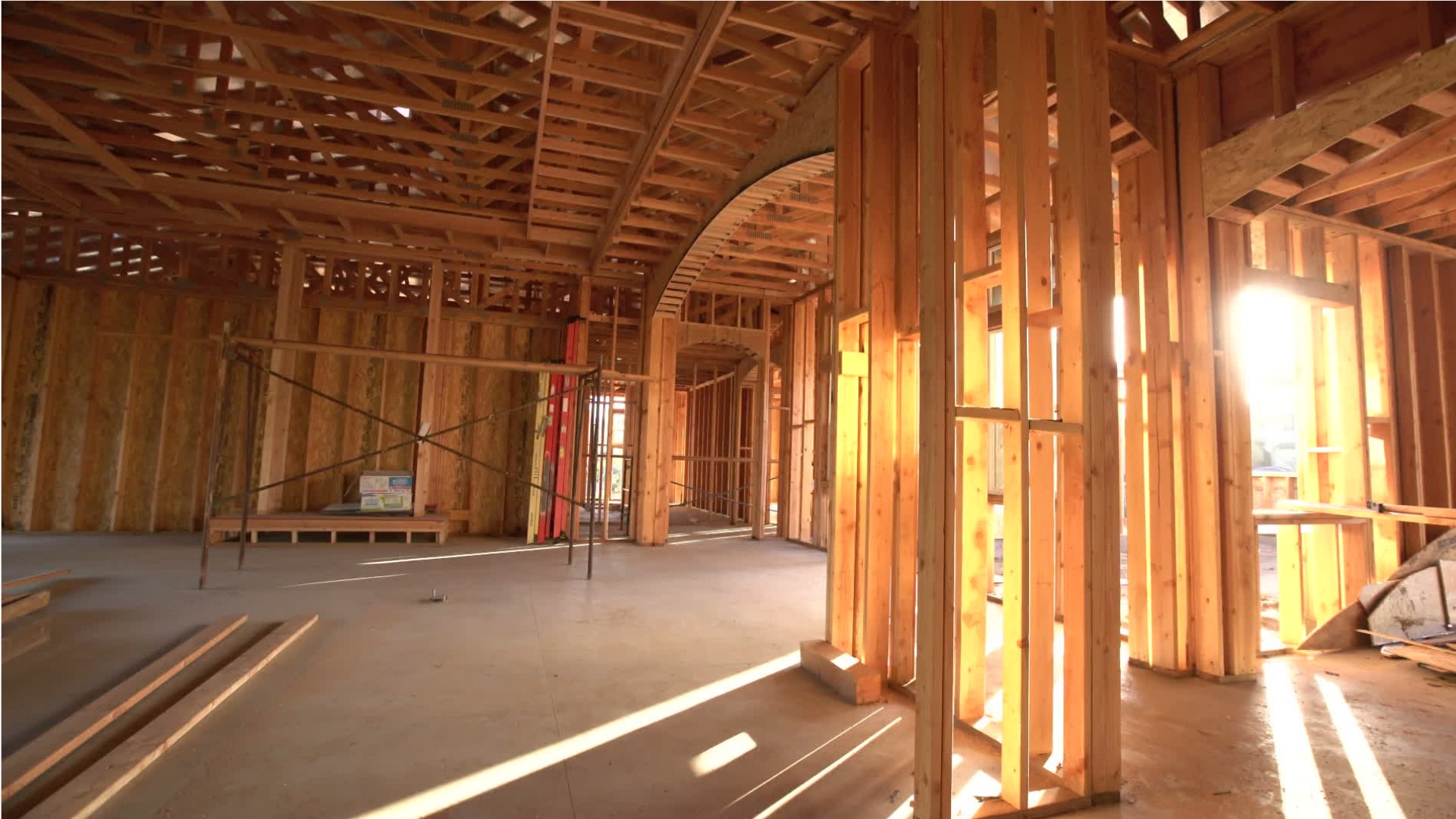
Construct, erect, install, or repair structures and fixtures made of wood and comparable materials, such as concrete forms; building frameworks, including partitions, joists, studding, and rafters; and wood stairways, window and door frames, and hardwood floors. May also install cabinets, siding, drywall, and batt or roll insulation. Includes brattice builders who build doors or brattices (ventilation walls or partitions) in underground passageways.
Yearly Salary
| High: | $87K |
| Median: | $49K |
| Low: | $31K |
Demand

Core Tasks
- Follow established safety rules and regulations and maintain a safe and clean environment.
- Measure and mark cutting lines on materials, using a ruler, pencil, chalk, and marking gauge.
- Assemble and fasten materials to make frameworks or props, using hand tools and wood screws, nails, dowel pins, or glue.
- Shape or cut materials to specified measurements, using hand tools, machines, or power saws.
- Study specifications in blueprints, sketches, or building plans to prepare project layout and determine dimensions and materials required.
- Verify trueness of structure, using plumb bob and level.
- Cover subfloors with building paper to keep out moisture and lay hardwood, parquet, or wood-strip-block floors by nailing floors to subfloor or cementing them to mastic or asphalt base.
- Arrange for subcontractors to deal with special areas, such as heating or electrical wiring work.
- Build or repair cabinets, doors, frameworks, floors, or other wooden fixtures used in buildings, using woodworking machines, carpenter's hand tools, or power tools.
- Construct forms or chutes for pouring concrete.
- Inspect ceiling or floor tile, wall coverings, siding, glass, or woodwork to detect broken or damaged structures.
- Erect scaffolding or ladders for assembling structures above ground level.
- Finish surfaces of woodwork or wallboard in houses or buildings, using paint, hand tools, or paneling.
- Install structures or fixtures, such as windows, frames, floorings, trim, or hardware, using carpenters' hand or power tools.
- Maintain records, document actions, and present written progress reports.
- Remove damaged or defective parts or sections of structures and repair or replace, using hand tools.
- Select and order lumber or other required materials.
- Work with or remove hazardous material.
- Fill cracks or other defects in plaster or plasterboard and sand patch, using patching plaster, trowel, and sanding tool.
- Maintain job records and schedule work crew.
- Anchor and brace forms and other structures in place, using nails, bolts, anchor rods, steel cables, planks, wedges, and timbers.
- Prepare cost estimates for clients or employers.
- Bore boltholes in timber, masonry or concrete walls, using power drill.
- Install rough door and window frames, subflooring, fixtures, or temporary supports in structures undergoing construction or repair.
- Perform minor plumbing, welding, or concrete mixing work.
- Dig or direct digging of post holes and set poles to support structures.
- Apply shock-absorbing, sound-deadening, or decorative paneling to ceilings or walls.
- Examine structural timbers and supports to detect decay, and replace timbers as required, using hand tools, nuts, and bolts.
- Build sleds from logs and timbers for use in hauling camp buildings and machinery through wooded areas.
Technology Skills
Technology
Example
Hot Technology
Tools Used
Tool
Example
Top 10 Knowledge Required
Building and Construction
94%
Knowledge of materials, methods, and the tools involved in the construction or repair of houses, buildings, or other structures such as highways and roads.
Administration and Management
79%
Knowledge of business and management principles involved in strategic planning, resource allocation, human resources modeling, leadership technique, production methods, and coordination of people and resources.
Mathematics
79%
Knowledge of arithmetic, algebra, geometry, calculus, statistics, and their applications.
Design
78%
Knowledge of design techniques, tools, and principles involved in production of precision technical plans, blueprints, drawings, and models.
Engineering and Technology
72%
Knowledge of the practical application of engineering science and technology. This includes applying principles, techniques, procedures, and equipment to the design and production of various goods and services.
Public Safety and Security
70%
Knowledge of relevant equipment, policies, procedures, and strategies to promote effective local, state, or national security operations for the protection of people, data, property, and institutions.
Mechanical
66%
Knowledge of machines and tools, including their designs, uses, repair, and maintenance.
Education and Training
65%
Knowledge of principles and methods for curriculum and training design, teaching and instruction for individuals and groups, and the measurement of training effects.
Customer and Personal Service
62%
Knowledge of principles and processes for providing customer and personal services. This includes customer needs assessment, meeting quality standards for services, and evaluation of customer satisfaction.
Physics
61%
Knowledge and prediction of physical principles, laws, their interrelationships, and applications to understanding fluid, material, and atmospheric dynamics, and mechanical, electrical, atomic and sub-atomic structures and processes.
Top 10 Skills
Active Listening
68%
Giving full attention to what other people are saying, taking time to understand the points being made, asking questions as appropriate, and not interrupting at inappropriate times.
Critical Thinking
68%
Using logic and reasoning to identify the strengths and weaknesses of alternative solutions, conclusions, or approaches to problems.
Monitoring
68%
Monitoring/Assessing performance of yourself, other individuals, or organizations to make improvements or take corrective action.
Coordination
65%
Adjusting actions in relation to others' actions.
Quality Control Analysis
63%
Conducting tests and inspections of products, services, or processes to evaluate quality or performance.
Reading Comprehension
63%
Understanding written sentences and paragraphs in work-related documents.
Speaking
63%
Talking to others to convey information effectively.
Active Learning
60%
Understanding the implications of new information for both current and future problem-solving and decision-making.
Complex Problem Solving
60%
Identifying complex problems and reviewing related information to develop and evaluate options and implement solutions.
Judgment and Decision Making
60%
Considering the relative costs and benefits of potential actions to choose the most appropriate one.
Top 10 Abilities
Problem Sensitivity
78%
The ability to tell when something is wrong or is likely to go wrong. It does not involve solving the problem, only recognizing that there is a problem.
Visualization
78%
The ability to imagine how something will look after it is moved around or when its parts are moved or rearranged.
Finger Dexterity
73%
The ability to make precisely coordinated movements of the fingers of one or both hands to grasp, manipulate, or assemble very small objects.
Manual Dexterity
73%
The ability to quickly move your hand, your hand together with your arm, or your two hands to grasp, manipulate, or assemble objects.
Near Vision
73%
The ability to see details at close range (within a few feet of the observer).
Arm-Hand Steadiness
70%
The ability to keep your hand and arm steady while moving your arm or while holding your arm and hand in one position.
Deductive Reasoning
70%
The ability to apply general rules to specific problems to produce answers that make sense.
Information Ordering
70%
The ability to arrange things or actions in a certain order or pattern according to a specific rule or set of rules (e.g., patterns of numbers, letters, words, pictures, mathematical operations).
Trunk Strength
70%
The ability to use your abdominal and lower back muscles to support part of the body repeatedly or continuously over time without "giving out" or fatiguing.
Far Vision
68%
The ability to see details at a distance.
Top 10 Work Activities
Identifying Objects, Actions, and Events
84%
Identifying information by categorizing, estimating, recognizing differences or similarities, and detecting changes in circumstances or events.
Getting Information
83%
Observing, receiving, and otherwise obtaining information from all relevant sources.
Inspecting Equipment, Structures, or Materials
82%
Inspecting equipment, structures, or materials to identify the cause of errors or other problems or defects.
Monitoring Processes, Materials, or Surroundings
82%
Monitoring and reviewing information from materials, events, or the environment, to detect or assess problems.
Handling and Moving Objects
81%
Using hands and arms in handling, installing, positioning, and moving materials, and manipulating things.
Performing General Physical Activities
81%
Performing general physical activities includes doing activities that require considerable use of your arms and legs and moving your whole body, such as climbing, lifting, balancing, walking, stooping, and handling materials.
Communicating with Supervisors, Peers, or Subordinates
79%
Providing information to supervisors, co-workers, and subordinates by telephone, in written form, e-mail, or in person.
Making Decisions and Solving Problems
77%
Analyzing information and evaluating results to choose the best solution and solve problems.
Organizing, Planning, and Prioritizing Work
74%
Developing specific goals and plans to prioritize, organize, and accomplish your work.
Coordinating the Work and Activities of Others
73%
Getting members of a group to work together to accomplish tasks.
Detailed Work Activities
- Clean work sites.
- Measure materials or objects for installation or assembly.
- Mark reference points on construction materials.
- Assemble temporary equipment or structures.
- Review blueprints or specifications to determine work requirements.
- Cut wood components for installation.
- Verify alignment of structures or equipment.
- Inspect work sites to determine condition or necessary repairs.
- Install building fixtures.
- Install doors or windows.
- Install wooden structural components.
- Prepare operational reports.
- Remove worn, damaged or outdated materials from work areas.
- Record operational or environmental data.
- Position construction forms or molds.
- Drill holes in construction materials.
- Install safety or support equipment.
- Dig holes or trenches.
- Position safety or support equipment.
- Direct construction or extraction personnel.
- Install carpet or flooring.
- Build construction forms or molds.
- Coordinate construction project activities.
- Apply decorative or textured finishes or coverings.
- Select construction materials.
- Order construction or extraction materials or equipment.
- Prepare hazardous waste for processing or disposal.
- Apply material to fill gaps in surfaces.
- Estimate construction project costs.
- Mix substances or compounds needed for work activities.
- Weld metal components.
- Install trim or paneling.
- Assemble products or production equipment.
Education
Interests
Realistic
97%
Work involves designing, building, or repairing of equipment, materials, or structures, engaging in physical activity, or working outdoors. Realistic occupations are often associated with engineering, mechanics and electronics, construction, woodworking, transportation, machine operation, agriculture, animal services, physical or manual labor, athletics, or protective services.
Conventional
50%
Work involves following procedures and regulations to organize information or data, typically in a business setting. Conventional occupations are often associated with office work, accounting, mathematics/statistics, information technology, finance, or human resources.
Artistic
32%
Work involves creating original visual artwork, performances, written works, food, or music for a variety of media, or applying artistic principles to the design of various objects and materials. Artistic occupations are often associated with visual arts, applied arts and design, performing arts, music, creative writing, media, or culinary art.
Investigative
28%
Work involves studying and researching non-living objects, living organisms, disease or other forms of impairment, or human behavior. Investigative occupations are often associated with physical, life, medical, or social sciences, and can be found in the fields of humanities, mathematics/statistics, information technology, or health care service.
Social
28%
Work involves helping, teaching, advising, assisting, or providing service to others. Social occupations are often associated with social, health care, personal service, teaching/education, or religious activities.
Enterprising
26%
Work involves managing, negotiating, marketing, or selling, typically in a business setting, or leading or advising people in political and legal situations. Enterprising occupations are often associated with business initiatives, sales, marketing/advertising, finance, management/administration, professional advising, public speaking, politics, or law.
Work Values
Support
69%
Occupations that satisfy this work value offer supportive management that stands behind employees. Corresponding needs are Company Policies, Supervision: Human Relations and Supervision: Technical.
Independence
62%
Occupations that satisfy this work value allow employees to work on their own and make decisions. Corresponding needs are Creativity, Responsibility and Autonomy.
Working Conditions
55%
Occupations that satisfy this work value offer job security and good working conditions. Corresponding needs are Activity, Compensation, Independence, Security, Variety and Working Conditions.
Achievement
53%
Occupations that satisfy this work value are results oriented and allow employees to use their strongest abilities, giving them a feeling of accomplishment. Corresponding needs are Ability Utilization and Achievement.
Relationships
43%
Occupations that satisfy this work value allow employees to provide service to others and work with co-workers in a friendly non-competitive environment. Corresponding needs are Co-workers, Moral Values and Social Service.
Recognition
41%
Occupations that satisfy this work value offer advancement, potential for leadership, and are often considered prestigious. Corresponding needs are Advancement, Authority, Recognition and Social Status.