Firefighters
Overview
SaveJob Zone Three: Medium Preparation Needed
Experience
Previous work-related skill, knowledge, or experience is required for these occupations. For example, an electrician must have completed three or four years of apprenticeship or several years of vocational training, and often must have passed a licensing exam, in order to perform the job.
Education
Most occupations in this zone require training in vocational schools, related on-the-job experience, or an associate's degree.
Job Training
Employees in these occupations usually need one or two years of training involving both on-the-job experience and informal training with experienced workers. A recognized apprenticeship program may be associated with these occupations.
Examples
These occupations usually involve using communication and organizational skills to coordinate, supervise, manage, or train others to accomplish goals. Examples include hydroelectric production managers, desktop publishers, electricians, agricultural technicians, barbers, court reporters and simultaneous captioners, and medical assistants.
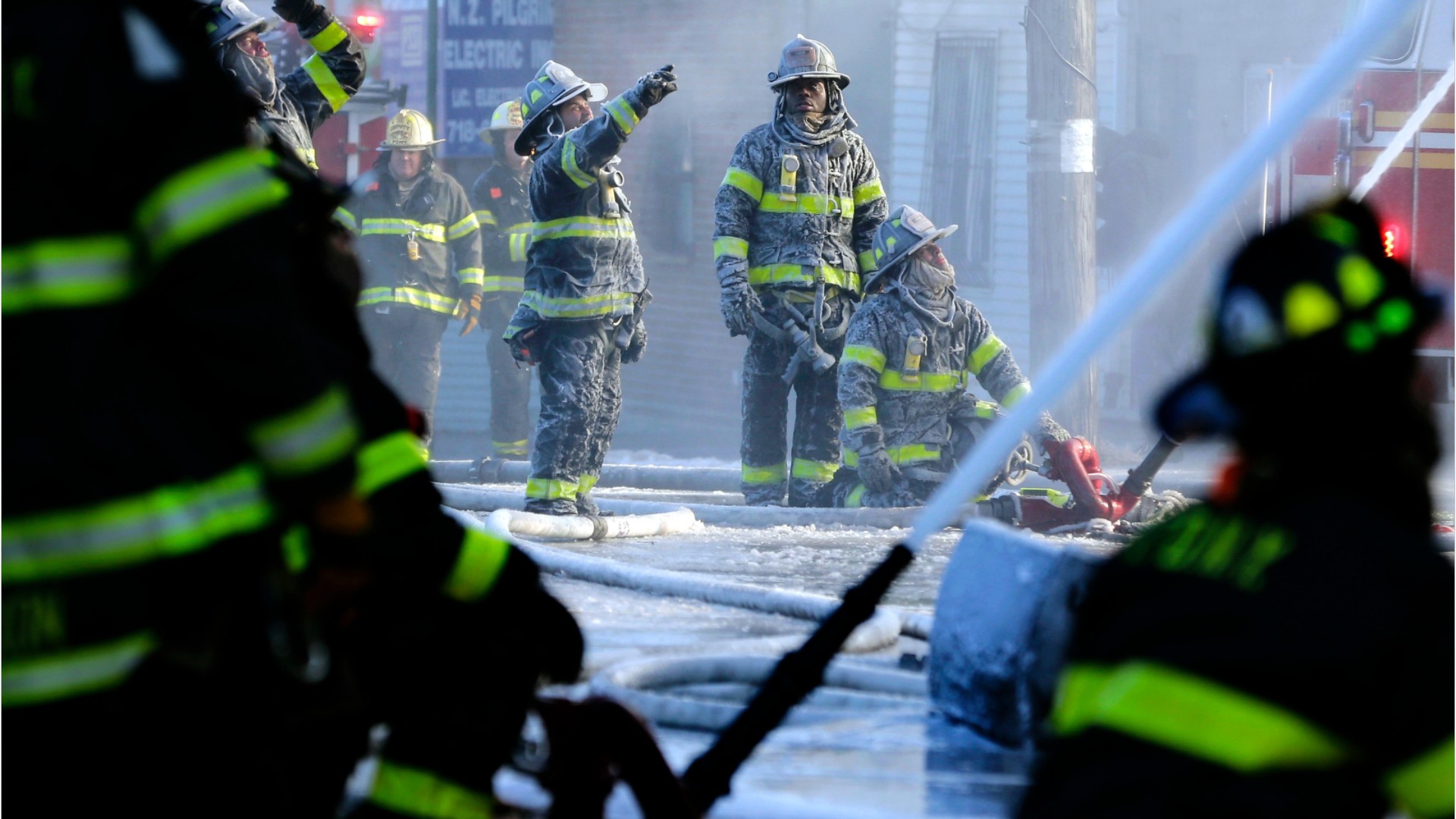
Control and extinguish fires or respond to emergency situations where life, property, or the environment is at risk. Duties may include fire prevention, emergency medical service, hazardous material response, search and rescue, and disaster assistance.
Yearly Salary
| High: | $93K |
| Median: | $52K |
| Low: | $26K |
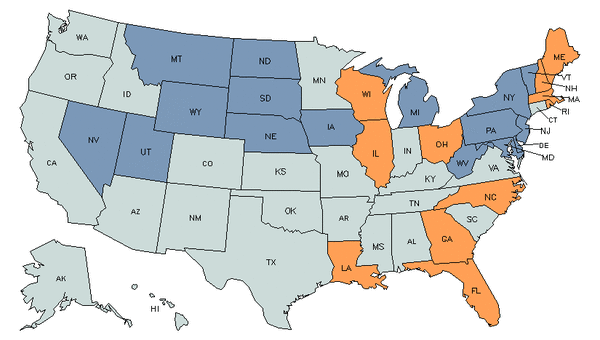
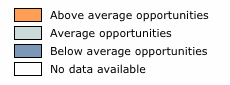
Demand
Core Tasks
- Rescue survivors from burning buildings, accident sites, and water hazards.
- Dress with equipment such as fire-resistant clothing and breathing apparatus.
- Assess fires and situations and report conditions to superiors to receive instructions, using two-way radios.
- Move toward the source of a fire, using knowledge of types of fires, construction design, building materials, and physical layout of properties.
- Respond to fire alarms and other calls for assistance, such as automobile and industrial accidents.
- Create openings in buildings for ventilation or entrance, using axes, chisels, crowbars, electric saws, or core cutters.
- Drive and operate fire fighting vehicles and equipment.
- Inspect fire sites after flames have been extinguished to ensure that there is no further danger.
- Position and climb ladders to gain access to upper levels of buildings, or to rescue individuals from burning structures.
- Select and attach hose nozzles, depending on fire type, and direct streams of water or chemicals onto fires.
- Operate pumps connected to high-pressure hoses.
- Collaborate with other firefighters as a member of a firefighting crew.
- Maintain contact with fire dispatchers at all times to notify them of the need for additional firefighters and supplies, or to detail any difficulties encountered.
- Collaborate with police to respond to accidents, disasters, and arson investigation calls.
- Patrol burned areas after fires to locate and eliminate hot spots that may restart fires.
- Maintain knowledge of current firefighting practices by participating in drills and by attending seminars, conventions, and conferences.
- Participate in fire drills and demonstrations of fire fighting techniques.
- Prepare written reports that detail specifics of fire incidents.
- Inform and educate the public on fire prevention.
- Participate in physical training activities to maintain a high level of physical fitness.
- Protect property from water and smoke, using waterproof salvage covers, smoke ejectors, and deodorants.
- Salvage property by removing broken glass, pumping out water, and ventilating buildings to remove smoke.
- Clean and maintain fire stations and fire fighting equipment and apparatus.
- Inspect buildings for fire hazards and compliance with fire prevention ordinances, testing and checking smoke alarms and fire suppression equipment as necessary.
- Orient self in relation to fire, using compass and map, and collect supplies and equipment dropped by parachute.
- Take action to contain any hazardous chemicals that could catch fire, leak, or spill.
- Extinguish flames and embers to suppress fires, using shovels or engine- or hand-driven water or chemical pumps.
Technology Skills
Technology
Example
Hot Technology
Tools Used
Tool
Example
Top 10 Knowledge Required
Public Safety and Security
91%
Knowledge of relevant equipment, policies, procedures, and strategies to promote effective local, state, or national security operations for the protection of people, data, property, and institutions.
Customer and Personal Service
84%
Knowledge of principles and processes for providing customer and personal services. This includes customer needs assessment, meeting quality standards for services, and evaluation of customer satisfaction.
Education and Training
83%
Knowledge of principles and methods for curriculum and training design, teaching and instruction for individuals and groups, and the measurement of training effects.
Building and Construction
81%
Knowledge of materials, methods, and the tools involved in the construction or repair of houses, buildings, or other structures such as highways and roads.
English Language
79%
Knowledge of the structure and content of the English language including the meaning and spelling of words, and rules of composition and grammar.
Mechanical
76%
Knowledge of machines and tools, including their designs, uses, repair, and maintenance.
Medicine and Dentistry
73%
Knowledge of the information and techniques needed to diagnose and treat human injuries, diseases, and deformities. This includes symptoms, treatment alternatives, drug properties and interactions, and preventive health-care measures.
Telecommunications
72%
Knowledge of transmission, broadcasting, switching, control, and operation of telecommunications systems.
Administration and Management
69%
Knowledge of business and management principles involved in strategic planning, resource allocation, human resources modeling, leadership technique, production methods, and coordination of people and resources.
Transportation
69%
Knowledge of principles and methods for moving people or goods by air, rail, sea, or road, including the relative costs and benefits.
Top 10 Skills
Critical Thinking
78%
Using logic and reasoning to identify the strengths and weaknesses of alternative solutions, conclusions, or approaches to problems.
Coordination
73%
Adjusting actions in relation to others' actions.
Judgment and Decision Making
73%
Considering the relative costs and benefits of potential actions to choose the most appropriate one.
Service Orientation
73%
Actively looking for ways to help people.
Active Learning
70%
Understanding the implications of new information for both current and future problem-solving and decision-making.
Active Listening
70%
Giving full attention to what other people are saying, taking time to understand the points being made, asking questions as appropriate, and not interrupting at inappropriate times.
Monitoring
70%
Monitoring/Assessing performance of yourself, other individuals, or organizations to make improvements or take corrective action.
Speaking
70%
Talking to others to convey information effectively.
Social Perceptiveness
68%
Being aware of others' reactions and understanding why they react as they do.
Complex Problem Solving
65%
Identifying complex problems and reviewing related information to develop and evaluate options and implement solutions.
Top 10 Abilities
Problem Sensitivity
83%
The ability to tell when something is wrong or is likely to go wrong. It does not involve solving the problem, only recognizing that there is a problem.
Oral Comprehension
78%
The ability to listen to and understand information and ideas presented through spoken words and sentences.
Arm-Hand Steadiness
75%
The ability to keep your hand and arm steady while moving your arm or while holding your arm and hand in one position.
Deductive Reasoning
75%
The ability to apply general rules to specific problems to produce answers that make sense.
Far Vision
75%
The ability to see details at a distance.
Oral Expression
75%
The ability to communicate information and ideas in speaking so others will understand.
Static Strength
75%
The ability to exert maximum muscle force to lift, push, pull, or carry objects.
Control Precision
73%
The ability to quickly and repeatedly adjust the controls of a machine or a vehicle to exact positions.
Inductive Reasoning
73%
The ability to combine pieces of information to form general rules or conclusions (includes finding a relationship among seemingly unrelated events).
Multilimb Coordination
73%
The ability to coordinate two or more limbs (for example, two arms, two legs, or one leg and one arm) while sitting, standing, or lying down. It does not involve performing the activities while the whole body is in motion.
Top 10 Work Activities
Inspecting Equipment, Structures, or Materials
91%
Inspecting equipment, structures, or materials to identify the cause of errors or other problems or defects.
Assisting and Caring for Others
90%
Providing personal assistance, medical attention, emotional support, or other personal care to others such as coworkers, customers, or patients.
Operating Vehicles, Mechanized Devices, or Equipment
90%
Running, maneuvering, navigating, or driving vehicles or mechanized equipment, such as forklifts, passenger vehicles, aircraft, or watercraft.
Making Decisions and Solving Problems
88%
Analyzing information and evaluating results to choose the best solution and solve problems.
Performing General Physical Activities
87%
Performing general physical activities includes doing activities that require considerable use of your arms and legs and moving your whole body, such as climbing, lifting, balancing, walking, stooping, and handling materials.
Getting Information
85%
Observing, receiving, and otherwise obtaining information from all relevant sources.
Performing for or Working Directly with the Public
85%
Performing for people or dealing directly with the public. This includes serving customers in restaurants and stores, and receiving clients or guests.
Documenting/Recording Information
84%
Entering, transcribing, recording, storing, or maintaining information in written or electronic/magnetic form.
Handling and Moving Objects
84%
Using hands and arms in handling, installing, positioning, and moving materials, and manipulating things.
Identifying Objects, Actions, and Events
84%
Identifying information by categorizing, estimating, recognizing differences or similarities, and detecting changes in circumstances or events.
Detailed Work Activities
- Rescue people from hazardous situations.
- Select tools, equipment, or technologies for use in operations or projects.
- Assess characteristics of fires.
- Relay information about incidents or emergencies to personnel using phones or two-way radios.
- Locate fires or fire danger areas.
- Respond to emergencies to provide assistance.
- Operate firefighting equipment.
- Examine debris to obtain information about causes of fires.
- Prepare hoses or water supplies to fight fires.
- Request emergency personnel.
- Communicate with other workers to coordinate activities.
- Patrol natural areas to ensure safety or enforce regulations.
- Collaborate with law enforcement or security agencies to respond to incidents.
- Demonstrate activity techniques or equipment use.
- Prepare investigation or incident reports.
- Attend training to learn new skills or update knowledge.
- Maintain professional knowledge or certifications.
- Participate in physical training to maintain fitness.
- Protect property from fire or water damage.
- Educate the public about fire safety or prevention.
- Maintain fire fighting tools or equipment.
- Inspect facilities to ensure compliance with fire regulations.
- Inspect equipment to ensure safety or proper functioning.
- Provide first aid or rescue assistance in emergencies.
- Treat medical emergencies.
- Implement advanced life support techniques.
- Train personnel on proper operational procedures.
Education
Interests
Realistic
94%
Work involves designing, building, or repairing of equipment, materials, or structures, engaging in physical activity, or working outdoors. Realistic occupations are often associated with engineering, mechanics and electronics, construction, woodworking, transportation, machine operation, agriculture, animal services, physical or manual labor, athletics, or protective services.
Conventional
50%
Work involves following procedures and regulations to organize information or data, typically in a business setting. Conventional occupations are often associated with office work, accounting, mathematics/statistics, information technology, finance, or human resources.
Social
49%
Work involves helping, teaching, advising, assisting, or providing service to others. Social occupations are often associated with social, health care, personal service, teaching/education, or religious activities.
Enterprising
43%
Work involves managing, negotiating, marketing, or selling, typically in a business setting, or leading or advising people in political and legal situations. Enterprising occupations are often associated with business initiatives, sales, marketing/advertising, finance, management/administration, professional advising, public speaking, politics, or law.
Investigative
42%
Work involves studying and researching non-living objects, living organisms, disease or other forms of impairment, or human behavior. Investigative occupations are often associated with physical, life, medical, or social sciences, and can be found in the fields of humanities, mathematics/statistics, information technology, or health care service.
Artistic
19%
Work involves creating original visual artwork, performances, written works, food, or music for a variety of media, or applying artistic principles to the design of various objects and materials. Artistic occupations are often associated with visual arts, applied arts and design, performing arts, music, creative writing, media, or culinary art.
Work Values
Support
84%
Occupations that satisfy this work value offer supportive management that stands behind employees. Corresponding needs are Company Policies, Supervision: Human Relations and Supervision: Technical.
Relationships
81%
Occupations that satisfy this work value allow employees to provide service to others and work with co-workers in a friendly non-competitive environment. Corresponding needs are Co-workers, Moral Values and Social Service.
Achievement
79%
Occupations that satisfy this work value are results oriented and allow employees to use their strongest abilities, giving them a feeling of accomplishment. Corresponding needs are Ability Utilization and Achievement.
Recognition
69%
Occupations that satisfy this work value offer advancement, potential for leadership, and are often considered prestigious. Corresponding needs are Advancement, Authority, Recognition and Social Status.
Independence
67%
Occupations that satisfy this work value allow employees to work on their own and make decisions. Corresponding needs are Creativity, Responsibility and Autonomy.
Working Conditions
65%
Occupations that satisfy this work value offer job security and good working conditions. Corresponding needs are Activity, Compensation, Independence, Security, Variety and Working Conditions.
Colleges
SAGE Scholars Member Schools that offer majors leading to this career.
Check out the College Search to see the full list of schools with majors for this career.