Police and Sheriff's Patrol Officers
Overview
SaveJob Zone Three: Medium Preparation Needed
Experience
Previous work-related skill, knowledge, or experience is required for these occupations. For example, an electrician must have completed three or four years of apprenticeship or several years of vocational training, and often must have passed a licensing exam, in order to perform the job.
Education
Most occupations in this zone require training in vocational schools, related on-the-job experience, or an associate's degree.
Job Training
Employees in these occupations usually need one or two years of training involving both on-the-job experience and informal training with experienced workers. A recognized apprenticeship program may be associated with these occupations.
Examples
These occupations usually involve using communication and organizational skills to coordinate, supervise, manage, or train others to accomplish goals. Examples include hydroelectric production managers, desktop publishers, electricians, agricultural technicians, barbers, court reporters and simultaneous captioners, and medical assistants.
Maintain order and protect life and property by enforcing local, tribal, state, or federal laws and ordinances. Perform a combination of the following duties: patrol a specific area; direct traffic; issue traffic summonses; investigate accidents; apprehend and arrest suspects, or serve legal processes of courts. Includes police officers working at educational institutions.

Yearly Salary
| High: | $109K |
| Median: | $65K |
| Low: | $38K |
Demand
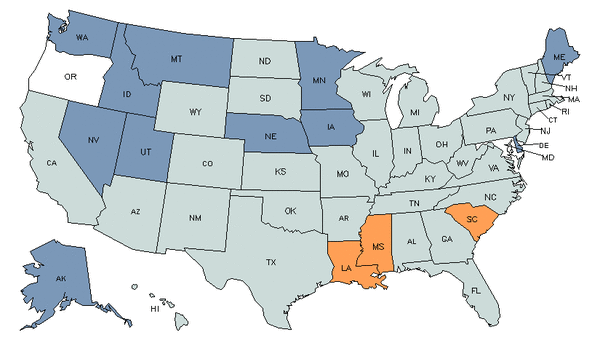
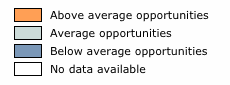
Core Tasks
- Identify, pursue, and arrest suspects and perpetrators of criminal acts.
- Provide for public safety by maintaining order, responding to emergencies, protecting people and property, enforcing motor vehicle and criminal laws, and promoting good community relations.
- Record facts to prepare reports that document incidents and activities.
- Render aid to accident survivors and other persons requiring first aid for physical injuries.
- Investigate illegal or suspicious activities.
- Review facts of incidents to determine if criminal act or statute violations were involved.
- Monitor, note, report, and investigate suspicious persons and situations, safety hazards, and unusual or illegal activity in patrol area.
- Process prisoners, and prepare and maintain records of prisoner bookings and prisoner status during booking and pre-trial process.
- Testify in court to present evidence or act as witness in traffic and criminal cases.
- Monitor traffic to ensure motorists observe traffic regulations and exhibit safe driving procedures.
- Relay complaint and emergency-request information to appropriate agency dispatchers.
- Drive vehicles or patrol specific areas to detect law violators, issue citations, and make arrests.
- Evaluate complaint and emergency-request information to determine response requirements.
- Execute arrest warrants, locating and taking persons into custody.
- Patrol and guard courthouses, grand jury rooms, or assigned areas to provide security, enforce laws, maintain order, and arrest violators.
- Photograph or draw diagrams of crime or accident scenes and interview principals and eyewitnesses.
- Investigate traffic accidents and other accidents to determine causes and to determine if a crime has been committed.
- Patrol specific area on foot, horseback, or motorized conveyance, responding promptly to calls for assistance.
- Supervise law enforcement staff, such as jail staff, officers, and deputy sheriffs.
- Verify that the proper legal charges have been made against law offenders.
- Transport or escort prisoners and defendants en route to courtrooms, prisons or jails, attorneys' offices, or medical facilities.
- Direct traffic flow and reroute traffic in case of emergencies.
- Question individuals entering secured areas to determine their business, directing and rerouting individuals as necessary.
- Notify patrol units to take violators into custody or to provide needed assistance or medical aid.
- Place people in protective custody.
- Inform citizens of community services and recommend options to facilitate longer-term problem resolution.
- Serve statements of claims, subpoenas, summonses, jury summonses, orders to pay alimony, and other court orders.
- Locate and confiscate real or personal property, as directed by court order.
- Provide road information to assist motorists.
- Conduct community programs for all ages concerning topics such as drugs and violence.
Technology Skills
Technology
Example
Hot Technology
Tools Used
Tool
Example
Top 10 Knowledge Required
Law and Government
97%
Knowledge of laws, legal codes, court procedures, precedents, government regulations, executive orders, agency rules, and the democratic political process.
Public Safety and Security
97%
Knowledge of relevant equipment, policies, procedures, and strategies to promote effective local, state, or national security operations for the protection of people, data, property, and institutions.
English Language
86%
Knowledge of the structure and content of the English language including the meaning and spelling of words, and rules of composition and grammar.
Psychology
82%
Knowledge of human behavior and performance; individual differences in ability, personality, and interests; learning and motivation; psychological research methods; and the assessment and treatment of behavioral and affective disorders.
Customer and Personal Service
80%
Knowledge of principles and processes for providing customer and personal services. This includes customer needs assessment, meeting quality standards for services, and evaluation of customer satisfaction.
Education and Training
76%
Knowledge of principles and methods for curriculum and training design, teaching and instruction for individuals and groups, and the measurement of training effects.
Administration and Management
70%
Knowledge of business and management principles involved in strategic planning, resource allocation, human resources modeling, leadership technique, production methods, and coordination of people and resources.
Telecommunications
70%
Knowledge of transmission, broadcasting, switching, control, and operation of telecommunications systems.
Administrative
69%
Knowledge of administrative and office procedures and systems such as word processing, managing files and records, stenography and transcription, designing forms, and workplace terminology.
Computers and Electronics
68%
Knowledge of circuit boards, processors, chips, electronic equipment, and computer hardware and software, including applications and programming.
Top 10 Skills
Active Listening
78%
Giving full attention to what other people are saying, taking time to understand the points being made, asking questions as appropriate, and not interrupting at inappropriate times.
Social Perceptiveness
78%
Being aware of others' reactions and understanding why they react as they do.
Speaking
78%
Talking to others to convey information effectively.
Active Learning
75%
Understanding the implications of new information for both current and future problem-solving and decision-making.
Critical Thinking
75%
Using logic and reasoning to identify the strengths and weaknesses of alternative solutions, conclusions, or approaches to problems.
Coordination
73%
Adjusting actions in relation to others' actions.
Judgment and Decision Making
73%
Considering the relative costs and benefits of potential actions to choose the most appropriate one.
Persuasion
73%
Persuading others to change their minds or behavior.
Reading Comprehension
73%
Understanding written sentences and paragraphs in work-related documents.
Monitoring
70%
Monitoring/Assessing performance of yourself, other individuals, or organizations to make improvements or take corrective action.
Top 10 Abilities
Oral Comprehension
90%
The ability to listen to and understand information and ideas presented through spoken words and sentences.
Problem Sensitivity
90%
The ability to tell when something is wrong or is likely to go wrong. It does not involve solving the problem, only recognizing that there is a problem.
Deductive Reasoning
85%
The ability to apply general rules to specific problems to produce answers that make sense.
Inductive Reasoning
85%
The ability to combine pieces of information to form general rules or conclusions (includes finding a relationship among seemingly unrelated events).
Oral Expression
83%
The ability to communicate information and ideas in speaking so others will understand.
Speech Clarity
78%
The ability to speak clearly so others can understand you.
Written Comprehension
78%
The ability to read and understand information and ideas presented in writing.
Information Ordering
75%
The ability to arrange things or actions in a certain order or pattern according to a specific rule or set of rules (e.g., patterns of numbers, letters, words, pictures, mathematical operations).
Near Vision
75%
The ability to see details at close range (within a few feet of the observer).
Far Vision
73%
The ability to see details at a distance.
Top 10 Work Activities
Performing for or Working Directly with the Public
96%
Performing for people or dealing directly with the public. This includes serving customers in restaurants and stores, and receiving clients or guests.
Getting Information
94%
Observing, receiving, and otherwise obtaining information from all relevant sources.
Resolving Conflicts and Negotiating with Others
94%
Handling complaints, settling disputes, and resolving grievances and conflicts, or otherwise negotiating with others.
Making Decisions and Solving Problems
92%
Analyzing information and evaluating results to choose the best solution and solve problems.
Identifying Objects, Actions, and Events
91%
Identifying information by categorizing, estimating, recognizing differences or similarities, and detecting changes in circumstances or events.
Communicating with Supervisors, Peers, or Subordinates
90%
Providing information to supervisors, co-workers, and subordinates by telephone, in written form, e-mail, or in person.
Operating Vehicles, Mechanized Devices, or Equipment
90%
Running, maneuvering, navigating, or driving vehicles or mechanized equipment, such as forklifts, passenger vehicles, aircraft, or watercraft.
Documenting/Recording Information
89%
Entering, transcribing, recording, storing, or maintaining information in written or electronic/magnetic form.
Assisting and Caring for Others
87%
Providing personal assistance, medical attention, emotional support, or other personal care to others such as coworkers, customers, or patients.
Communicating with People Outside the Organization
87%
Communicating with people outside the organization, representing the organization to customers, the public, government, and other external sources. This information can be exchanged in person, in writing, or by telephone or e-mail.
Detailed Work Activities
- Apprehend criminal suspects.
- Maintain public order or security.
- Respond to emergencies to provide assistance.
- Prepare investigation or incident reports.
- Administer first aid.
- Investigate accidents to determine causes.
- Investigate illegal or suspicious activities.
- Maintain surveillance of individuals or establishments.
- Communicate situation details to appropriate personnel.
- Testify at legal or legislative proceedings.
- Relay information about incidents or emergencies to personnel using phones or two-way radios.
- Monitor access or flow of people to prevent problems.
- Patrol properties to maintain safety.
- Guard facilities.
- Interview people to gather information about criminal activities.
- Record crime or accident scene evidence with video or still cameras.
- Determine operational procedures.
- Investigate legal issues.
- Escort prisoners to courtrooms, prisons, or other facilities.
- Direct vehicle traffic.
- Interview people to obtain information about actions or status of individuals.
- Detain suspects or witnesses.
- Serve court ordered documents.
- Inform the public about policies, services or procedures.
- Recommend improvements to increase safety or reduce risks.
- Locate suspicious objects or vehicles.
- Confiscate prohibited or dangerous items.
- Assist motorists or pedestrians.
- Communicate health and wellness information to the public.
- Present social services program information to the public.
- Record information about suspects or criminals.
- Maintain operational records.
- Direct law enforcement activities.
Education
Interests
Realistic
77%
Work involves designing, building, or repairing of equipment, materials, or structures, engaging in physical activity, or working outdoors. Realistic occupations are often associated with engineering, mechanics and electronics, construction, woodworking, transportation, machine operation, agriculture, animal services, physical or manual labor, athletics, or protective services.
Conventional
63%
Work involves following procedures and regulations to organize information or data, typically in a business setting. Conventional occupations are often associated with office work, accounting, mathematics/statistics, information technology, finance, or human resources.
Enterprising
59%
Work involves managing, negotiating, marketing, or selling, typically in a business setting, or leading or advising people in political and legal situations. Enterprising occupations are often associated with business initiatives, sales, marketing/advertising, finance, management/administration, professional advising, public speaking, politics, or law.
Social
49%
Work involves helping, teaching, advising, assisting, or providing service to others. Social occupations are often associated with social, health care, personal service, teaching/education, or religious activities.
Investigative
40%
Work involves studying and researching non-living objects, living organisms, disease or other forms of impairment, or human behavior. Investigative occupations are often associated with physical, life, medical, or social sciences, and can be found in the fields of humanities, mathematics/statistics, information technology, or health care service.
Artistic
16%
Work involves creating original visual artwork, performances, written works, food, or music for a variety of media, or applying artistic principles to the design of various objects and materials. Artistic occupations are often associated with visual arts, applied arts and design, performing arts, music, creative writing, media, or culinary art.
Work Values
Achievement
81%
Occupations that satisfy this work value are results oriented and allow employees to use their strongest abilities, giving them a feeling of accomplishment. Corresponding needs are Ability Utilization and Achievement.
Independence
81%
Occupations that satisfy this work value allow employees to work on their own and make decisions. Corresponding needs are Creativity, Responsibility and Autonomy.
Relationships
81%
Occupations that satisfy this work value allow employees to provide service to others and work with co-workers in a friendly non-competitive environment. Corresponding needs are Co-workers, Moral Values and Social Service.
Support
81%
Occupations that satisfy this work value offer supportive management that stands behind employees. Corresponding needs are Company Policies, Supervision: Human Relations and Supervision: Technical.
Recognition
74%
Occupations that satisfy this work value offer advancement, potential for leadership, and are often considered prestigious. Corresponding needs are Advancement, Authority, Recognition and Social Status.
Working Conditions
68%
Occupations that satisfy this work value offer job security and good working conditions. Corresponding needs are Activity, Compensation, Independence, Security, Variety and Working Conditions.
Majors
Colleges
SAGE Scholars Member Schools that offer majors leading to this career.
Check out the College Search to see the full list of schools with majors for this career.