Nannies
Overview
SaveJob Zone Two: Some Preparation Needed
Experience
Some previous work-related skill, knowledge, or experience is usually needed. For example, a teller would benefit from experience working directly with the public.
Education
These occupations usually require a high school diploma.
Job Training
Employees in these occupations need anywhere from a few months to one year of working with experienced employees. A recognized apprenticeship program may be associated with these occupations.
Examples
These occupations often involve using your knowledge and skills to help others. Examples include orderlies, counter and rental clerks, customer service representatives, security guards, upholsterers, tellers, and dental laboratory technicians.
Care for children in private households and provide support and expertise to parents in satisfying children's physical, emotional, intellectual, and social needs. Duties may include meal planning and preparation, laundry and clothing care, organization of play activities and outings, discipline, intellectual stimulation, language activities, and transportation.
Yearly Salary
| High: | $37K |
| Median: | $25K |
| Low: | $18K |
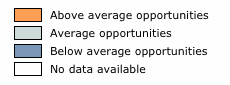
Demand

Core Tasks
- Instruct children in safe behavior, such as seeking adult assistance when crossing the street and avoiding contact with unsafe objects.
- Perform first aid or cardiopulmonary resuscitation (CPR) when required.
- Remove hazards and develop appropriate boundaries and rules to create a safe environment for children.
- Instruct and assist children in the development of health and personal habits, such as eating, resting, and toilet behavior.
- Regulate children's rest periods and nap schedules.
- Teach and perform age-appropriate activities, such as lap play, reading, and arts and crafts, to encourage intellectual development of children.
- Help prepare and serve nutritionally balanced meals and snacks for children.
- Model appropriate social behaviors and encourage concern for others to cultivate development of interpersonal relationships and communication skills.
- Organize and conduct age-appropriate recreational activities, such as games, arts and crafts, sports, walks, and play dates.
- Assign appropriate chores and praise targeted behaviors to encourage development of self-control, self-confidence, and responsibility.
- Observe children's behavior for irregularities, take temperature, transport children to doctor, or administer medications, as directed, to maintain children's health.
- Work with parents to develop and implement discipline programs to promote desirable child behavior.
- Meet regularly with parents to discuss children's activities and development.
- Perform housekeeping and cleaning duties related to children's care.
- Supervise and assist with homework.
- Transport children to schools, social outings, and medical appointments.
- Keep records of play, meal schedules, and bill payment.
- Help develop or monitor family schedule.
- Shop for groceries, clothing, and other items needed for children's care.
Technology Skills
Technology
Example
Hot Technology
Tools Used
Tool
Example
Top 10 Knowledge Required
English Language
76%
Knowledge of the structure and content of the English language including the meaning and spelling of words, and rules of composition and grammar.
Customer and Personal Service
72%
Knowledge of principles and processes for providing customer and personal services. This includes customer needs assessment, meeting quality standards for services, and evaluation of customer satisfaction.
Psychology
69%
Knowledge of human behavior and performance; individual differences in ability, personality, and interests; learning and motivation; psychological research methods; and the assessment and treatment of behavioral and affective disorders.
Education and Training
65%
Knowledge of principles and methods for curriculum and training design, teaching and instruction for individuals and groups, and the measurement of training effects.
Public Safety and Security
65%
Knowledge of relevant equipment, policies, procedures, and strategies to promote effective local, state, or national security operations for the protection of people, data, property, and institutions.
Sociology and Anthropology
55%
Knowledge of group behavior and dynamics, societal trends and influences, human migrations, ethnicity, cultures, and their history and origins.
Transportation
54%
Knowledge of principles and methods for moving people or goods by air, rail, sea, or road, including the relative costs and benefits.
Medicine and Dentistry
52%
Knowledge of the information and techniques needed to diagnose and treat human injuries, diseases, and deformities. This includes symptoms, treatment alternatives, drug properties and interactions, and preventive health-care measures.
Communications and Media
50%
Knowledge of media production, communication, and dissemination techniques and methods. This includes alternative ways to inform and entertain via written, oral, and visual media.
Food Production
50%
Knowledge of techniques and equipment for planting, growing, and harvesting food products (both plant and animal) for consumption, including storage/handling techniques.
Top 10 Skills
Active Listening
78%
Giving full attention to what other people are saying, taking time to understand the points being made, asking questions as appropriate, and not interrupting at inappropriate times.
Monitoring
78%
Monitoring/Assessing performance of yourself, other individuals, or organizations to make improvements or take corrective action.
Social Perceptiveness
78%
Being aware of others' reactions and understanding why they react as they do.
Service Orientation
75%
Actively looking for ways to help people.
Speaking
75%
Talking to others to convey information effectively.
Critical Thinking
73%
Using logic and reasoning to identify the strengths and weaknesses of alternative solutions, conclusions, or approaches to problems.
Judgment and Decision Making
73%
Considering the relative costs and benefits of potential actions to choose the most appropriate one.
Persuasion
73%
Persuading others to change their minds or behavior.
Coordination
70%
Adjusting actions in relation to others' actions.
Time Management
70%
Managing one's own time and the time of others.
Top 10 Abilities
Oral Comprehension
80%
The ability to listen to and understand information and ideas presented through spoken words and sentences.
Oral Expression
80%
The ability to communicate information and ideas in speaking so others will understand.
Problem Sensitivity
78%
The ability to tell when something is wrong or is likely to go wrong. It does not involve solving the problem, only recognizing that there is a problem.
Speech Clarity
75%
The ability to speak clearly so others can understand you.
Speech Recognition
75%
The ability to identify and understand the speech of another person.
Deductive Reasoning
73%
The ability to apply general rules to specific problems to produce answers that make sense.
Inductive Reasoning
70%
The ability to combine pieces of information to form general rules or conclusions (includes finding a relationship among seemingly unrelated events).
Written Comprehension
68%
The ability to read and understand information and ideas presented in writing.
Fluency of Ideas
63%
The ability to come up with a number of ideas about a topic (the number of ideas is important, not their quality, correctness, or creativity).
Near Vision
63%
The ability to see details at close range (within a few feet of the observer).
Top 10 Work Activities
Assisting and Caring for Others
96%
Providing personal assistance, medical attention, emotional support, or other personal care to others such as coworkers, customers, or patients.
Establishing and Maintaining Interpersonal Relationships
87%
Developing constructive and cooperative working relationships with others, and maintaining them over time.
Performing General Physical Activities
84%
Performing general physical activities includes doing activities that require considerable use of your arms and legs and moving your whole body, such as climbing, lifting, balancing, walking, stooping, and handling materials.
Making Decisions and Solving Problems
81%
Analyzing information and evaluating results to choose the best solution and solve problems.
Communicating with Supervisors, Peers, or Subordinates
79%
Providing information to supervisors, co-workers, and subordinates by telephone, in written form, e-mail, or in person.
Scheduling Work and Activities
79%
Scheduling events, programs, and activities, as well as the work of others.
Thinking Creatively
78%
Developing, designing, or creating new applications, ideas, relationships, systems, or products, including artistic contributions.
Getting Information
76%
Observing, receiving, and otherwise obtaining information from all relevant sources.
Organizing, Planning, and Prioritizing Work
74%
Developing specific goals and plans to prioritize, organize, and accomplish your work.
Resolving Conflicts and Negotiating with Others
73%
Handling complaints, settling disputes, and resolving grievances and conflicts, or otherwise negotiating with others.
Detailed Work Activities
- Teach daily living skills or behaviors.
- Monitor environment to ensure safety.
- Administer first aid.
- Teach health or hygiene practices.
- Develop daily schedules for children or families.
- Prepare foods or meals.
- Organize recreational activities or events.
- Monitor health or behavior of people or animals.
- Drive vehicles to transport patrons.
- Administer basic health care or medical treatments.
- Discuss child development and behavior with parents or guardians.
- Perform housekeeping duties.
- Provide escort or transportation.
- Maintain client information or service records.
- Provide for basic needs of children.
- Purchase products or services.
Education
Interests
Social
88%
Work involves helping, teaching, advising, assisting, or providing service to others. Social occupations are often associated with social, health care, personal service, teaching/education, or religious activities.
Artistic
55%
Work involves creating original visual artwork, performances, written works, food, or music for a variety of media, or applying artistic principles to the design of various objects and materials. Artistic occupations are often associated with visual arts, applied arts and design, performing arts, music, creative writing, media, or culinary art.
Conventional
47%
Work involves following procedures and regulations to organize information or data, typically in a business setting. Conventional occupations are often associated with office work, accounting, mathematics/statistics, information technology, finance, or human resources.
Realistic
43%
Work involves designing, building, or repairing of equipment, materials, or structures, engaging in physical activity, or working outdoors. Realistic occupations are often associated with engineering, mechanics and electronics, construction, woodworking, transportation, machine operation, agriculture, animal services, physical or manual labor, athletics, or protective services.
Enterprising
40%
Work involves managing, negotiating, marketing, or selling, typically in a business setting, or leading or advising people in political and legal situations. Enterprising occupations are often associated with business initiatives, sales, marketing/advertising, finance, management/administration, professional advising, public speaking, politics, or law.
Investigative
30%
Work involves studying and researching non-living objects, living organisms, disease or other forms of impairment, or human behavior. Investigative occupations are often associated with physical, life, medical, or social sciences, and can be found in the fields of humanities, mathematics/statistics, information technology, or health care service.
Work Values
Relationships
86%
Occupations that satisfy this work value allow employees to provide service to others and work with co-workers in a friendly non-competitive environment. Corresponding needs are Co-workers, Moral Values and Social Service.
Independence
72%
Occupations that satisfy this work value allow employees to work on their own and make decisions. Corresponding needs are Creativity, Responsibility and Autonomy.
Achievement
67%
Occupations that satisfy this work value are results oriented and allow employees to use their strongest abilities, giving them a feeling of accomplishment. Corresponding needs are Ability Utilization and Achievement.
Working Conditions
55%
Occupations that satisfy this work value offer job security and good working conditions. Corresponding needs are Activity, Compensation, Independence, Security, Variety and Working Conditions.
Recognition
34%
Occupations that satisfy this work value offer advancement, potential for leadership, and are often considered prestigious. Corresponding needs are Advancement, Authority, Recognition and Social Status.
Support
29%
Occupations that satisfy this work value offer supportive management that stands behind employees. Corresponding needs are Company Policies, Supervision: Human Relations and Supervision: Technical.
Colleges
SAGE Scholars Member Schools that offer majors leading to this career.
Check out the College Search to see the full list of schools with majors for this career.