Rotary Drill Operators, Oil and Gas
Overview
SaveJob Zone Two: Some Preparation Needed
Experience
Some previous work-related skill, knowledge, or experience is usually needed. For example, a teller would benefit from experience working directly with the public.
Education
These occupations usually require a high school diploma.
Job Training
Employees in these occupations need anywhere from a few months to one year of working with experienced employees. A recognized apprenticeship program may be associated with these occupations.
Examples
These occupations often involve using your knowledge and skills to help others. Examples include orderlies, counter and rental clerks, customer service representatives, security guards, upholsterers, tellers, and dental laboratory technicians.
Set up or operate a variety of drills to remove underground oil and gas, or remove core samples for testing during oil and gas exploration.
Yearly Salary
| High: | $90K |
| Median: | $53K |
| Low: | $33K |
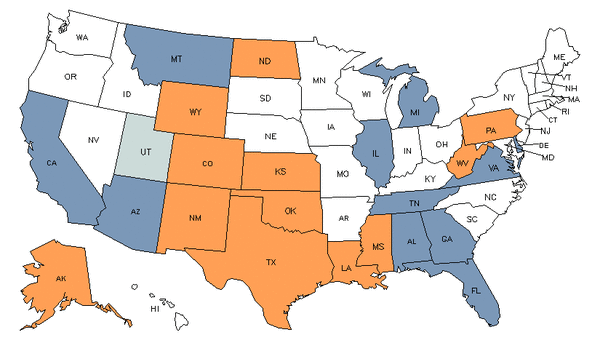
Demand

Core Tasks
- Observe pressure gauge and move throttles and levers to control the speed of rotary tables, and to regulate pressure of tools at bottoms of boreholes.
- Train crews, and introduce procedures to make drill work more safe and effective.
- Count sections of drill rod to determine depths of boreholes.
- Connect sections of drill pipe, using hand tools and powered wrenches and tongs.
- Maintain records of footage drilled, location and nature of strata penetrated, materials and tools used, services rendered, and time required.
- Push levers and brake pedals to control gasoline, diesel, electric, or steam draw works that lower and raise drill pipes and casings in and out of wells.
- Maintain and adjust machinery to ensure proper performance.
- Locate and recover lost or broken bits, casings, and drill pipes from wells, using special tools.
- Start and examine operation of slush pumps to ensure circulation and consistency of drilling fluid or mud in well.
- Direct rig crews in drilling and other activities, such as setting up rigs and completing or servicing wells.
- Weigh clay, and mix with water and chemicals to make drilling mud.
- Monitor progress of drilling operations, and select and change drill bits according to the nature of strata, using hand tools.
- Cap wells with packers, or turn valves, to regulate outflow of oil from wells.
- Repair or replace defective parts of machinery, such as rotary drill rigs, water trucks, air compressors, and pumps, using hand tools.
- Clean and oil pulleys, blocks, and cables.
- Bolt together pump and engine parts, and connect tanks and flow lines.
- Line drilled holes with pipes, and install all necessary hardware, to prepare new wells.
- Position and prepare truck-mounted derricks at drilling areas specified on field maps.
- Remove core samples during drilling to determine the nature of the strata being drilled.
- Plug observation wells, and restore sites.
Technology Skills
Technology
Example
Hot Technology
Tools Used
Tool
Example
Top 10 Knowledge Required
Mechanical
78%
Knowledge of machines and tools, including their designs, uses, repair, and maintenance.
Mathematics
76%
Knowledge of arithmetic, algebra, geometry, calculus, statistics, and their applications.
Administration and Management
67%
Knowledge of business and management principles involved in strategic planning, resource allocation, human resources modeling, leadership technique, production methods, and coordination of people and resources.
Education and Training
64%
Knowledge of principles and methods for curriculum and training design, teaching and instruction for individuals and groups, and the measurement of training effects.
Personnel and Human Resources
62%
Knowledge of principles and procedures for personnel recruitment, selection, training, compensation and benefits, labor relations and negotiation, and personnel information systems.
Public Safety and Security
57%
Knowledge of relevant equipment, policies, procedures, and strategies to promote effective local, state, or national security operations for the protection of people, data, property, and institutions.
Chemistry
55%
Knowledge of the chemical composition, structure, and properties of substances and of the chemical processes and transformations that they undergo. This includes uses of chemicals and their interactions, danger signs, production techniques, and disposal methods.
Production and Processing
55%
Knowledge of raw materials, production processes, quality control, costs, and other techniques for maximizing the effective manufacture and distribution of goods.
Transportation
55%
Knowledge of principles and methods for moving people or goods by air, rail, sea, or road, including the relative costs and benefits.
Engineering and Technology
53%
Knowledge of the practical application of engineering science and technology. This includes applying principles, techniques, procedures, and equipment to the design and production of various goods and services.
Top 10 Skills
Critical Thinking
73%
Using logic and reasoning to identify the strengths and weaknesses of alternative solutions, conclusions, or approaches to problems.
Operation and Control
73%
Controlling operations of equipment or systems.
Operations Monitoring
73%
Watching gauges, dials, or other indicators to make sure a machine is working properly.
Monitoring
70%
Monitoring/Assessing performance of yourself, other individuals, or organizations to make improvements or take corrective action.
Active Listening
68%
Giving full attention to what other people are saying, taking time to understand the points being made, asking questions as appropriate, and not interrupting at inappropriate times.
Instructing
68%
Teaching others how to do something.
Coordination
65%
Adjusting actions in relation to others' actions.
Speaking
65%
Talking to others to convey information effectively.
Complex Problem Solving
63%
Identifying complex problems and reviewing related information to develop and evaluate options and implement solutions.
Judgment and Decision Making
63%
Considering the relative costs and benefits of potential actions to choose the most appropriate one.
Top 10 Abilities
Control Precision
80%
The ability to quickly and repeatedly adjust the controls of a machine or a vehicle to exact positions.
Problem Sensitivity
80%
The ability to tell when something is wrong or is likely to go wrong. It does not involve solving the problem, only recognizing that there is a problem.
Near Vision
78%
The ability to see details at close range (within a few feet of the observer).
Arm-Hand Steadiness
75%
The ability to keep your hand and arm steady while moving your arm or while holding your arm and hand in one position.
Manual Dexterity
75%
The ability to quickly move your hand, your hand together with your arm, or your two hands to grasp, manipulate, or assemble objects.
Multilimb Coordination
75%
The ability to coordinate two or more limbs (for example, two arms, two legs, or one leg and one arm) while sitting, standing, or lying down. It does not involve performing the activities while the whole body is in motion.
Information Ordering
73%
The ability to arrange things or actions in a certain order or pattern according to a specific rule or set of rules (e.g., patterns of numbers, letters, words, pictures, mathematical operations).
Oral Comprehension
73%
The ability to listen to and understand information and ideas presented through spoken words and sentences.
Oral Expression
73%
The ability to communicate information and ideas in speaking so others will understand.
Finger Dexterity
70%
The ability to make precisely coordinated movements of the fingers of one or both hands to grasp, manipulate, or assemble very small objects.
Top 10 Work Activities
Inspecting Equipment, Structures, or Materials
92%
Inspecting equipment, structures, or materials to identify the cause of errors or other problems or defects.
Controlling Machines and Processes
89%
Using either control mechanisms or direct physical activity to operate machines or processes (not including computers or vehicles).
Handling and Moving Objects
87%
Using hands and arms in handling, installing, positioning, and moving materials, and manipulating things.
Performing General Physical Activities
85%
Performing general physical activities includes doing activities that require considerable use of your arms and legs and moving your whole body, such as climbing, lifting, balancing, walking, stooping, and handling materials.
Communicating with Supervisors, Peers, or Subordinates
84%
Providing information to supervisors, co-workers, and subordinates by telephone, in written form, e-mail, or in person.
Identifying Objects, Actions, and Events
84%
Identifying information by categorizing, estimating, recognizing differences or similarities, and detecting changes in circumstances or events.
Getting Information
83%
Observing, receiving, and otherwise obtaining information from all relevant sources.
Repairing and Maintaining Mechanical Equipment
83%
Servicing, repairing, adjusting, and testing machines, devices, moving parts, and equipment that operate primarily on the basis of mechanical (not electronic) principles.
Making Decisions and Solving Problems
82%
Analyzing information and evaluating results to choose the best solution and solve problems.
Operating Vehicles, Mechanized Devices, or Equipment
81%
Running, maneuvering, navigating, or driving vehicles or mechanized equipment, such as forklifts, passenger vehicles, aircraft, or watercraft.
Detailed Work Activities
- Train construction or extraction personnel.
- Operate drilling equipment.
- Measure work site dimensions.
- Operate cranes, hoists, or other moving or lifting equipment.
- Install drilling equipment.
- Record operational or environmental data.
- Maintain drilling equipment.
- Inspect equipment or tools to be used in construction or excavation.
- Operate pumps or compressors.
- Measure materials or objects for installation or assembly.
- Mix substances or compounds needed for work activities.
- Direct construction or extraction personnel.
- Monitor extraction operations.
- Select construction equipment.
- Install equipment attachments or components.
- Clean equipment or facilities.
- Assemble products or production equipment.
- Collect geological samples.
- Install plumbing or piping.
- Position construction or extraction equipment.
- Prepare excavation or extraction sites for commissioning or decommissioning.
Education
Interests
Realistic
100%
Work involves designing, building, or repairing of equipment, materials, or structures, engaging in physical activity, or working outdoors. Realistic occupations are often associated with engineering, mechanics and electronics, construction, woodworking, transportation, machine operation, agriculture, animal services, physical or manual labor, athletics, or protective services.
Conventional
54%
Work involves following procedures and regulations to organize information or data, typically in a business setting. Conventional occupations are often associated with office work, accounting, mathematics/statistics, information technology, finance, or human resources.
Investigative
44%
Work involves studying and researching non-living objects, living organisms, disease or other forms of impairment, or human behavior. Investigative occupations are often associated with physical, life, medical, or social sciences, and can be found in the fields of humanities, mathematics/statistics, information technology, or health care service.
Enterprising
32%
Work involves managing, negotiating, marketing, or selling, typically in a business setting, or leading or advising people in political and legal situations. Enterprising occupations are often associated with business initiatives, sales, marketing/advertising, finance, management/administration, professional advising, public speaking, politics, or law.
Social
17%
Work involves helping, teaching, advising, assisting, or providing service to others. Social occupations are often associated with social, health care, personal service, teaching/education, or religious activities.
Artistic
15%
Work involves creating original visual artwork, performances, written works, food, or music for a variety of media, or applying artistic principles to the design of various objects and materials. Artistic occupations are often associated with visual arts, applied arts and design, performing arts, music, creative writing, media, or culinary art.
Work Values
Support
86%
Occupations that satisfy this work value offer supportive management that stands behind employees. Corresponding needs are Company Policies, Supervision: Human Relations and Supervision: Technical.
Relationships
62%
Occupations that satisfy this work value allow employees to provide service to others and work with co-workers in a friendly non-competitive environment. Corresponding needs are Co-workers, Moral Values and Social Service.
Independence
48%
Occupations that satisfy this work value allow employees to work on their own and make decisions. Corresponding needs are Creativity, Responsibility and Autonomy.
Working Conditions
48%
Occupations that satisfy this work value offer job security and good working conditions. Corresponding needs are Activity, Compensation, Independence, Security, Variety and Working Conditions.
Recognition
43%
Occupations that satisfy this work value offer advancement, potential for leadership, and are often considered prestigious. Corresponding needs are Advancement, Authority, Recognition and Social Status.
Achievement
39%
Occupations that satisfy this work value are results oriented and allow employees to use their strongest abilities, giving them a feeling of accomplishment. Corresponding needs are Ability Utilization and Achievement.