Locomotive Engineers
Overview
SaveJob Zone Two: Some Preparation Needed
Experience
Some previous work-related skill, knowledge, or experience is usually needed. For example, a teller would benefit from experience working directly with the public.
Education
These occupations usually require a high school diploma.
Job Training
Employees in these occupations need anywhere from a few months to one year of working with experienced employees. A recognized apprenticeship program may be associated with these occupations.
Examples
These occupations often involve using your knowledge and skills to help others. Examples include orderlies, counter and rental clerks, customer service representatives, security guards, upholsterers, tellers, and dental laboratory technicians.
Drive electric, diesel-electric, steam, or gas-turbine-electric locomotives to transport passengers or freight. Interpret train orders, electronic or manual signals, and railroad rules and regulations.

Yearly Salary
| High: | $97K |
| Median: | $71K |
| Low: | $43K |
Demand
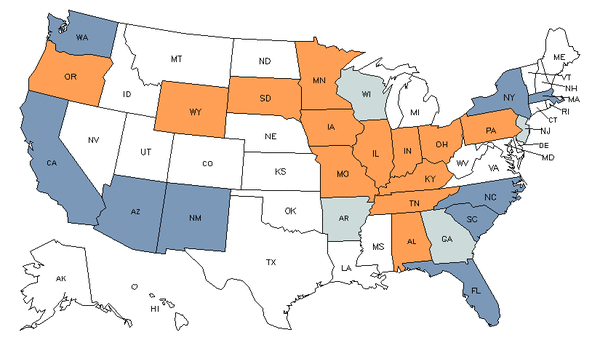

Core Tasks
- Interpret train orders, signals, or railroad rules and regulations that govern the operation of locomotives.
- Confer with conductors or traffic control center personnel via radiophones to issue or receive information concerning stops, delays, or oncoming trains.
- Monitor gauges or meters that measure speed, amperage, battery charge, or air pressure in brake lines or in main reservoirs.
- Receive starting signals from conductors and use controls such as throttles or air brakes to drive electric, diesel-electric, steam, or gas turbine-electric locomotives.
- Observe tracks to detect obstructions.
- Call out train signals to assistants to verify meanings.
- Operate locomotives to transport freight or passengers between stations or to assemble or disassemble trains within rail yards.
- Check to ensure that brake examination tests are conducted at shunting stations.
- Inspect locomotives to verify adequate fuel, sand, water, or other supplies before each run or to check for mechanical problems.
- Respond to emergency conditions or breakdowns, following applicable safety procedures and rules.
- Inspect locomotives after runs to detect damaged or defective equipment.
- Prepare reports regarding any problems encountered, such as accidents, signaling problems, unscheduled stops, or delays.
- Check to ensure that documentation, such as procedure manuals or logbooks, are in the driver's cab and available for staff use.
- Monitor train loading procedures to ensure that freight or rolling stock are loaded or unloaded without damage.
Technology Skills
Technology
Example
Hot Technology
Tools Used
Tool
Example
Top 10 Knowledge Required
Transportation
90%
Knowledge of principles and methods for moving people or goods by air, rail, sea, or road, including the relative costs and benefits.
Public Safety and Security
73%
Knowledge of relevant equipment, policies, procedures, and strategies to promote effective local, state, or national security operations for the protection of people, data, property, and institutions.
Education and Training
67%
Knowledge of principles and methods for curriculum and training design, teaching and instruction for individuals and groups, and the measurement of training effects.
English Language
67%
Knowledge of the structure and content of the English language including the meaning and spelling of words, and rules of composition and grammar.
Customer and Personal Service
61%
Knowledge of principles and processes for providing customer and personal services. This includes customer needs assessment, meeting quality standards for services, and evaluation of customer satisfaction.
Mechanical
60%
Knowledge of machines and tools, including their designs, uses, repair, and maintenance.
Administration and Management
56%
Knowledge of business and management principles involved in strategic planning, resource allocation, human resources modeling, leadership technique, production methods, and coordination of people and resources.
Law and Government
49%
Knowledge of laws, legal codes, court procedures, precedents, government regulations, executive orders, agency rules, and the democratic political process.
Telecommunications
49%
Knowledge of transmission, broadcasting, switching, control, and operation of telecommunications systems.
Computers and Electronics
47%
Knowledge of circuit boards, processors, chips, electronic equipment, and computer hardware and software, including applications and programming.
Top 10 Skills
Operation and Control
83%
Controlling operations of equipment or systems.
Operations Monitoring
80%
Watching gauges, dials, or other indicators to make sure a machine is working properly.
Active Listening
75%
Giving full attention to what other people are saying, taking time to understand the points being made, asking questions as appropriate, and not interrupting at inappropriate times.
Critical Thinking
73%
Using logic and reasoning to identify the strengths and weaknesses of alternative solutions, conclusions, or approaches to problems.
Monitoring
73%
Monitoring/Assessing performance of yourself, other individuals, or organizations to make improvements or take corrective action.
Speaking
73%
Talking to others to convey information effectively.
Judgment and Decision Making
68%
Considering the relative costs and benefits of potential actions to choose the most appropriate one.
Reading Comprehension
68%
Understanding written sentences and paragraphs in work-related documents.
Active Learning
63%
Understanding the implications of new information for both current and future problem-solving and decision-making.
Complex Problem Solving
63%
Identifying complex problems and reviewing related information to develop and evaluate options and implement solutions.
Top 10 Abilities
Far Vision
88%
The ability to see details at a distance.
Control Precision
80%
The ability to quickly and repeatedly adjust the controls of a machine or a vehicle to exact positions.
Response Orientation
80%
The ability to choose quickly between two or more movements in response to two or more different signals (lights, sounds, pictures). It includes the speed with which the correct response is started with the hand, foot, or other body part.
Selective Attention
80%
The ability to concentrate on a task over a period of time without being distracted.
Depth Perception
78%
The ability to judge which of several objects is closer or farther away from you, or to judge the distance between you and an object.
Near Vision
78%
The ability to see details at close range (within a few feet of the observer).
Problem Sensitivity
78%
The ability to tell when something is wrong or is likely to go wrong. It does not involve solving the problem, only recognizing that there is a problem.
Reaction Time
78%
The ability to quickly respond (with the hand, finger, or foot) to a signal (sound, light, picture) when it appears.
Multilimb Coordination
75%
The ability to coordinate two or more limbs (for example, two arms, two legs, or one leg and one arm) while sitting, standing, or lying down. It does not involve performing the activities while the whole body is in motion.
Oral Comprehension
75%
The ability to listen to and understand information and ideas presented through spoken words and sentences.
Top 10 Work Activities
Controlling Machines and Processes
93%
Using either control mechanisms or direct physical activity to operate machines or processes (not including computers or vehicles).
Identifying Objects, Actions, and Events
90%
Identifying information by categorizing, estimating, recognizing differences or similarities, and detecting changes in circumstances or events.
Inspecting Equipment, Structures, or Materials
90%
Inspecting equipment, structures, or materials to identify the cause of errors or other problems or defects.
Operating Vehicles, Mechanized Devices, or Equipment
89%
Running, maneuvering, navigating, or driving vehicles or mechanized equipment, such as forklifts, passenger vehicles, aircraft, or watercraft.
Getting Information
87%
Observing, receiving, and otherwise obtaining information from all relevant sources.
Evaluating Information to Determine Compliance with Standards
85%
Using relevant information and individual judgment to determine whether events or processes comply with laws, regulations, or standards.
Monitoring Processes, Materials, or Surroundings
84%
Monitoring and reviewing information from materials, events, or the environment, to detect or assess problems.
Communicating with Supervisors, Peers, or Subordinates
83%
Providing information to supervisors, co-workers, and subordinates by telephone, in written form, e-mail, or in person.
Processing Information
79%
Compiling, coding, categorizing, calculating, tabulating, auditing, or verifying information or data.
Making Decisions and Solving Problems
78%
Analyzing information and evaluating results to choose the best solution and solve problems.
Detailed Work Activities
- Monitor equipment gauges or displays to ensure proper operation.
- Monitor surroundings to detect potential hazards.
- Receive information or instructions for performing work assignments.
- Operate locomotives or other rail vehicles.
- Communicate with others to coordinate vehicle movement.
- Respond to transportation emergencies.
- Monitor operational quality or safety.
- Signal others to coordinate vehicle movement.
- Monitor availability of equipment or supplies.
- Prepare accident or incident reports.
- Inspect locomotives or other railroad equipment.
- Monitor loading processes to ensure they are performed properly.
Education
Interests
Realistic
97%
Work involves designing, building, or repairing of equipment, materials, or structures, engaging in physical activity, or working outdoors. Realistic occupations are often associated with engineering, mechanics and electronics, construction, woodworking, transportation, machine operation, agriculture, animal services, physical or manual labor, athletics, or protective services.
Conventional
65%
Work involves following procedures and regulations to organize information or data, typically in a business setting. Conventional occupations are often associated with office work, accounting, mathematics/statistics, information technology, finance, or human resources.
Investigative
50%
Work involves studying and researching non-living objects, living organisms, disease or other forms of impairment, or human behavior. Investigative occupations are often associated with physical, life, medical, or social sciences, and can be found in the fields of humanities, mathematics/statistics, information technology, or health care service.
Enterprising
31%
Work involves managing, negotiating, marketing, or selling, typically in a business setting, or leading or advising people in political and legal situations. Enterprising occupations are often associated with business initiatives, sales, marketing/advertising, finance, management/administration, professional advising, public speaking, politics, or law.
Social
28%
Work involves helping, teaching, advising, assisting, or providing service to others. Social occupations are often associated with social, health care, personal service, teaching/education, or religious activities.
Artistic
15%
Work involves creating original visual artwork, performances, written works, food, or music for a variety of media, or applying artistic principles to the design of various objects and materials. Artistic occupations are often associated with visual arts, applied arts and design, performing arts, music, creative writing, media, or culinary art.
Work Values
Support
86%
Occupations that satisfy this work value offer supportive management that stands behind employees. Corresponding needs are Company Policies, Supervision: Human Relations and Supervision: Technical.
Relationships
62%
Occupations that satisfy this work value allow employees to provide service to others and work with co-workers in a friendly non-competitive environment. Corresponding needs are Co-workers, Moral Values and Social Service.
Working Conditions
62%
Occupations that satisfy this work value offer job security and good working conditions. Corresponding needs are Activity, Compensation, Independence, Security, Variety and Working Conditions.
Independence
53%
Occupations that satisfy this work value allow employees to work on their own and make decisions. Corresponding needs are Creativity, Responsibility and Autonomy.
Recognition
48%
Occupations that satisfy this work value offer advancement, potential for leadership, and are often considered prestigious. Corresponding needs are Advancement, Authority, Recognition and Social Status.
Achievement
39%
Occupations that satisfy this work value are results oriented and allow employees to use their strongest abilities, giving them a feeling of accomplishment. Corresponding needs are Ability Utilization and Achievement.