Hoist and Winch Operators
Overview
SaveJob Zone Two: Some Preparation Needed
Experience
Some previous work-related skill, knowledge, or experience is usually needed. For example, a teller would benefit from experience working directly with the public.
Education
These occupations usually require a high school diploma.
Job Training
Employees in these occupations need anywhere from a few months to one year of working with experienced employees. A recognized apprenticeship program may be associated with these occupations.
Examples
These occupations often involve using your knowledge and skills to help others. Examples include orderlies, counter and rental clerks, customer service representatives, security guards, upholsterers, tellers, and dental laboratory technicians.
Operate or tend hoists or winches to lift and pull loads using power-operated cable equipment.

Yearly Salary
| High: | $98K |
| Median: | $62K |
| Low: | $31K |
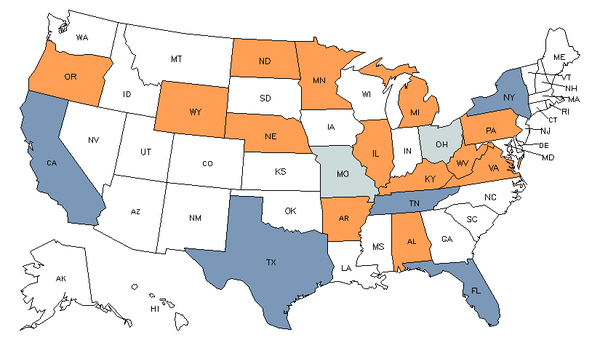
Demand

Core Tasks
- Move levers, pedals, and throttles to stop, start, and regulate speeds of hoist or winch drums in response to hand, bell, buzzer, telephone, loud-speaker, or whistle signals, or by observing dial indicators or cable marks.
- Apply hand or foot brakes and move levers to lock hoists or winches.
- Start engines of hoists or winches and use levers and pedals to wind or unwind cable on drums.
- Observe equipment gauges and indicators and hand signals of other workers to verify load positions or depths.
- Oil winch drums so that cables will wind smoothly.
- Operate compressed air, diesel, electric, gasoline, or steam-driven hoists or winches to control movement of cableways, cages, derricks, draglines, loaders, railcars, or skips.
- Climb ladders to position and set up vehicle-mounted derricks.
- Move or reposition hoists, winches, loads and materials, manually or using equipment and machines such as trucks, cars, and hand trucks.
- Select loads or materials according to weight and size specifications.
- Repair, maintain, and adjust equipment, using hand tools.
- Signal and assist other workers loading or unloading materials.
- Tend auxiliary equipment, such as jacks, slings, cables, or stop blocks, to facilitate moving items or materials for further processing.
- Attach, fasten, and disconnect cables or lines to loads, materials, and equipment, using hand tools.
Technology Skills
Technology
Example
Hot Technology
Tools Used
Tool
Example
Top 10 Knowledge Required
Mechanical
62%
Knowledge of machines and tools, including their designs, uses, repair, and maintenance.
Customer and Personal Service
58%
Knowledge of principles and processes for providing customer and personal services. This includes customer needs assessment, meeting quality standards for services, and evaluation of customer satisfaction.
English Language
53%
Knowledge of the structure and content of the English language including the meaning and spelling of words, and rules of composition and grammar.
Public Safety and Security
53%
Knowledge of relevant equipment, policies, procedures, and strategies to promote effective local, state, or national security operations for the protection of people, data, property, and institutions.
Transportation
52%
Knowledge of principles and methods for moving people or goods by air, rail, sea, or road, including the relative costs and benefits.
Administration and Management
50%
Knowledge of business and management principles involved in strategic planning, resource allocation, human resources modeling, leadership technique, production methods, and coordination of people and resources.
Education and Training
50%
Knowledge of principles and methods for curriculum and training design, teaching and instruction for individuals and groups, and the measurement of training effects.
Engineering and Technology
50%
Knowledge of the practical application of engineering science and technology. This includes applying principles, techniques, procedures, and equipment to the design and production of various goods and services.
Mathematics
46%
Knowledge of arithmetic, algebra, geometry, calculus, statistics, and their applications.
Physics
43%
Knowledge and prediction of physical principles, laws, their interrelationships, and applications to understanding fluid, material, and atmospheric dynamics, and mechanical, electrical, atomic and sub-atomic structures and processes.
Top 10 Skills
Critical Thinking
75%
Using logic and reasoning to identify the strengths and weaknesses of alternative solutions, conclusions, or approaches to problems.
Monitoring
73%
Monitoring/Assessing performance of yourself, other individuals, or organizations to make improvements or take corrective action.
Operations Monitoring
73%
Watching gauges, dials, or other indicators to make sure a machine is working properly.
Time Management
70%
Managing one's own time and the time of others.
Active Listening
68%
Giving full attention to what other people are saying, taking time to understand the points being made, asking questions as appropriate, and not interrupting at inappropriate times.
Operation and Control
68%
Controlling operations of equipment or systems.
Complex Problem Solving
65%
Identifying complex problems and reviewing related information to develop and evaluate options and implement solutions.
Judgment and Decision Making
65%
Considering the relative costs and benefits of potential actions to choose the most appropriate one.
Social Perceptiveness
63%
Being aware of others' reactions and understanding why they react as they do.
Speaking
63%
Talking to others to convey information effectively.
Top 10 Abilities
Problem Sensitivity
78%
The ability to tell when something is wrong or is likely to go wrong. It does not involve solving the problem, only recognizing that there is a problem.
Arm-Hand Steadiness
73%
The ability to keep your hand and arm steady while moving your arm or while holding your arm and hand in one position.
Control Precision
73%
The ability to quickly and repeatedly adjust the controls of a machine or a vehicle to exact positions.
Depth Perception
73%
The ability to judge which of several objects is closer or farther away from you, or to judge the distance between you and an object.
Reaction Time
73%
The ability to quickly respond (with the hand, finger, or foot) to a signal (sound, light, picture) when it appears.
Multilimb Coordination
70%
The ability to coordinate two or more limbs (for example, two arms, two legs, or one leg and one arm) while sitting, standing, or lying down. It does not involve performing the activities while the whole body is in motion.
Near Vision
70%
The ability to see details at close range (within a few feet of the observer).
Deductive Reasoning
68%
The ability to apply general rules to specific problems to produce answers that make sense.
Manual Dexterity
68%
The ability to quickly move your hand, your hand together with your arm, or your two hands to grasp, manipulate, or assemble objects.
Oral Comprehension
68%
The ability to listen to and understand information and ideas presented through spoken words and sentences.
Top 10 Work Activities
Repairing and Maintaining Mechanical Equipment
85%
Servicing, repairing, adjusting, and testing machines, devices, moving parts, and equipment that operate primarily on the basis of mechanical (not electronic) principles.
Getting Information
83%
Observing, receiving, and otherwise obtaining information from all relevant sources.
Handling and Moving Objects
83%
Using hands and arms in handling, installing, positioning, and moving materials, and manipulating things.
Operating Vehicles, Mechanized Devices, or Equipment
83%
Running, maneuvering, navigating, or driving vehicles or mechanized equipment, such as forklifts, passenger vehicles, aircraft, or watercraft.
Communicating with Supervisors, Peers, or Subordinates
82%
Providing information to supervisors, co-workers, and subordinates by telephone, in written form, e-mail, or in person.
Controlling Machines and Processes
82%
Using either control mechanisms or direct physical activity to operate machines or processes (not including computers or vehicles).
Monitoring Processes, Materials, or Surroundings
82%
Monitoring and reviewing information from materials, events, or the environment, to detect or assess problems.
Inspecting Equipment, Structures, or Materials
79%
Inspecting equipment, structures, or materials to identify the cause of errors or other problems or defects.
Organizing, Planning, and Prioritizing Work
79%
Developing specific goals and plans to prioritize, organize, and accomplish your work.
Identifying Objects, Actions, and Events
77%
Identifying information by categorizing, estimating, recognizing differences or similarities, and detecting changes in circumstances or events.
Detailed Work Activities
- Operate cranes, hoists, or other moving or lifting equipment.
- Monitor equipment gauges or displays to ensure proper operation.
- Move materials, equipment, or supplies.
- Position material handling equipment.
- Select project materials.
- Load shipments, belongings, or materials.
- Communicate with others to coordinate material handling or movement.
- Connect cables or electrical lines.
- Maintain material moving equipment in good working condition.
- Climb ladders or vehicles to perform duties.
Education
Interests
Realistic
99%
Work involves designing, building, or repairing of equipment, materials, or structures, engaging in physical activity, or working outdoors. Realistic occupations are often associated with engineering, mechanics and electronics, construction, woodworking, transportation, machine operation, agriculture, animal services, physical or manual labor, athletics, or protective services.
Conventional
48%
Work involves following procedures and regulations to organize information or data, typically in a business setting. Conventional occupations are often associated with office work, accounting, mathematics/statistics, information technology, finance, or human resources.
Investigative
23%
Work involves studying and researching non-living objects, living organisms, disease or other forms of impairment, or human behavior. Investigative occupations are often associated with physical, life, medical, or social sciences, and can be found in the fields of humanities, mathematics/statistics, information technology, or health care service.
Enterprising
21%
Work involves managing, negotiating, marketing, or selling, typically in a business setting, or leading or advising people in political and legal situations. Enterprising occupations are often associated with business initiatives, sales, marketing/advertising, finance, management/administration, professional advising, public speaking, politics, or law.
Social
21%
Work involves helping, teaching, advising, assisting, or providing service to others. Social occupations are often associated with social, health care, personal service, teaching/education, or religious activities.
Artistic
16%
Work involves creating original visual artwork, performances, written works, food, or music for a variety of media, or applying artistic principles to the design of various objects and materials. Artistic occupations are often associated with visual arts, applied arts and design, performing arts, music, creative writing, media, or culinary art.
Work Values
Support
86%
Occupations that satisfy this work value offer supportive management that stands behind employees. Corresponding needs are Company Policies, Supervision: Human Relations and Supervision: Technical.
Independence
67%
Occupations that satisfy this work value allow employees to work on their own and make decisions. Corresponding needs are Creativity, Responsibility and Autonomy.
Relationships
58%
Occupations that satisfy this work value allow employees to provide service to others and work with co-workers in a friendly non-competitive environment. Corresponding needs are Co-workers, Moral Values and Social Service.
Working Conditions
50%
Occupations that satisfy this work value offer job security and good working conditions. Corresponding needs are Activity, Compensation, Independence, Security, Variety and Working Conditions.
Achievement
43%
Occupations that satisfy this work value are results oriented and allow employees to use their strongest abilities, giving them a feeling of accomplishment. Corresponding needs are Ability Utilization and Achievement.
Recognition
34%
Occupations that satisfy this work value offer advancement, potential for leadership, and are often considered prestigious. Corresponding needs are Advancement, Authority, Recognition and Social Status.