Equal Opportunity Representatives and Officers
Overview
SaveJob Zone Four: Considerable Preparation Needed
Experience
A considerable amount of work-related skill, knowledge, or experience is needed for these occupations. For example, an accountant must complete four years of college and work for several years in accounting to be considered qualified.
Education
Most of these occupations require a four-year bachelor's degree, but some do not.
Job Training
Employees in these occupations usually need several years of work-related experience, on-the-job training, and/or vocational training.
Examples
Many of these occupations involve coordinating, supervising, managing, or training others. Examples include real estate brokers, sales managers, database administrators, graphic designers, conservation scientists, art directors, and cost estimators.
Monitor and evaluate compliance with equal opportunity laws, guidelines, and policies to ensure that employment practices and contracting arrangements give equal opportunity without regard to race, religion, color, national origin, sex, age, or disability.

Yearly Salary
| High: | $115K |
| Median: | $71K |
| Low: | $40K |
Demand
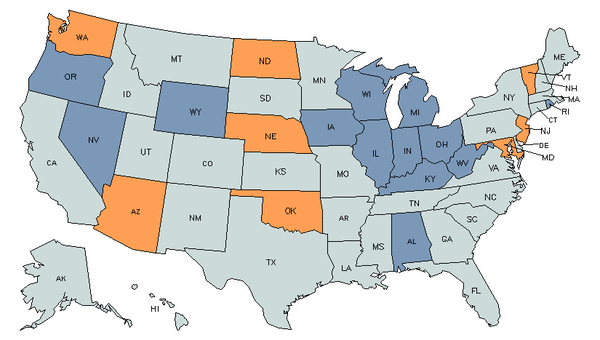
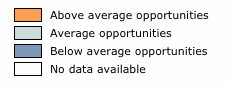
Core Tasks
- Investigate employment practices or alleged violations of laws to document and correct discriminatory factors.
- Interview persons involved in equal opportunity complaints to verify case information.
- Prepare reports related to investigations of equal opportunity complaints.
- Study equal opportunity complaints to clarify issues.
- Interpret civil rights laws and equal opportunity regulations for individuals or employers.
- Meet with persons involved in equal opportunity complaints to arbitrate and settle disputes.
- Develop guidelines for nondiscriminatory employment practices.
- Prepare reports of selection, survey, or other statistics and recommendations for corrective action.
- Monitor the implementation and impact of guidelines for nondiscriminatory employment practices.
- Coordinate, monitor, or revise complaint procedures to ensure timely processing and review of complaints.
- Provide information, technical assistance, or training to supervisors, managers, or employees on topics such as employee supervision, hiring, grievance procedures, or staff development.
- Conduct surveys and evaluate findings to determine if systematic discrimination exists.
- Meet with job search committees or coordinators to explain the role of the equal opportunity coordinator, to provide resources for advertising, or to explain expectations for future contacts.
- Counsel newly hired members of minority or disadvantaged groups, informing them about details of civil rights laws.
- Review company contracts to determine actions required to meet governmental equal opportunity provisions.
- Verify that all job descriptions are submitted for review and approval and that descriptions meet regulatory standards.
- Consult with community representatives to develop technical assistance agreements in accordance with governmental regulations.
- Participate in the recruitment of employees through job fairs, career days, or advertising plans.
Technology Skills
Technology
Example
Hot Technology
Tools Used
Tool
Example
Top 10 Knowledge Required
Law and Government
89%
Knowledge of laws, legal codes, court procedures, precedents, government regulations, executive orders, agency rules, and the democratic political process.
English Language
80%
Knowledge of the structure and content of the English language including the meaning and spelling of words, and rules of composition and grammar.
Personnel and Human Resources
79%
Knowledge of principles and procedures for personnel recruitment, selection, training, compensation and benefits, labor relations and negotiation, and personnel information systems.
Customer and Personal Service
76%
Knowledge of principles and processes for providing customer and personal services. This includes customer needs assessment, meeting quality standards for services, and evaluation of customer satisfaction.
Sociology and Anthropology
68%
Knowledge of group behavior and dynamics, societal trends and influences, human migrations, ethnicity, cultures, and their history and origins.
Administration and Management
66%
Knowledge of business and management principles involved in strategic planning, resource allocation, human resources modeling, leadership technique, production methods, and coordination of people and resources.
Administrative
64%
Knowledge of administrative and office procedures and systems such as word processing, managing files and records, stenography and transcription, designing forms, and workplace terminology.
Education and Training
61%
Knowledge of principles and methods for curriculum and training design, teaching and instruction for individuals and groups, and the measurement of training effects.
Psychology
58%
Knowledge of human behavior and performance; individual differences in ability, personality, and interests; learning and motivation; psychological research methods; and the assessment and treatment of behavioral and affective disorders.
Computers and Electronics
56%
Knowledge of circuit boards, processors, chips, electronic equipment, and computer hardware and software, including applications and programming.
Top 10 Skills
Active Listening
85%
Giving full attention to what other people are saying, taking time to understand the points being made, asking questions as appropriate, and not interrupting at inappropriate times.
Reading Comprehension
83%
Understanding written sentences and paragraphs in work-related documents.
Critical Thinking
80%
Using logic and reasoning to identify the strengths and weaknesses of alternative solutions, conclusions, or approaches to problems.
Social Perceptiveness
80%
Being aware of others' reactions and understanding why they react as they do.
Speaking
80%
Talking to others to convey information effectively.
Writing
78%
Communicating effectively in writing as appropriate for the needs of the audience.
Active Learning
75%
Understanding the implications of new information for both current and future problem-solving and decision-making.
Complex Problem Solving
75%
Identifying complex problems and reviewing related information to develop and evaluate options and implement solutions.
Judgment and Decision Making
73%
Considering the relative costs and benefits of potential actions to choose the most appropriate one.
Monitoring
68%
Monitoring/Assessing performance of yourself, other individuals, or organizations to make improvements or take corrective action.
Top 10 Abilities
Written Comprehension
88%
The ability to read and understand information and ideas presented in writing.
Oral Comprehension
85%
The ability to listen to and understand information and ideas presented through spoken words and sentences.
Inductive Reasoning
83%
The ability to combine pieces of information to form general rules or conclusions (includes finding a relationship among seemingly unrelated events).
Oral Expression
83%
The ability to communicate information and ideas in speaking so others will understand.
Problem Sensitivity
83%
The ability to tell when something is wrong or is likely to go wrong. It does not involve solving the problem, only recognizing that there is a problem.
Written Expression
83%
The ability to communicate information and ideas in writing so others will understand.
Deductive Reasoning
80%
The ability to apply general rules to specific problems to produce answers that make sense.
Speech Recognition
80%
The ability to identify and understand the speech of another person.
Speech Clarity
78%
The ability to speak clearly so others can understand you.
Information Ordering
75%
The ability to arrange things or actions in a certain order or pattern according to a specific rule or set of rules (e.g., patterns of numbers, letters, words, pictures, mathematical operations).
Top 10 Work Activities
Evaluating Information to Determine Compliance with Standards
96%
Using relevant information and individual judgment to determine whether events or processes comply with laws, regulations, or standards.
Identifying Objects, Actions, and Events
90%
Identifying information by categorizing, estimating, recognizing differences or similarities, and detecting changes in circumstances or events.
Communicating with Supervisors, Peers, or Subordinates
89%
Providing information to supervisors, co-workers, and subordinates by telephone, in written form, e-mail, or in person.
Resolving Conflicts and Negotiating with Others
89%
Handling complaints, settling disputes, and resolving grievances and conflicts, or otherwise negotiating with others.
Analyzing Data or Information
87%
Identifying the underlying principles, reasons, or facts of information by breaking down information or data into separate parts.
Getting Information
87%
Observing, receiving, and otherwise obtaining information from all relevant sources.
Establishing and Maintaining Interpersonal Relationships
86%
Developing constructive and cooperative working relationships with others, and maintaining them over time.
Making Decisions and Solving Problems
85%
Analyzing information and evaluating results to choose the best solution and solve problems.
Communicating with People Outside the Organization
84%
Communicating with people outside the organization, representing the organization to customers, the public, government, and other external sources. This information can be exchanged in person, in writing, or by telephone or e-mail.
Documenting/Recording Information
83%
Entering, transcribing, recording, storing, or maintaining information in written or electronic/magnetic form.
Detailed Work Activities
- Evaluate personnel practices to ensure adherence to regulations.
- Prepare research reports.
- Interview witnesses, suspects, or claimants.
- Explain regulations, policies, or procedures.
- Negotiate agreements to resolve disputes.
- Establish organizational guidelines or policies.
- Monitor organizational processes.
- Train personnel on managerial topics.
- Conduct surveys in organizations.
- Confer with personnel to coordinate business operations.
- Advise others on human resources topics.
- Coordinate regulatory documentation activities.
- Negotiate contracts with clients or service providers.
- Coordinate personnel recruitment activities.
Education
Interests
Enterprising
77%
Work involves managing, negotiating, marketing, or selling, typically in a business setting, or leading or advising people in political and legal situations. Enterprising occupations are often associated with business initiatives, sales, marketing/advertising, finance, management/administration, professional advising, public speaking, politics, or law.
Conventional
75%
Work involves following procedures and regulations to organize information or data, typically in a business setting. Conventional occupations are often associated with office work, accounting, mathematics/statistics, information technology, finance, or human resources.
Social
61%
Work involves helping, teaching, advising, assisting, or providing service to others. Social occupations are often associated with social, health care, personal service, teaching/education, or religious activities.
Investigative
43%
Work involves studying and researching non-living objects, living organisms, disease or other forms of impairment, or human behavior. Investigative occupations are often associated with physical, life, medical, or social sciences, and can be found in the fields of humanities, mathematics/statistics, information technology, or health care service.
Artistic
25%
Work involves creating original visual artwork, performances, written works, food, or music for a variety of media, or applying artistic principles to the design of various objects and materials. Artistic occupations are often associated with visual arts, applied arts and design, performing arts, music, creative writing, media, or culinary art.
Realistic
18%
Work involves designing, building, or repairing of equipment, materials, or structures, engaging in physical activity, or working outdoors. Realistic occupations are often associated with engineering, mechanics and electronics, construction, woodworking, transportation, machine operation, agriculture, animal services, physical or manual labor, athletics, or protective services.
Work Values
Relationships
81%
Occupations that satisfy this work value allow employees to provide service to others and work with co-workers in a friendly non-competitive environment. Corresponding needs are Co-workers, Moral Values and Social Service.
Achievement
77%
Occupations that satisfy this work value are results oriented and allow employees to use their strongest abilities, giving them a feeling of accomplishment. Corresponding needs are Ability Utilization and Achievement.
Independence
72%
Occupations that satisfy this work value allow employees to work on their own and make decisions. Corresponding needs are Creativity, Responsibility and Autonomy.
Working Conditions
72%
Occupations that satisfy this work value offer job security and good working conditions. Corresponding needs are Activity, Compensation, Independence, Security, Variety and Working Conditions.
Support
67%
Occupations that satisfy this work value offer supportive management that stands behind employees. Corresponding needs are Company Policies, Supervision: Human Relations and Supervision: Technical.
Recognition
62%
Occupations that satisfy this work value offer advancement, potential for leadership, and are often considered prestigious. Corresponding needs are Advancement, Authority, Recognition and Social Status.
Colleges
SAGE Scholars Member Schools that offer majors leading to this career.
Check out the College Search to see the full list of schools with majors for this career.