English Language and Literature Teachers, Postsecondary
Overview
SaveJob Zone Five: Extensive Preparation Needed
Experience
Extensive skill, knowledge, and experience are needed for these occupations. Many require more than five years of experience. For example, surgeons must complete four years of college and an additional five to seven years of specialized medical training to be able to do their job.
Education
Most of these occupations require graduate school. For example, they may require a master's degree, and some require a Ph.D., M.D., or J.D. (law degree).
Job Training
Employees may need some on-the-job training, but most of these occupations assume that the person will already have the required skills, knowledge, work-related experience, and/or training.
Examples
These occupations often involve coordinating, training, supervising, or managing the activities of others to accomplish goals. Very advanced communication and organizational skills are required. Examples include pharmacists, lawyers, astronomers, biologists, clergy, physician assistants, and veterinarians.
Teach courses in English language and literature, including linguistics and comparative literature. Includes both teachers primarily engaged in teaching and those who do a combination of teaching and research.

Yearly Salary
| High: | $141K |
| Median: | $69K |
| Low: | $39K |
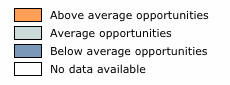
Demand

Core Tasks
- Evaluate and grade students' class work, assignments, and papers.
- Teach writing or communication classes.
- Prepare course materials, such as syllabi, homework assignments, and handouts.
- Initiate, facilitate, and moderate classroom discussions.
- Maintain student attendance records, grades, and other required records.
- Plan, evaluate, and revise curricula, course content, course materials, and methods of instruction.
- Assist students who need extra help with their coursework outside of class.
- Prepare and deliver lectures to undergraduate or graduate students on topics such as poetry, novel structure, and translation and adaptation.
- Keep abreast of developments in the field by reading current literature, talking with colleagues, and participating in professional conferences.
- Compile, administer, and grade examinations, or assign this work to others.
- Maintain regularly scheduled office hours to advise and assist students.
- Conduct research in a particular field of knowledge and publish findings in professional journals, books, or electronic media.
- Advise students on academic and vocational curricula and on career issues.
- Teach classes using online technology.
- Schedule courses.
- Collaborate with colleagues to address teaching and research issues.
- Write letters of recommendation for students.
- Select and obtain materials and supplies, such as textbooks.
- Supervise undergraduate or graduate teaching, internship, and research work.
- Perform administrative duties, such as serving as department head.
- Serve on academic or administrative committees that deal with institutional policies, departmental matters, and academic issues.
- Participate in campus and community events.
- Recruit, train, and supervise department personnel, such as faculty and student writing instructors.
- Compile bibliographies of specialized materials for outside reading assignments.
- Participate in student recruitment, registration, and placement activities.
- Participate in cultural and literary activities, such as traveling abroad and attending performing arts events.
- Provide assistance to students in college writing centers.
- Conduct staff performance evaluations.
- Write original literary pieces.
- Act as advisers to student organizations.
- Write grant proposals to procure external research funding.
- Review manuscripts for publication in professional journals.
- Provide professional consulting services to government or industry.
Technology Skills
Technology
Example
Hot Technology
Tools Used
Tool
Example
Top 10 Knowledge Required
English Language
95%
Knowledge of the structure and content of the English language including the meaning and spelling of words, and rules of composition and grammar.
Education and Training
90%
Knowledge of principles and methods for curriculum and training design, teaching and instruction for individuals and groups, and the measurement of training effects.
Communications and Media
82%
Knowledge of media production, communication, and dissemination techniques and methods. This includes alternative ways to inform and entertain via written, oral, and visual media.
History and Archeology
75%
Knowledge of historical events and their causes, indicators, and effects on civilizations and cultures.
Philosophy and Theology
75%
Knowledge of different philosophical systems and religions. This includes their basic principles, values, ethics, ways of thinking, customs, practices, and their impact on human culture.
Sociology and Anthropology
74%
Knowledge of group behavior and dynamics, societal trends and influences, human migrations, ethnicity, cultures, and their history and origins.
Customer and Personal Service
70%
Knowledge of principles and processes for providing customer and personal services. This includes customer needs assessment, meeting quality standards for services, and evaluation of customer satisfaction.
Computers and Electronics
67%
Knowledge of circuit boards, processors, chips, electronic equipment, and computer hardware and software, including applications and programming.
Psychology
66%
Knowledge of human behavior and performance; individual differences in ability, personality, and interests; learning and motivation; psychological research methods; and the assessment and treatment of behavioral and affective disorders.
Administrative
61%
Knowledge of administrative and office procedures and systems such as word processing, managing files and records, stenography and transcription, designing forms, and workplace terminology.
Top 10 Skills
Reading Comprehension
95%
Understanding written sentences and paragraphs in work-related documents.
Instructing
93%
Teaching others how to do something.
Writing
85%
Communicating effectively in writing as appropriate for the needs of the audience.
Speaking
83%
Talking to others to convey information effectively.
Active Listening
80%
Giving full attention to what other people are saying, taking time to understand the points being made, asking questions as appropriate, and not interrupting at inappropriate times.
Learning Strategies
80%
Selecting and using training/instructional methods and procedures appropriate for the situation when learning or teaching new things.
Active Learning
78%
Understanding the implications of new information for both current and future problem-solving and decision-making.
Critical Thinking
75%
Using logic and reasoning to identify the strengths and weaknesses of alternative solutions, conclusions, or approaches to problems.
Monitoring
73%
Monitoring/Assessing performance of yourself, other individuals, or organizations to make improvements or take corrective action.
Judgment and Decision Making
68%
Considering the relative costs and benefits of potential actions to choose the most appropriate one.
Top 10 Abilities
Written Comprehension
98%
The ability to read and understand information and ideas presented in writing.
Oral Expression
93%
The ability to communicate information and ideas in speaking so others will understand.
Oral Comprehension
85%
The ability to listen to and understand information and ideas presented through spoken words and sentences.
Written Expression
85%
The ability to communicate information and ideas in writing so others will understand.
Speech Clarity
80%
The ability to speak clearly so others can understand you.
Deductive Reasoning
78%
The ability to apply general rules to specific problems to produce answers that make sense.
Inductive Reasoning
78%
The ability to combine pieces of information to form general rules or conclusions (includes finding a relationship among seemingly unrelated events).
Near Vision
70%
The ability to see details at close range (within a few feet of the observer).
Problem Sensitivity
68%
The ability to tell when something is wrong or is likely to go wrong. It does not involve solving the problem, only recognizing that there is a problem.
Speech Recognition
68%
The ability to identify and understand the speech of another person.
Top 10 Work Activities
Training and Teaching Others
95%
Identifying the educational needs of others, developing formal educational or training programs or classes, and teaching or instructing others.
Establishing and Maintaining Interpersonal Relationships
91%
Developing constructive and cooperative working relationships with others, and maintaining them over time.
Interpreting the Meaning of Information for Others
91%
Translating or explaining what information means and how it can be used.
Communicating with Supervisors, Peers, or Subordinates
90%
Providing information to supervisors, co-workers, and subordinates by telephone, in written form, e-mail, or in person.
Thinking Creatively
90%
Developing, designing, or creating new applications, ideas, relationships, systems, or products, including artistic contributions.
Making Decisions and Solving Problems
89%
Analyzing information and evaluating results to choose the best solution and solve problems.
Coaching and Developing Others
85%
Identifying the developmental needs of others and coaching, mentoring, or otherwise helping others to improve their knowledge or skills.
Organizing, Planning, and Prioritizing Work
85%
Developing specific goals and plans to prioritize, organize, and accomplish your work.
Documenting/Recording Information
84%
Entering, transcribing, recording, storing, or maintaining information in written or electronic/magnetic form.
Working with Computers
83%
Using computers and computer systems (including hardware and software) to program, write software, set up functions, enter data, or process information.
Detailed Work Activities
- Teach classes in area of specialization.
- Teach humanities courses at the college level.
- Evaluate student work.
- Develop instructional materials.
- Guide class discussions.
- Maintain student records.
- Evaluate effectiveness of educational programs.
- Develop instructional objectives.
- Tutor students who need extra assistance.
- Stay informed about current developments in field of specialization.
- Attend training sessions or professional meetings to develop or maintain professional knowledge.
- Administer tests to assess educational needs or progress.
- Prepare tests.
- Advise students on academic or career matters.
- Research topics in area of expertise.
- Write articles, books or other original materials in area of expertise.
- Teach online courses.
- Schedule instructional activities.
- Prepare staff schedules or work assignments.
- Prepare activity or work schedules.
- Write reports or evaluations.
- Select educational materials or equipment.
- Order instructional or library materials or equipment.
- Serve on institutional or departmental committees.
- Plan community programs or activities for the general public.
- Promote educational institutions or programs.
- Perform student enrollment or registration activities.
- Compile specialized bibliographies or lists of materials.
- Supervise student research or internship work.
- Direct department activities.
- Train staff members.
- Direct activities of subordinates.
- Evaluate performance of educational staff.
- Write grant proposals.
- Proofread documents, records, or other files to ensure accuracy.
- Edit written materials.
- Edit documents.
- Advise educators on curricula, instructional methods, or policies.
Education
Interests
Social
100%
Work involves helping, teaching, advising, assisting, or providing service to others. Social occupations are often associated with social, health care, personal service, teaching/education, or religious activities.
Investigative
68%
Work involves studying and researching non-living objects, living organisms, disease or other forms of impairment, or human behavior. Investigative occupations are often associated with physical, life, medical, or social sciences, and can be found in the fields of humanities, mathematics/statistics, information technology, or health care service.
Artistic
60%
Work involves creating original visual artwork, performances, written works, food, or music for a variety of media, or applying artistic principles to the design of various objects and materials. Artistic occupations are often associated with visual arts, applied arts and design, performing arts, music, creative writing, media, or culinary art.
Conventional
51%
Work involves following procedures and regulations to organize information or data, typically in a business setting. Conventional occupations are often associated with office work, accounting, mathematics/statistics, information technology, finance, or human resources.
Enterprising
35%
Work involves managing, negotiating, marketing, or selling, typically in a business setting, or leading or advising people in political and legal situations. Enterprising occupations are often associated with business initiatives, sales, marketing/advertising, finance, management/administration, professional advising, public speaking, politics, or law.
Realistic
34%
Work involves designing, building, or repairing of equipment, materials, or structures, engaging in physical activity, or working outdoors. Realistic occupations are often associated with engineering, mechanics and electronics, construction, woodworking, transportation, machine operation, agriculture, animal services, physical or manual labor, athletics, or protective services.
Work Values
Relationships
91%
Occupations that satisfy this work value allow employees to provide service to others and work with co-workers in a friendly non-competitive environment. Corresponding needs are Co-workers, Moral Values and Social Service.
Achievement
86%
Occupations that satisfy this work value are results oriented and allow employees to use their strongest abilities, giving them a feeling of accomplishment. Corresponding needs are Ability Utilization and Achievement.
Working Conditions
86%
Occupations that satisfy this work value offer job security and good working conditions. Corresponding needs are Activity, Compensation, Independence, Security, Variety and Working Conditions.
Independence
81%
Occupations that satisfy this work value allow employees to work on their own and make decisions. Corresponding needs are Creativity, Responsibility and Autonomy.
Recognition
72%
Occupations that satisfy this work value offer advancement, potential for leadership, and are often considered prestigious. Corresponding needs are Advancement, Authority, Recognition and Social Status.
Support
48%
Occupations that satisfy this work value offer supportive management that stands behind employees. Corresponding needs are Company Policies, Supervision: Human Relations and Supervision: Technical.
Majors
Colleges
SAGE Scholars Member Schools that offer majors leading to this career.
Check out the College Search to see the full list of schools with majors for this career.