Cement Masons and Concrete Finishers
Overview
SaveJob Zone One: Little or No Preparation Needed
Experience
Little or no previous work-related skill, knowledge, or experience is needed for these occupations. For example, a person can become a waiter or waitress even if he/she has never worked before.
Education
Some of these occupations may require a high school diploma or GED certificate.
Job Training
Employees in these occupations need anywhere from a few days to a few months of training. Usually, an experienced worker could show you how to do the job.
Examples
These occupations involve following instructions and helping others. Examples include agricultural equipment operators, dishwashers, floor sanders and finishers, landscaping and groundskeeping workers, logging equipment operators, baristas, and maids and housekeeping cleaners.
Smooth and finish surfaces of poured concrete, such as floors, walks, sidewalks, roads, or curbs using a variety of hand and power tools. Align forms for sidewalks, curbs, or gutters; patch voids; and use saws to cut expansion joints.

Yearly Salary
| High: | $75K |
| Median: | $46K |
| Low: | $31K |
Demand
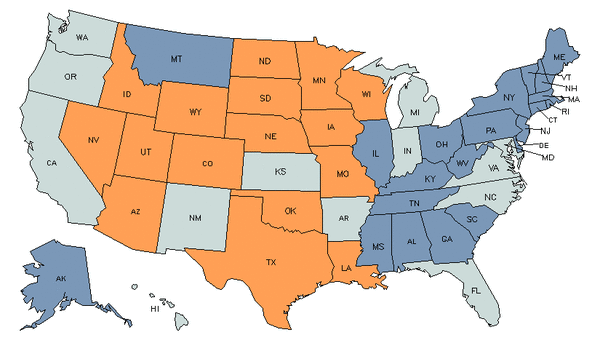
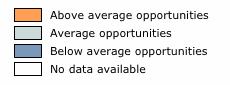
Core Tasks
- Check the forms that hold the concrete to see that they are properly constructed.
- Set the forms that hold concrete to the desired pitch and depth, and align them.
- Spread, level, and smooth concrete, using rake, shovel, hand or power trowel, hand or power screed, and float.
- Monitor how the wind, heat, or cold affect the curing of the concrete throughout the entire process.
- Mold expansion joints and edges, using edging tools, jointers, and straightedge.
- Signal truck driver to position truck to facilitate pouring concrete, and move chute to direct concrete on forms.
- Direct the casting of the concrete and supervise laborers who use shovels or special tools to spread it.
- Produce rough concrete surface, using broom.
- Apply hardening and sealing compounds to cure surface of concrete, and waterproof or restore surface.
- Operate power vibrator to compact concrete.
- Install anchor bolts, steel plates, door sills and other fixtures in freshly poured concrete or pattern or stamp the surface to provide a decorative finish.
- Wet surface to prepare for bonding, fill holes and cracks with grout or slurry, and smooth, using trowel.
- Waterproof or restore concrete surfaces, using appropriate compounds.
- Mix cement, sand, and water to produce concrete, grout, or slurry, using hoe, trowel, tamper, scraper, or concrete-mixing machine.
- Chip, scrape, and grind high spots, ridges, and rough projections to finish concrete, using pneumatic chisels, power grinders, or hand tools.
- Sprinkle colored marble or stone chips, powdered steel, or coloring powder over surface to produce prescribed finish.
- Cut out damaged areas, drill holes for reinforcing rods, and position reinforcing rods to repair concrete, using power saw and drill.
- Wet concrete surface, and rub with stone to smooth surface and obtain specified finish.
- Fabricate concrete beams, columns, and panels.
- Build wooden molds, and clamp molds around area to be repaired, using hand tools.
- Clean chipped area, using wire brush, and feel and observe surface to determine if it is rough or uneven.
- Polish surface, using polishing or surfacing machine.
- Cut metal division strips, and press them into terrazzo base so that top edges form desired design or pattern.
- Push roller over surface to embed chips in surface.
- Apply muriatic acid to clean surface, and rinse with water.
- Spread roofing paper on surface of foundation, and spread concrete onto roofing paper with trowel to form terrazzo base.
Technology Skills
Technology
Example
Hot Technology
Tools Used
Tool
Example
Top 10 Knowledge Required
English Language
74%
Knowledge of the structure and content of the English language including the meaning and spelling of words, and rules of composition and grammar.
Building and Construction
71%
Knowledge of materials, methods, and the tools involved in the construction or repair of houses, buildings, or other structures such as highways and roads.
Mathematics
62%
Knowledge of arithmetic, algebra, geometry, calculus, statistics, and their applications.
Public Safety and Security
62%
Knowledge of relevant equipment, policies, procedures, and strategies to promote effective local, state, or national security operations for the protection of people, data, property, and institutions.
Mechanical
53%
Knowledge of machines and tools, including their designs, uses, repair, and maintenance.
Administration and Management
52%
Knowledge of business and management principles involved in strategic planning, resource allocation, human resources modeling, leadership technique, production methods, and coordination of people and resources.
Transportation
50%
Knowledge of principles and methods for moving people or goods by air, rail, sea, or road, including the relative costs and benefits.
Customer and Personal Service
47%
Knowledge of principles and processes for providing customer and personal services. This includes customer needs assessment, meeting quality standards for services, and evaluation of customer satisfaction.
Education and Training
47%
Knowledge of principles and methods for curriculum and training design, teaching and instruction for individuals and groups, and the measurement of training effects.
Foreign Language
45%
Knowledge of the structure and content of a foreign (non-English) language including the meaning and spelling of words, rules of composition and grammar, and pronunciation.
Top 10 Skills
Monitoring
65%
Monitoring/Assessing performance of yourself, other individuals, or organizations to make improvements or take corrective action.
Coordination
63%
Adjusting actions in relation to others' actions.
Quality Control Analysis
63%
Conducting tests and inspections of products, services, or processes to evaluate quality or performance.
Speaking
63%
Talking to others to convey information effectively.
Time Management
63%
Managing one's own time and the time of others.
Active Listening
60%
Giving full attention to what other people are saying, taking time to understand the points being made, asking questions as appropriate, and not interrupting at inappropriate times.
Complex Problem Solving
60%
Identifying complex problems and reviewing related information to develop and evaluate options and implement solutions.
Critical Thinking
60%
Using logic and reasoning to identify the strengths and weaknesses of alternative solutions, conclusions, or approaches to problems.
Judgment and Decision Making
60%
Considering the relative costs and benefits of potential actions to choose the most appropriate one.
Operation and Control
58%
Controlling operations of equipment or systems.
Top 10 Abilities
Manual Dexterity
78%
The ability to quickly move your hand, your hand together with your arm, or your two hands to grasp, manipulate, or assemble objects.
Trunk Strength
75%
The ability to use your abdominal and lower back muscles to support part of the body repeatedly or continuously over time without "giving out" or fatiguing.
Multilimb Coordination
73%
The ability to coordinate two or more limbs (for example, two arms, two legs, or one leg and one arm) while sitting, standing, or lying down. It does not involve performing the activities while the whole body is in motion.
Near Vision
73%
The ability to see details at close range (within a few feet of the observer).
Arm-Hand Steadiness
70%
The ability to keep your hand and arm steady while moving your arm or while holding your arm and hand in one position.
Control Precision
70%
The ability to quickly and repeatedly adjust the controls of a machine or a vehicle to exact positions.
Extent Flexibility
68%
The ability to bend, stretch, twist, or reach with your body, arms, and/or legs.
Deductive Reasoning
65%
The ability to apply general rules to specific problems to produce answers that make sense.
Dynamic Strength
65%
The ability to exert muscle force repeatedly or continuously over time. This involves muscular endurance and resistance to muscle fatigue.
Information Ordering
65%
The ability to arrange things or actions in a certain order or pattern according to a specific rule or set of rules (e.g., patterns of numbers, letters, words, pictures, mathematical operations).
Top 10 Work Activities
Handling and Moving Objects
87%
Using hands and arms in handling, installing, positioning, and moving materials, and manipulating things.
Inspecting Equipment, Structures, or Materials
86%
Inspecting equipment, structures, or materials to identify the cause of errors or other problems or defects.
Getting Information
85%
Observing, receiving, and otherwise obtaining information from all relevant sources.
Performing General Physical Activities
85%
Performing general physical activities includes doing activities that require considerable use of your arms and legs and moving your whole body, such as climbing, lifting, balancing, walking, stooping, and handling materials.
Controlling Machines and Processes
84%
Using either control mechanisms or direct physical activity to operate machines or processes (not including computers or vehicles).
Scheduling Work and Activities
84%
Scheduling events, programs, and activities, as well as the work of others.
Identifying Objects, Actions, and Events
83%
Identifying information by categorizing, estimating, recognizing differences or similarities, and detecting changes in circumstances or events.
Making Decisions and Solving Problems
82%
Analyzing information and evaluating results to choose the best solution and solve problems.
Monitoring Processes, Materials, or Surroundings
78%
Monitoring and reviewing information from materials, events, or the environment, to detect or assess problems.
Coordinating the Work and Activities of Others
76%
Getting members of a group to work together to accomplish tasks.
Detailed Work Activities
- Inspect completed work to ensure proper installation.
- Position construction forms or molds.
- Spread concrete or other aggregate mixtures.
- Finish concrete surfaces.
- Monitor construction operations.
- Pour materials into or on designated areas.
- Signal equipment operators to indicate proper equipment positioning.
- Direct construction or extraction personnel.
- Apply sealants or other protective coatings.
- Compact materials to create level bases.
- Install metal structural components.
- Install building fixtures.
- Prepare surfaces for finishing.
- Install masonry materials.
- Apply material to fill gaps in surfaces.
- Mix substances or compounds needed for work activities.
- Smooth surfaces with abrasive materials or tools.
- Drill holes in construction materials.
- Position structural components.
- Break up rock, asphalt, or concrete.
- Clean surfaces in preparation for work activities.
- Build construction forms or molds.
- Apply decorative masonry finishes.
- Fabricate parts or components.
- Cut metal components for installation.
- Install roofing materials.
Education
Interests
Realistic
100%
Work involves designing, building, or repairing of equipment, materials, or structures, engaging in physical activity, or working outdoors. Realistic occupations are often associated with engineering, mechanics and electronics, construction, woodworking, transportation, machine operation, agriculture, animal services, physical or manual labor, athletics, or protective services.
Conventional
47%
Work involves following procedures and regulations to organize information or data, typically in a business setting. Conventional occupations are often associated with office work, accounting, mathematics/statistics, information technology, finance, or human resources.
Investigative
33%
Work involves studying and researching non-living objects, living organisms, disease or other forms of impairment, or human behavior. Investigative occupations are often associated with physical, life, medical, or social sciences, and can be found in the fields of humanities, mathematics/statistics, information technology, or health care service.
Artistic
24%
Work involves creating original visual artwork, performances, written works, food, or music for a variety of media, or applying artistic principles to the design of various objects and materials. Artistic occupations are often associated with visual arts, applied arts and design, performing arts, music, creative writing, media, or culinary art.
Enterprising
15%
Work involves managing, negotiating, marketing, or selling, typically in a business setting, or leading or advising people in political and legal situations. Enterprising occupations are often associated with business initiatives, sales, marketing/advertising, finance, management/administration, professional advising, public speaking, politics, or law.
Social
15%
Work involves helping, teaching, advising, assisting, or providing service to others. Social occupations are often associated with social, health care, personal service, teaching/education, or religious activities.
Work Values
Relationships
62%
Occupations that satisfy this work value allow employees to provide service to others and work with co-workers in a friendly non-competitive environment. Corresponding needs are Co-workers, Moral Values and Social Service.
Support
58%
Occupations that satisfy this work value offer supportive management that stands behind employees. Corresponding needs are Company Policies, Supervision: Human Relations and Supervision: Technical.
Independence
53%
Occupations that satisfy this work value allow employees to work on their own and make decisions. Corresponding needs are Creativity, Responsibility and Autonomy.
Working Conditions
43%
Occupations that satisfy this work value offer job security and good working conditions. Corresponding needs are Activity, Compensation, Independence, Security, Variety and Working Conditions.
Recognition
39%
Occupations that satisfy this work value offer advancement, potential for leadership, and are often considered prestigious. Corresponding needs are Advancement, Authority, Recognition and Social Status.
Achievement
34%
Occupations that satisfy this work value are results oriented and allow employees to use their strongest abilities, giving them a feeling of accomplishment. Corresponding needs are Ability Utilization and Achievement.